

 admin
admin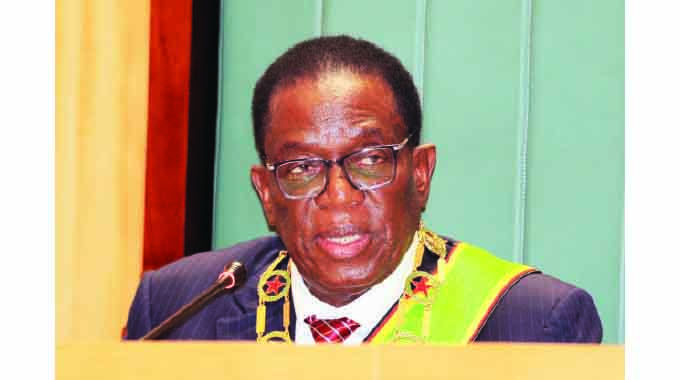
Ranga Mataire-Group Political Editor
AMID heightened anticipation following the adjustment of the ZiG, President Mnangagwa on Wednesday delivered his State of the Nation Address and opened the Second Session of the 10th Parliament of Zimbabwe at the New Parliament Building in Mt Hampden, where he outlined pertinent issues of national concern and the interventions being implemented by the Government.
The State of the Nation Address had the effect of calming restive minds that may have predicted major policy announcement from the Head of State and Government, who since successfully hosting the 44th SADC Summit has continued pushing through the country’s economic agenda by encouraging innovation at tertiary institutions and the modernisation of infrastructure.
Currency
In his presentation, President Mnangagwa said his Government supports the willing-buyer willing seller system. He said recent measures by the RBZ are meant to liberalise the currency market and encourage participation by holders of foreign currency.
He attributed the currency volatility to speculation, which he said must be curtailed. The President said the currency will continue being backed by reserves and 50 percent of mineral royalties.
“Currency stabilisation is at the core of macro-economic stability. The adoption of the Zimbabwe Gold (ZiG) in April 2024, was an important step towards stabilising the domestic currency anchored by our gold and eight precious metal reserves. It remains the duty of all of us to respect and abide by measures and instruments intended to maintain economic stability and tame inflation,” the President said.
On the issue of flexibility on the foreign exchange market, the President said this is expected to promote effective price discovery and encourage holders of foreign exchange to participate in the willing buyer willing-seller market.
The banking sector, he said, was on sound footing with sufficient capital and liquidity buffers, while profitability, asset quality and liquidity matrix have also remained stable. He assured the nation that corrective measures were being instituted to protect all Zimbabweans from economic disruptions.
Parliament
On Parliament business, President Mnangagwa exhorted legislators to expedite the enactment of all outstanding Bills from the previous Sessions. At least 18 Bills are outstanding. These include the Persons with Disabilities; Administration of Estates Amendment; Civil Aviation Amendment; Death Penalty Abolition; Parks and Wildlife Amendment; Private Voluntary Organisations Amendment; and Mines and Minerals Amendment. Other critical Bills are the Medical Services Amendment; and the Insurance and Pensions Amendment.
The President emphasised that the processing of the Bills was essential as some of them are critical in dealing with outdated legislation while others have to do with aligning the country’s legislation with regional protocols.
A number of Protocols expected to be tabled for ratification during the Second Session of this Tenth Parliament include: the Protocol Amending the Trade-Related Aspects of Intellectual Property Rights Amendment Protocol of 2005; the Lisbon Treaty to the Geneva Act as well as the Zimbabwe-Russia Cooperation Agreement.
President Mnangagwa particularly cited the Zimbabwe School Examinations Council Bill, which he said was expected to enhance the efficiency and good corporate governance of the ZIMSEC Board.
The ZIMSEC Bill, Teaching Professions Council Bill, Occupational Safety and Health Bill, State Service Pensions Bill establishing the State Service Pensions Fund, Public Service Act will be amended to align with the Constitution, Rural Electrification Fund Act; the Public Entities Corporate Governance Act and the Pipelines Act, Legal Practitioners (Amendment) Bill, Public Interest Disclosure (Protection of WhistleBlowers) Bill, Electronic Transactions and Electronic Commerce Bill, the Standards Bill; the Legal Metrology Bill; the Broadcasting Services Amendment Bill and the Media Practitioners Bill.
Drought relief
The President highlighted that the Government is taking steps to deal with the effects of drought through drought relief in both urban and rural communities. In schools Government has introduced feeding schemes while the Grain Marketing Board has opened agro shops to provide affordable food, as well as the Presidential Borehole Drilling Programme, which is enabling communities to have access to clean water for domestic use and for livestock.
Regrettably, the President said the El Nino-induced drought constrained the country’s growth across all economic sectors particularly the agriculture sector. However, under the Food Deficit Mitigation Programme, communities requiring food assistance in rural areas are already receiving grain, while vulnerable households in urban areas are benefiting through the Cash-for-Cereals Programme.
Agriculture
A record wheat harvest of 600 000 tonnes is expected this year. Summer cropping will be supported through private-sector financing and Government programmes for vulnerable groups. The project wheat harvest record is as a result of unity of purpose and effective policy frameworks. President Mnangagwa was optimistic that the 2024-2025 Summer Cropping seasons will be a positive one given the projections of normal to above normal rainfall in most provinces. He was pleased with the pace of inputs distribution under the Pfumvudza/Intwasa Presidential Climate-Proofed Agriculture Production Scheme and other programmes.
Mining
The mining sector was encouraged to increase production. Mining continues to attract favourable investment as demand for new energy minerals is also growing with its associated opportunities for the country’s entry into the value chain industries. Mining companies in the gold and other precious minerals sector have been called to scale up production.
The President said assets under the Sovereign Wealth Fund are envisioned to bolster performance and revenue from the mining and other sectors with the overarching goal of benefiting all Zimbabweans.
Infrastructure
The Government’s infrastructure development projects have resulted in positive spill-offs. New programmes to be introduced where provincial road authorities pool their equipment into single construction units to implement local projects.
“Going into the future, infrastructure development will be a critical pillar to our economic growth, revitalisation and creation of jobs as well as stimulation of broader production and capacity utilisation.”
Media/Telecoms
Government is supporting the transformation of the media landscape, through bold measures to preserve our culture and nurture a positive country image. Examples highlighted by the President in enhancing his mantra of not leaving anyone and any place behind is the modernisation of the Montrose Television Studios in Bulawayo and the coming into operation of community radio stations such as Khulumani FM and Central FM as well as Mbembesi and Ntepe Manama in Matabeleland North and South respectively together with Madziva FM in Mashonaland Central.
The entry of new local and international players is going to improve availability and affordability of digital and telecommunication services.
Power
Power supply remains subdued; however Independent Power Producers are set to commission new projects. The Government is planning to add more incentives to encourage renewable energy projects. President Mnangagwa said besides solar energy, the country’s position on the use of alternative energy should be intentionally examined.
Over and above the use of solar energy, the country’s position on the use of alternative energy sources should be intentionally examined.
Health
The Government plans to increase resources to Central, Provincial and District hospitals. Resources for the acquisition of essential medicines and specialist medical equipment for all our Central, Provincial and District hospitals are being availed and in line with emerging technologies, citizens in remote areas will benefit from the introduction of telemedicine to facilitate virtual specialist consultations.
Trade
Zimbabwe signed a tripartite pact with Botswana and Mozambique for the construction of a railway line that links our three countries meant to advance regional economic integration, investment and growth. Another tripartite agreement with Zambia and Mozambique was signed and will facilitate the establishment of an initiative for the management of shared natural resources, as well as fauna and flora.
Diaspora
The first external e-passport offices at the Zimbabwe Consulates in South Africa are now open. The service will be rolled out to more destinations.
The President’s State of the Nation Address was on point in highlighting pertinent areas of national concern as well as achievements realised so far.
President Mnangagwa’s commitment in enhancing the well-being of the people and entrenching unity, stability, security and development remains apparent throughout his address.
He clearly articulated that his Government is committed to the realisation of the promises made by our ruling Party, ZANU PF and that despite enormous challenges and difficulties as a result of the illegal economic sanctions imposed on our country, the country continue to record encouraging progress.


 Online Reporter