Chronicle Editor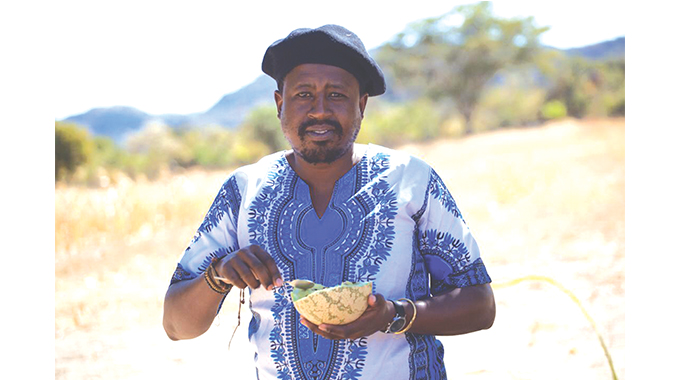
Thandeka Moyo-Ndlovu, Health Reporter
MANY African culinary delights have over centuries been “taken,” modified and presented back to the continent as exotic, expensive and mouth-watering cuisines.
The reason — indigenous knowledge is often not documented and vital information is lost in history.
A culinary chef and Lupane State University lecturer Makhosi Mahlangu is out to change that through an African diet-based health eating cook-book.
He notes that food, like culture, is dynamic but aims to restore original delicacies that he believes contributed to Africans’ longevity.
Chef Mahlangu’s book brings science, human determinism, intuition, food artistry, history and technology into one pot to develop future food production systems using locally-based resources and techniques.
“What we eat is what we are, that is why I firmly believe in retaining traditional food to safeguard the future of Ubuntu — the belief in a universal bond of sharing that connects all humanity. Food is medicine and when you have access to local food it creates an ecosystem within the place hence there is no need for us to import seeds,” he notes.
The chef, hails from Chief Sivalo’s area in Nkayi, one of the world’s most food insecure districts but his passion has pushed him to document food recipes and food preservation methods which many can only access through oral tradition, if their parents or grandparents are alive.
Chef Mahlangu spent years gathering information on how Zimbabweans and Africans can use traditional foods at their disposal for healthier lives.
His grandmother who is a traditional healer birthed the passion for food which has seen him travel and study food cultures in countries like Italy, France, Spain and the Democratic Republic of Congo.
Chef Mahlangu’s love for traditional food dates back to the early 1980s when as the first born, despite growing up in a patriarchal community, he was expected to cook for the whole family.
He observes that many Africans may be languishing in food insecurity simply because they do not value locally-produced foods.
Chef Mahlangu argues that the secret to the longevity of Africans of yesteryear, who lived without the imported genetically modified foods and seeds, lies in their indigenous diets.
That, he says, is the reason why he patiently absorbed age-old knowledge shared by his grandmother orally and his experiences in food cultures into a book that can be read by anyone.
“Food has always been around me and my grandmother taught us to produce food from the sun and water because that’s all that one needs for food. She taught us how to grow and use aromatic herbs like rosemary, thyme, and parsley. I realised that when you combine these with locally grown green leafy vegetables you get a savoury explosion in your mouth,” says the Food Science and Technology lecturer.
“When I passed my A-level, I went to the University of Zimbabwe where I did a BSc in Food Science and Technology.
Afterwards the Ndebele calling got to me and I went to South Africa where I was a waiter for about two years.”
Chef Mahlangu said his working conditions were not the best in the neighbouring country but he says the opportunity gave him yet another chance to closely deal with food and study the origins and health benefits of what he was serving clients.
“My years as a waiter were like the worst but I learnt about food indirectly because all the menus I learnt from spurs to Nescafé, I can recreate them in Zimbabwe,” he says.
The 37-year-old foodie returned to Zimbabwe in 2008, the year that most of his born-free peers call their worst.
Not only did the year leave millions hungry due to drought and economic challenges, many Zimbabweans were also forced to live without access to water and electricity.
Many succumbed to cholera that year and thousands mastered survival tips which helped them bear the hardships.
“We took water from the communal borehole and watered our garden where we planted numerous herbs and vegetables. For our family 2008 wasn’t really a bad year. We could even afford to roast meat over our braai stand because we also understand that the method of cooking plays a great role in food texture,” he says.
According to Chef Mahlangu, economic hardships can deter many from achieving their goals but should never be a reason why people especially Africans, who have access to sunlight more than anyone in the world, go without food.
“The funny thing is that when the economy is bad the sun always shines. My grandmother taught us to work the land because with water and sunlight it is possible to produce food on a small piece of land. We really never had it tough in 2008 when everyone else was struggling to put food on the table, in fact, we had the best meals,” he says.
His love for food took a different turn as circumstances forced him to teach A-level Mathematics before he managed to raise funds that earned him a degree in Animal Science from Lupane State University.
“I became a teacher at Masotsha High School for two years before I got a scholarship to Fort Hare University to do Animal Science again under the guidance of renowned Professor Muchenje where I studied ostriches,” he says.
He says the experience was fulfilling and it also resulted in him getting a scholarship to Italy to learn food science.
“When I got there,” he says, “I learnt a lot about the food culture as I spent some time in Italy, France and Spain. One day in Spain I was told to go milk the goats and I realised that if I am milking goats in Spain why not go back home and milk goats. I have learnt a lot from cheese making to ice cream making to pizza making to meat processing.
When I came back to Africa, we worked on the Amagugu Food Expo where we got over 300 attendees.”
Chef Mahlangu says the experience in those countries confirmed that he had a calling to educate his people on food which materialised on Friday when his book was launched.
The book is an in-depth analysis of traditional African cooking with reference to the Ndebele ways of cooking.
Entitled ‘‘Introduction — Our Food, Our Heritage, and Our Future’’ the book kicks off with an introduction to the history of Zimbabweans and culinary traditions by renowned historian and traditionalist Mr Pathisa Nyathi.
Other chapters were dedicated to meat, sorghum, traditional beer known as umqombothi, maize, milk and underground tubers known as izadenda.
“There is a need to learn the primary production systems, fruit and vegetable processing methods, milk processing and other typologies of foods consumed by our people. A lot of food stories have still not been fully exploited and told in Africa, as most are still hidden as oral stories in the minds of our grandparents and great-grandparents,” he says.
“The future of African food will embrace all these elements and create a new food industry which embraces the spirit of Ubuntu, sustainable harvesting and basic food processing techniques.”
According to Chef Mahlangu, African villages remain the main source of food information in Africa even though their rich source of food literature remains underutilised.
On non-communicable diseases, Mr Mahlangu says Zimbabweans have lots of wild fruits and trees that can help people lead healthy lifestyles.
“The fruit trees, plants and herbs that grow in our communities are drought resilient and they produce chemicals and anti-oxidants which improve our immunity. The whole activity of harvesting the trees like idorofiya or uxakuxaku, umnyi is healthy and keeps us active that is why our food is important and healthy. We have to keep it local,” the chef notes. — @thamamoe



 Online Reporter