Online Reporter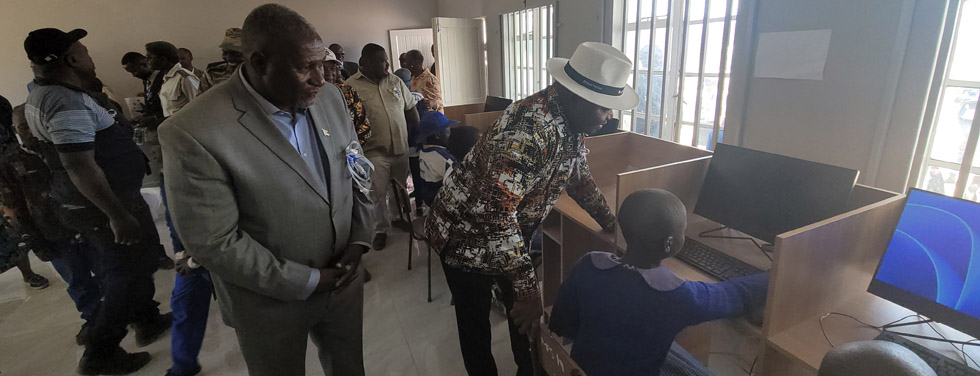
Tendai Gukutikwa
Post Reporter
THE train of technology waits for no one, and in Nyanga South, that train has arrived at Manjoro Primary School, where a high-tech computer laboratory is empowering rural learners to dream, research, and compete on an equal footing with their urban peers.
An Akello Smart Learning Centre, a cutting-edge computer laboratory, was officially opened at the school, marking a significant milestone in the region’s educational development.
Learners who once struggled with limited access to learning materials now have the world at their fingertips.
The newly commissioned computer laboratory is transforming classrooms into digital hubs of innovation and curiosity, providing 40 computers and internet access – a rare commodity in rural Nyanga.
The Akello Smart Learning Centre is equipped with modern computers, a server, and a Local Area Network (LAN) system, enabling learners to access digital resources and collaborate with peers globally.
The facility also includes a solar power system, ensuring uninterrupted learning even during power outages.
The computer laboratory was made possible through the partnership of the community, Nyanga South legislator, Honourable Supa Mandiwanzira and the funder, Ecobank.
In an interview, Information Communication Technology, Postal and Courier Services Deputy Minister, Honourable Dingumuzi Phuthi said the facility marks a milestone in Government’s quest to build an inclusive digital economy under Vision 2030.
He said the establishment of smart learning centres in rural schools like Manjoro is a direct response to President Mnangagwa’s call for a digitally empowered society.
“Through the Government’s efforts to promote computerisation in education, we are taking a bold step towards ensuring that every learner, no matter where they are, can access quality education through technology. This state-of-the-art computer laboratory, with modern equipment and internet access, allows children in rural Nyanga to learn just like those in Harare or Bulawayo. In today’s world, access to technology is not a privilege, it is a right,” he said.
Deputy Minister Phuthi said the initiative falls under the Digital Skills Ambassadors Programme, which aims to train over 2,5 million Zimbabweans in digital literacy by 2030.
“This facility at Manjoro is not just for learners. It will also serve the surrounding community through night-school programmes in digital skills training. It is a school-lab-community model that ensures both learners and adults gain the digital tools they need to thrive,” he said.
He also stressed the importance of cyber safety in schools.
“As we open the digital world to our children, we must also protect them. We are teaching learners, parents and teachers how to stay safe online and avoid cyberbullying, fraud and exposure to harmful content. To protect a child today is to protect the future,” he said.
He said the Akello Smart Learning Centre represents more than just a computer laboratory; it is a symbol of hope and equality. For decades, rural schools lagged behind their urban counterparts, but projects like this are levelling the playing field.
Deputy Minister Phuthi said such interventions are crucial to achieving the country’s development goals.
“Once our people access digital skills and services, we move closer to becoming an upper-middle-income economy. The GDPs of nations are now defined by how much their citizens can use technology and Zimbabwe is on the right path,” he said.
Nyanga South legislator, Honourable Supa Mandiwanzira said the facility is a product of strong collaboration between Government, private partners, and the local community.
“I am proud that my former school, Manjoro Primary, now stands as a model of what community-driven development can achieve. This computer lab is equipped with the latest technology, including Core i5 computers, thanks to partnerships with institutions such as Ecobank, which, despite not having a branch in Nyanga, chose to invest in our children’s future,” he said.
Honourable Mandiwanzira said the computer lab is, not only for learners, but also for the wider Manjoro community, who will receive free digital literacy lessons in the evenings.
“The idea is to ensure that development leaves no one behind. After school hours, parents and other community members will also be trained in basic computer skills. This way, the school becomes a hub for lifelong learning and empowerment,” said Honourable Mandiwanzira.
He also called on all Zimbabweans to contribute towards the digitalisation of education.
“If every former learner goes back to their school and donate just one computer, we will digitise thousands of schools within a few years. We all have a role to play in ensuring that our children are not left behind in this digital age,” he said.
For 12-year-old Beyoncé Nyamaropa, a Grade Six learner at the school, the introduction of the computer laboratory has opened doors she never thought possible.
“I had never used a computer before last month. Now I can type, draw, and even search for information for my school work. It feels like I am learning in the city. I have also been able to do research on past ZIMSEC exam papers and got the answers on the facility,” Beyoncé said shyly, her eyes lighting up as she clicked through an e-learning module during the interview.
Her classmate, Jack Nyambayo (12), echoed similar sentiments.
“We now learn Science, Maths, and English using computers. Sometimes the teacher tells us to research things online, and we get to see pictures and videos that help us understand better. I want to be an engineer one day, and this is helping me realise that dream,” he said confidently.
The children’s enthusiasm inspired their teachers as well.
Mrs Edna Mangaira, a teacher at the school, said the facility has completely changed the teaching and learning experience.
“Before, we relied mostly on textbooks, and sometimes we had to share because there were not enough. Now learners can research, type assignments, and use educational software,” she said, adding that the smart learning system has also made her job more fulfilling.
“As a teacher, I am now able to prepare lessons digitally and make them more interactive. Our learners can now compete with those in urban schools because they are gaining the same digital exposure. This is what equality in education truly looks like,” she said.
Parents in Manjoro Village also expressed gratitude for the development, saying it has given their children a chance to compete in a fast-changing digital world. They could not hide their excitement after learning that they too will soon benefit from free computer lessons to be conducted at the school after hours.
Mrs Mary Nyamadzawo, whose daughter is enrolled at the school, said the establishment of the computer laboratory had rekindled her hopes for her child’s future.
“I never imagined that my child, growing up here in the village, would one day learn using computers. When she comes home, she tells me about things she is learning on the internet. I can see her confidence growing, it makes me proud. And now that we, the parents, will also get lessons, I feel like we are stepping into the same future together,” she said with a smile.
Another parent, Mr James Nyambayo, uncle to Grade Six learner Jack, said the project is a true reflection of Government’s inclusive vision under the Second Republic.
“Our children are now learning in the same way as those in towns, and we, as parents, are not being left behind since we will also learn computers here. We are very grateful to Government and all the partners involved, and we hope more schools in Nyanga will get the same opportunity,” he said.
As the computers hum in the newly built lab, the learners of Manjoro Primary School and community members are typing their way into the future – one keystroke at a time.