Online Reporter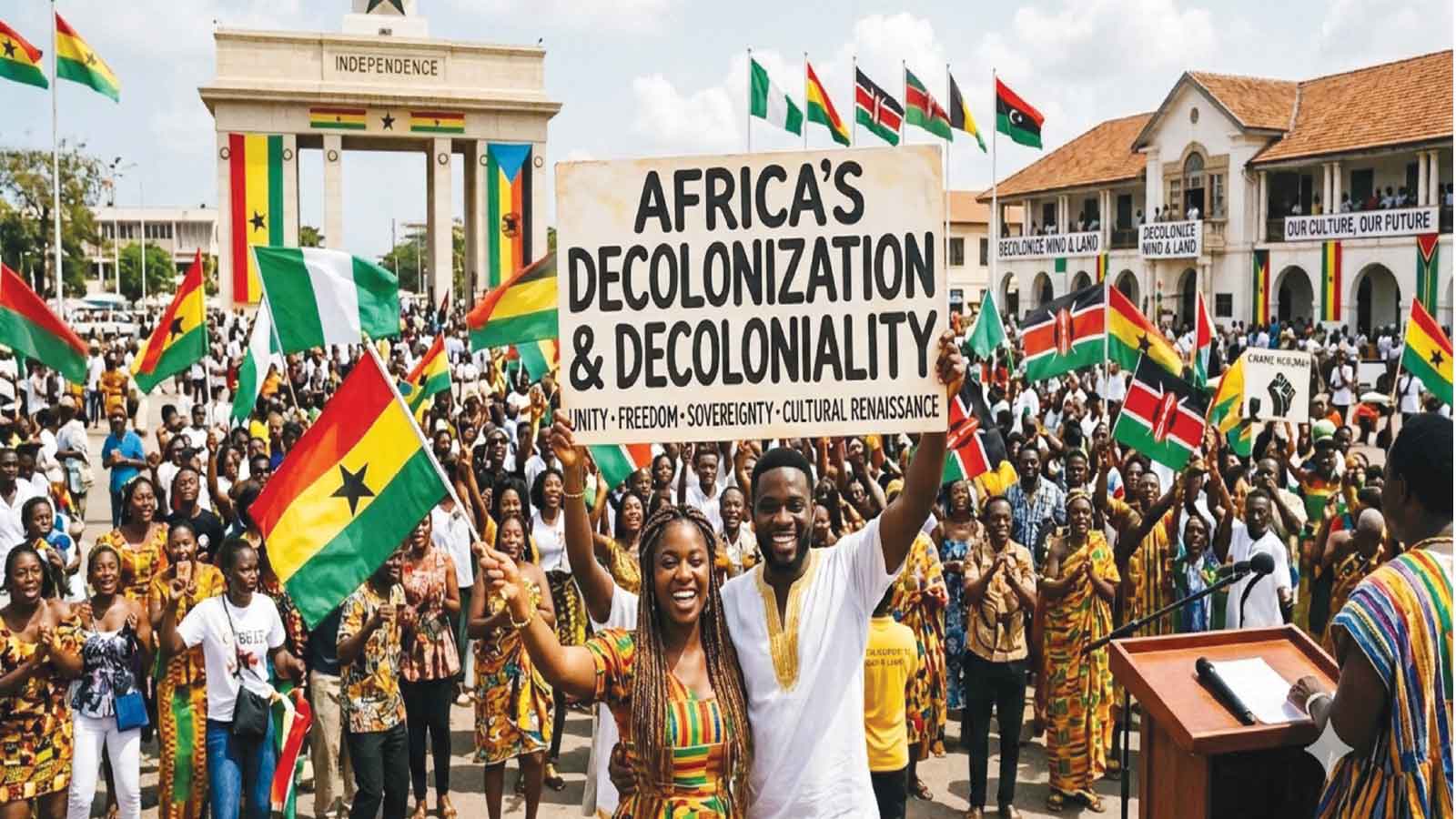
Gibson Nyikadzino
Zimpapers Politics Hub
DECOLONISATION and decoloniality are two different phenomena.
Decolonisation describes the process of withdrawal of political, military and economic rule from a colonised territory by the colonial master, while decoloniality is a project of intellectual dissidence to dismantle all biases emanating from the knowledge hierarchies founded on historical colonialism.
These two phenomena define different historical epochs which are confined to the greater Global South. At the dawn of Africa’s independence, the euphoria of decolonisation gripped the continent. Pan-Africanists and nationalist leaders forced the decolonisation of the imperial powers from the continent.
The decolonisation process in Africa south of the Sahara was and is proof that no continent had the determination to fight colonialism in unity at a greater speed than what Africans did.
In a decade from Ghana’s independence in 1957 to 1967, a total of 32 sub-Saharan African countries gained independence. This was an unprecedented decade of decolonisation which peaked in 1960 (known as the Year of Africa) when 17 nations achieved statehood.
By 1994, when South Africa achieved freedom at the end of Apartheid, the rest of the continent had achieved the decolonisation process that had been marked officially by the Berlin Conference of 1884-5.
Without doubt, the colonial powers withdrew their military, political and economic presence from Africa.
Violence of Decoloniality
However, the systems, institutions, and structures that the decolonised Africa inherited maintained the structural dominance of the powers that had withdrawn from the continent. While the physical withdrawal of colonial masters was received as a milestone, it is the invisible and unseen colonial dynamics that still prod Africans far away from realising actual independence.
The systems that Africans inherited at moments of decolonisation had been imposed purely by violence and some countries did not fight them with legitimate violence like what Zimbabweans did between 1966 and 1980. In some sub-regions, they were replaced through negotiation.
Decoloniality, therefore, challenges these structures. The decolonial project is also a process of violence. This violence is not physical, but psychological and intellectual as it discourses around separating the mind of the formerly colonised on depending on Global North institutions for their hierarchies that are biased, racialised, bigoted, exclusionary and erroneous.
Decoloniality disregards seeing the Western world as the epitome of civilisation and values. It does not consider denying the Global South equal attributes of self-determination, civilisational identity, political and economic independence as a natural consequence, but one that is designed by the Global North on the basis of colour and race to create knowledge systems that project themselves as superior just to make inferior Africa’s indigenous systems.
The idea of being
Progress that countries like China and India have made over the past decades resembles what the Global South can become when they decide to be. To discredit and target China, the West has categorised its economic rise as “the most formidable rising rival” of in history.
For India, before its colonisation by Britain in 1757, it had a total gross domestic product (GDP) of 23 percent, while at the time of its independence in 1947, after 190 years of plunder, its GDP had become three percent.
For India, since 1947 to date, it has used its Indianness to redefine the global economic value chain aided by many factors to become the fourth biggest global economy by GDP to date while Britain occupies number six out of the 10 leading economies.
India and China are being empirical in re-writing the global political and economic rulebook that without exploitation, plunder and resource theft from the Global South, the power of the West diminishes.
Therefore, the being of Africa and the Global South must not be measured on the basis of the knowledge, dictates and rules from the Western world. In this discourse, where equality is not upheld, defiance becomes an inevitable route to both epistemic and intellectual independence.
With decoloniality, the goal is to give new meaning and life to the self of the African and Global South citizen with a disruptive intellectual cognitive that reject an imposed view that Africans are “primitive”.
It is in the culture of Western ideological and intellectual thought to belittle the Global South as a region that requires a serious “hand-holding” hence it is always prescriptive of the political, social and economic models that Africans must use.
These prescriptions impact African society in ways that do not reflect the Global South being, but the domination of the Western class.
Bad Samaritans, malevolent force
South Korean economist in his book The Bad Samaritans argued that the rich countries from the West achieved economic prosperity using military force, protectionism and state intervention.
Today, the same countries now force Global South nations to adopt free-market policies that are meant to prevent them from ever catching up.
Without an epistemic challenge to the prescription models from the West, the Global South will be enabling or perpetuating colonial subordination on terms they are comfortable with. Decoloniality as a project is exposing the vulnerabilities of neoliberalism and how it has captured institutions that the Global South wants to depend on.
It is crucial for Africa to move boldly beyond Eurocentrism and use its values of development to address its environmental milieu. The Eurocentric knowledge systems are not crafted by ‘Good Samaritans’ but carefully written to extend the entrenched domination of the Global South using subtle, malevolent intentions packaged as redemptive.
The key aspect in decoloniality is to have Global South nations prioritise inward looking models for their reawakening and revival. More attention should be directed to indigenous notions of development and well-being.
In Southern Africa, Ubuntu has the answers; in Latin America they use the concept of Buen Vivir; while India uses the notion of Swaraj.
In the end, it cannot be correct for Africans to feel comfortable quoting Adam Smith, Edmund Burke and Jean-Jacques Rousseau among other economic and political philosophers while prominent African philosophers like Cheikh Anta Diop, Achille Mbembe, Amilcar Cabral, Valentin-Yves Mudimbe and Kwame Nkrumah are dismissed as mere public intellectuals!