Online Reporter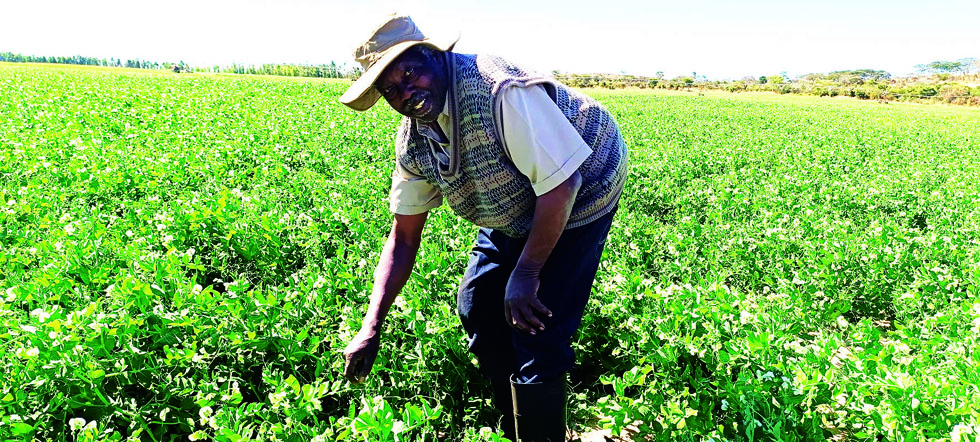
Samuel Kadungure
News Editor
IN the fertile fields of Headlands, a quiet agricultural revolution is underway.
Munch peas farming, once a niche crop, has emerged as a thriving industry, bringing new economic opportunities to local farmers.
One of the famers, Mr Lovemore Gijima Msindo is reaping the rewards of innovative farming practices, with a thriving 20-hectare munch peas crop now at the flowering stage, bound for export.
This success highlights the value of diversifying revenue streams and boosting soil fertility through crop rotation, essential strategies as the agricultural sector continues to evolve.
While some farmers in the area focus on wheat and green mealies, munch peas offer a viable alternative for commercial farmers with irrigation facilities.
The crop’s success is attributed to a contract farming between Mr Gijima Msindo and seed producing house, SeedCo.
Munch peas, also known as mangetout or snow peas, present a viable and potentially lucrative opportunity for local farmers, particularly in export markets.
The country’s winter season provides ideal conditions for producing high-quality peas, with cooler temperatures conducive to optimal growth.
Most of Zimbabwe’s peas are produced in winter when many international suppliers have exited the market, enabling pea farmers to send their produce to the European market and take advantage of this opportunity.
Mangetout peas are in demand on both international and local markets, providing food security to many people around the globe, and are one of the horticultural crops that can be grown in Zimbabwe, particularly for export, offering a promising avenue for farmers to tap into international markets.
Mr Msindo said harvesting of the pea crop, planted on May 1, begins in four weeks.
“The crop you see today was grown under contract with SeedCo, and we are producing seed primarily for export. The crop spans 20 hectares, and we anticipate harvesting two tonnes per hectare, totalling 40 tonnes – making it a lucrative venture indeed,” said Mr Msindo, adding that SeedCo only provided the seed, while his team handled agronomy and other aspects.
“Our major challenge is accessing a full package of inputs. We believe that to succeed, we need a scenario where farmers receive comprehensive support, allowing us to focus solely on production,” he said.
Despite being their first year, Mr Msindo expressed optimism about meeting their targets.
However, he highlighted water scarcity as a significant challenge.
“Since 1980 when we established ourselves here, we have never faced such a severe water shortage. To improve irrigation, we urgently need to drill additional boreholes,” he said, appealing to the Government for assistance, not in the form of handouts, but rather by facilitating access to loans.
“This will enable us to drill boreholes, boost irrigation, and increase production, and pay back the loan. We do not need freebies because this is a business. The crop is currently being irrigated using a towable centre pivot system covering 20 hectares, and we need additional irrigation infrastructure,” he said, adding their ability to produce was being compounded by limited access to finance.
“Farmers are not receiving sufficient support to produce. Some farmers have the capacity to produce massively, whether it is tobacco, maize, or wheat. However, partners often impose stringent conditions, failing to provide a comprehensive package, and expecting farmers to cover additional expenses,” said Mr Msindo as he emphasised challenges farmers face in securing loans from banks.
“The current economic climate makes it difficult for farmers to access loans. Banks are unwilling to lend, citing lack of funds. Government should create a conducive environment for farmers to access financing. We do not want handouts, but rather facilities that enable serious farmers to borrow money for production. Government should encourage the banking sector to support farmers,” he said.
Mr Msindo also stressed the importance of timely payment for produce delivered to the Grain Marketing Board.
“When farmers produce, GMB should pay us on time, enabling us to prepare for the next season. We are businesspeople, and our focus should be on production,” he said.
In a separate issue, Mr Msindo reported being defrauded by Yellow Metal Equipment and Spares, fronted by Mr Tichaona Mudondo, who failed to deliver on a US$24 000 contract to repair his dam in September last year.
Mr Msindo paid a US$10 000 deposit, but Mr Mudondo disappeared afterwards.
The matter was reported to the Criminal Investigation Department at Rusape Central under CR76/04/25.
When contacted for comment, Mr Mudondo acknowledged receiving payment from Mr Msindo and requested a meeting with this reporter to provide his side of the story.
However, he failed to honour the appointment.