Online Reporter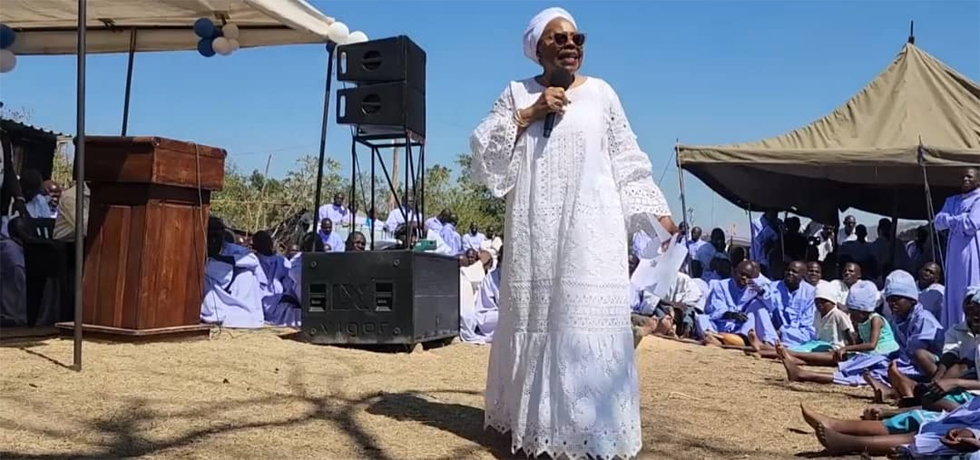
Tendai Gukutikwa
Post Reporter
APOSTOLIC churches have been urged to play a stronger role in national development by prioritising the empowerment of women and girls through education, skills training and sustainable income-generating projects.
Addressing hundreds of congregants at the Zviratidzo Zvavapostori Church national conference in Zimunya last Saturday, Women Affairs, Community, Small and Medium Enterprises Development Minister, Senator Monica Mutsvangwa, challenged apostolic church leaders to move away from harmful cultural and religious practices that stifle women’s potential and instead embrace Government-backed empowerment programmes.
She said women’s empowerment is key to the achievement of Vision 2030, which seeks to transform Zimbabwe into an upper middle-income economy.
“We cannot leave women and girls behind. They must be part of the journey. Empowering them is, not just about fairness, it is about building a stronger, more prosperous nation.
“Apostolic churches should become partners in development. Women and girls must be upskilled so that they can stand on their own and contribute meaningfully to our economy. It is time churches fullyembrace income-generating projects such as garment making, poultry production, mushroom farming and small businesses.
“My ministry has ward-based development officers across the country who are ready to train you. Please use them. These projects will uplift your families and your congregations,” she said.
She further explained that her ministry is working to expand training opportunities for apostolic women and girls.
Minister Mutsvangwa also said her officers will link the trained women with markets to ensure that the products of women-led projects find a place in the wider economy.
“We want to avoid situations where women and girls are trained, but left stranded. Our goal is to ensure that their efforts result in financial independence, sustainability, and a meaningful role in national development,” she said.
Minister Mutsvangwa warned that women’s economic dependence often fuels abuse and poverty, stressing that empowerment andeducation are crucial in breaking cycles of vulnerability.
She said the apostolic community has a unique opportunity to be a driver of change in their families and communities.
Minister Mutsvangwa also stressed that churches must, not serve as havens for child marriages, gender discrimination, or other harmful practices, but as platforms for social justice and community growth.
“No child should be married before the age of 18, and churches must respect that. It is, not only a moral obligation, but a legal requirement under the Marriages Act. I am speaking, not only as a Minister, but
also as a mother. Let our children grow, let our daughters go to school. Let them dream and achieve. A girl should not be forced into marriage when she is
still a child,” she said.
She called on parents to acquire birth certificates for all children to ensure that they access education and other rights, noting that lack of documentation continues to block many children from opportunities.
“Teach them, help them get birth certificates. This is, not just a matter of paperwork, but a gateway to education and protection. A child with no documentation is vulnerable,” she said.
The Zviratidzo Zvavapostori Church leader, Bishop Richman Nyamombe, welcomed Minister Mutsvangwa’s remarks, and pledged his church’s commitment to support Government initiatives on women and child empowerment.
“As a church, we stand guided by the laws of this country. We do not condone child marriages, and we will work with Government to ensure that every child, especially the girl child, is allowed to go to school and realise their dreams. We are also ready to participate in the economic empowerment programmes through training and projects that benefit ourcommunities,” said Bishop Nyamombe.
The bishop said the church recognised that apostolic churches,which command large followings, have a responsibility to align with national development goals and improve the well-being of their members.
The conference, which drew congregants from across thecountry and SADC region, focused on moral values, women’s empowerment, and national development.