Sundaymail Editor
Phyllis Johnson
DO you know who Samuel Safiishuna Nujoma, better known as Sam, is?
He used his life for the liberation of his country, and this impacted the whole of Southern Africa and Africa, but have the youth of this generation heard of his name or the person?
He had stories and experiences, more than most, but he seldom told stories with himself at the centre.
He was humble. He was honest.
South African agencies tried to get some dirt on him during his long exile in Zambia, but gave up when they could not find anything.
He had a smile as wide as his face, and that was real.
He liked people. But he was a second- or third-class citizen in his own country, which was occupied by apartheid South Africa.
He proved them wrong.
He mobilised the people of his country, with support from the continent and elsewhere, to defeat them militarily, politically and strategically.
Sam Nujoma was a founder member and the first president of the South West Africa People’s Organisation (SWAPO).
He started the liberation movement with Andimba Toivo ya Toivo and others to free his country, and in doing so, he helped to change Southern Africa as we know it today.
The boundaries between countries in Africa are false and were drawn on a map in Europe in 1885. So the resistance and oppression, discrimination and underdevelopment lasted a long time — more than 100 years and, in some places, 500 years.
Sam Nujoma was and is a hero, not only in Namibia but for Southern Africa and Africa.
He inspired Namibians to win back.
What he did helped to build the foundation for that.
Other people fought and died so the youth of the present and future would have a fresh start on their own land.
He left the country called South West Africa in 1960 at age 30, travelling surreptitiously through colonial territories by road, train and plane through what is now Botswana, Zimbabwe, Zambia, Tanzania and Ghana, not knowing that it would be another 30 years before his formal return in 1989 and independence in 1990.
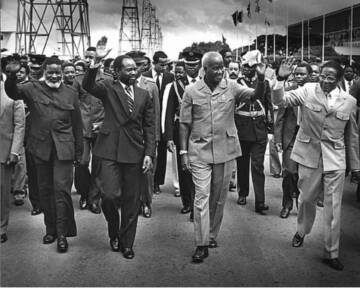
After Ghana, Nujoma went to Liberia, finally reaching New York in June 1960, where he petitioned the Fourth Committee of the United Nations General Assembly demanding the end to the South African colonial administration of his country.
He petitioned the UN, together with Chief Hosea Kutako, Samuel Witbooi and others, demanding that South West Africa be placed under the UN Trusteeship system, rather than under apartheid.
Sam Nujoma played a leading role as head of the national liberation movement SWAPO in establishing the People’s Liberation Army of Namibia (PLAN) in 1962 and the liberation war that started in 1966 at Omugulu-gOmbashe in the north of the country near the border with Angola, after the United Nations cancelled the mandate for South Africa to govern the country, but South Africa refused to go.
PLAN fighters were involved in the last battle for the liberation of Southern Africa, at Cuito Cuanavale, in Southern Angola.

The SADC region celebrates Southern Africa Liberation Day on March 23, the date of the end of the last battle against the occupation army, the South African Defence Force, at Cuito Cuanavale.
Namibia celebrates its own Independence Day on March 21.
His country was then called South West Africa, which is where it is located, but since independence 35 years ago, on March 21, 1990, the country’s name is officially Namibia.
Namibia joined the region at independence and Nujoma hosted the 1992 Summit of regional leaders that transformed the Southern African Development Coordination Conference (SADCC) into the Southern African Development Community (SADC).
Namibia is also the host country for the SADC Parliamentary Forum (SADC PF).
Yes, there is a lot still to do, so the countries and people of Southern Africa can prosper and grow, but Nujoma helped to build the conditions for the Atlantic west coast to join the region and link up to the east.
His government recovered the port of Walvis Bay from apartheid South Africa, and Walvis Bay is now a major port for regional trade, including an internal “dry port” for some countries, and the start of a regional highway across the Kalahari.
So why are we not mourning Sam Nujoma as a region, with our flags at half-mast? Are we forgetting? Is it only our leaders who remember?
Sam Nujoma served as founding President of Namibia from independence in 1990, and was elected to two terms post-independence, in 1995 and 2000, before stepping down.
He served his country for 47 years before and after Independence.
This is how Sam Nujoma told his story, in his own words:
“I am Sam Nujoma ja Nujoma, born on the 12th May 1929, the first of my parents’ eleven children, in an area then known by the world as colonial South West Africa, now the independent Republic of Namibia.
“Like the broad history of any one man’s life, mine could be told in a few sentences. As a child, I listened with pride to the stories of my parents’ and grandparents’ lives, grew in strength and learned responsibility in herding my family’s cattle and guarding them against natural predators — the lion, leopard and jackal.
“As a youth and young adult, I gained experience of the world through education, work and travel. Through those experiences, I learned that predation also existed in the racism, oppression and injustice of the colonial governments and the attendance structures of apartheid — that these unwanted, iniquitous regimes were predators too, feeding cruelly on the lives of the African people and on the riches of their land.
“I became a participant dedicated and committed to the political and military struggle for freedom and independence that has long been the story of Namibia. The people’s goal achieved at last, I have been honoured to serve the Republic of Namibia as its first President.
“Now, in the year 2000, I pause not merely to reminisce over the first 70 years of my own life, but more importantly, to recount how the path of my life has joined with others on the road to independence for Namibia. How that goal was accomplished is the real story of this book …”
The autobiography of Sam Nujoma is titled, Where Others Wavered, and he concludes by talking of the tasks ahead.
“As that great day of our independence drew to a close, there was one thought above all others in my mind: Tomorrow the history of independent Namibia begins and we owe it to all who have gone before, as well as to all who will come after, to make one worthy of them and of the heroic struggle in which we were able to triumph at last.
“We had, through this heroic struggle, attained political freedom, the essential first goal of SWAPO. But immediate tasks lay ahead.
“After independence, we would be faced with the challenges of nation building, of economic reconstruction and of unifying a population that had been torn along racial and ethnic lines during the centuries of colonial oppression, apartheid and ‘bantustanisation’.
“We would be working to provide for the wellbeing of all our people, to improve educational and health services and the infrastructure needed for the building of a modern, just society.
“Finally, it was my firm belief, and so it remains, that the independence victory of SWAPO would enable the Namibian people to participate in the wider Pan-African movement to attain the ultimate goal of a united continent, in which the aspirations of the African people on the continent and those in the Diaspora as a whole will be achieved.”
Hamba Khale, Nujoma ja Nujoma… Kala po Nawa…
*Phyllis Johnson is a founding director of the Southern African Research and Documentation Centre. She is currently working for the cohesion of the region through knowledge across borders, knowledge for development and Preserving Memory of Southern African Liberation History so we don’t forget the youth who liberated Southern Africa from colonialism and apartheid.


 Online Reporter