Moffat Mungazi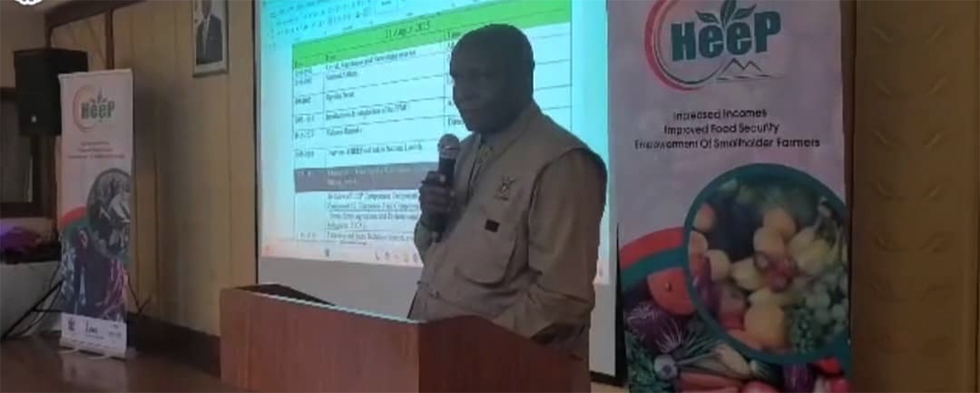
Lovemore Kadzura
Post Reporter
THE coming in of the Horticulture Enterprise Enhancement Project (HEEP) is set to transform farming in Manicaland Province, by boosting agricultural production and economic activity among smallholder farmers and Micro, Small and Medium Enterprises, ushering in a new era for farmers who have been yearning for funding.
HEEP financed to a tune of US$65,5 million, is an initiative being spearheaded by the Government, with support from the International Fund for Agricultural Development (IFAD) and the OPEC Fund for International Development.
The seven-year long project seeks to enhance production of horticultural crops, improve food security and nutrition, while boosting incomes for farmers especially smallholder ones.
The project will be rolled out in Manicaland, Matabeleland South, Masvingo and Midlands provinces. In Manicaland Province, the projects will be implemented in Chipinge, Chimanimani, Mutasa, Nyanga and Makoni districts where Village Garden Units (VGUs) will be established.
Factors leading to the choice of the districts include poverty and vulnerability levels, proximity to irrigation infrastructure, market and agribusiness potential and suitability of the agro-ecological zone for agriculture.
HEEP will also ride on the success of the Smallholder Irrigation Revitalisation Project (SIRP) which was funded by IFAD to revive irrigation schemes such as Romsely in Makoni, Cashel Valley in Chimanimani and Mutema-Musikavanhu in Chipinge. Farmers on these schemes stand will be prioritised.
31000 smallholder farmers will be selected to operate on 620 Village Garden Units across the country. An estimated 50 000 households will benefit indirectly from improved infrastructure such as farm roads and aggregation centres, as well as new jobs created in local services and trade.
In Manicaland, the project is poised to succeed as the province has all the ingredients that favours the success of horticultural activities. The province has abundant water sources such as perennial rivers, dams and under-ground water to enable irrigation activities.
There are a number of irrigation schemes across the province, coupled with favourable weather patterns and agro-ecological conditions suitable for horticulture activities.
Each Village Horticulture Garden will be 1,25 hectares in size, with one hectare going under high value commercial crops, while 0,25ha will be under nutrition sensitive crops for the benefit of beneficiaries.
Each VHG will be equipped with a solar powered borehole, three 1000-liter plastic tanks, a pack shed, administration offices, ablution facilities and farmers will receive input starter packs.
Speaking at the Manicaland Sensitisation Workshop on HEEP last week, Chief Director responsible for Business Development, Markets and Trade in the Ministry of Lands, Agriculture, Water, Fisheries and Rural Development, Mr Abraham Mashumba, said the new project perfectly fit in Government’s grand plan to build a US$2,5 billion horticulture, and rural transformation will be witnessed through the implementation of HEEP which is also complementing the Village Business Units being set up across communal areas.
“It is paramount to acknowledge the crucial role horticulture plays as a pillar of economic transformation. The data speaks volumes, our Horticulture Recovery and Growth Plan aspires to bolster a sub-sector generating over US$2,5 billion in annual gross revenue, creating approximately 600 000 direct jobs, while expanding production across 180 000 hectares. These figures extend beyond mere statistics. They encapsulate the potential to invigorate lives, fortify communities and build a prosperous future for our nation.
“The Horticulture Recovery and Growth Plan aims to stimulate, both conventional and rural horticultural production, enhancing productivity and value addition. This strategic thrust contributes to essential objectives such as increasing the profitability, production and sustainability of horticultural enterprises, focusing on food security, nutrition and export potential while contributing to our Gross Domestic Product growth.
“We will be embarking on rural horticulture transformation, anchored by the Presidential Horticulture Scheme, which promises a multiplicity of economic benefits. Enhancing competitiveness and market access. We will also foster innovation, research and development for improved foreign currency earnings, as well as attracting foreign investment by establishing sustainable funding mechanisms to stimulate interest in the horticultural sector,” he said.
He furthers stressed that HEEP will also address critical issues such as increased employment opportunities and income generation, while revitalising the necessary infrastructure, including agro-processing and marketing hubs integral for the country’s economic hub.
“HEEP is a stellar representation of Zimbabwe’s commitment to empower the horticulture sub-sector. In collaboration with esteemed partners such as IFAD, OPEC and various stakeholders, Government is embarking on comprehensive initiative designed to elevate horticulture as a central driver of national economic growth.
“The total financing for this project is projected at US$72 million, with substantial contributions from IFAD (US$37,5m), OPEC Fund (US$15m), supplemented by Government counterpart funding. HEEP is, not merely an agricultural project, it embodies a strategic initiative focused on improving rural livelihoods and economic conditions for smallholder farmers involved in sustainable horticulture value chains. This initiative explicitly aims to establish 620 Village Business Units, while enhancing the 4P model (Public, Private, Producers, and Partnerships), enabling smallholder farmers to engage meaningfully within commercial markets. Capacities will be bolstered through targeted capacity-building efforts, matching grants and public infrastructure investments that catalyse value chain actors’ contribution,” said Mr Mashumba.
Director of Economic Affairs in the Office of the Minister of State for Manicaland Provincial Affairs and Devolution, Mr Munyaradzi Rubaya, said the province has been afforded an opportunity to revive and maximise its full potential in the horticulture sector.
He called upon selected communities to fully embrace the opportunity to excel and find their way out of poverty.
“Every dollar invested in the horticulture sector can generate twice the impact in terms of economic growth and poverty reduction compared to investments in other sectors, making this project a catalyst for development in our province. We commend the project’s inclusive nature which presents a positive opportunity to uplift women, youth and the marginalised.
“In Manicaland Province where the potential for horticulture is vast, yet underulitised, this project brings a renewed sense of hope. Through its three interlinked components which are VHG, 4P mobilisation, Access to Finance and Institutional Support and Project Management, HEEP aims to build robust systems that connect farmers to markets, unlock financial opportunities and strengthen institutional capacities,” said Mr Rubaya.



 Online Reporter