malvernmugadzikwa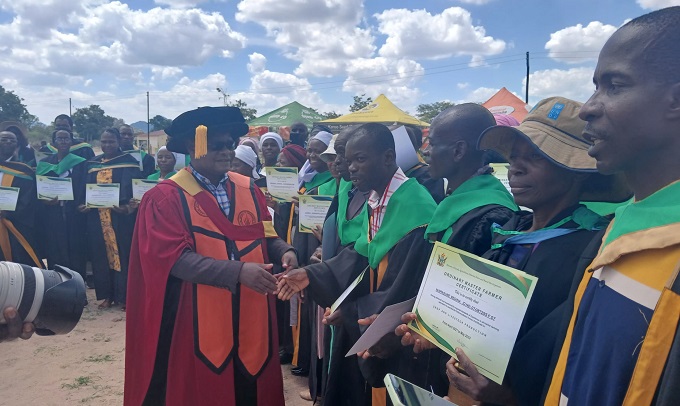
Malven Mugadzikwa in BUHERA
The Master Farmer training programme is working to transform the future of agriculture by equipping farmers with the knowledge, skills and confidence needed to boost productivity, enhance food security, and ensure a thriving agricultural sector.
Permanent Secretary in the Ministry of Lands, Agriculture, Fisheries, Water, and Rural Development Professor Obert Jiri made these remarks after handing over certificates to 365 Buhera district farmers who completed their two-year Master Farmer Training Programme at Murambinda B primary school on Saturday.
The programme saw a record-breaking of 1 918 graduating in Manicaland province this year, with Buhera district leading the charge.
It covers various topics that equip farmers with skills and knowledge.

“At the heart of our training programme is a structured curriculum that covers a wide range of essential topics that is from livestock, farm management, grain and cash crop production, and irrigation management, our curriculum is designed to equip farmers with the knowledge and skills they need to succeed,” said Prof Jiri.
Under the programme, farmers are supported and guided by dedicated Extension Officers who provide expert guidance, mentorship, and encouragement, helping farmers overcome challenges and achieve their full potential.
Profe Jiri said the Master Farmer programme has a strong history in Zimbabwe.
“The Master Farmer program’s roots trace back to 1920 when a missionary Emory Alvord established a training initiative at Mt. Selinda Mission in Chipinge District, Manicaland Province. With a vision to empower local farmers, Alvord equipped them with ten key principles for maximising yields, including deep ploughing, proper crop rotation, and effective pest control.

He said the programme has evolved to address the changing needs and challenges of the agricultural sector.
“With its clear objectives of producing skilled farmers, promoting informed decision-making, facilitating knowledge sharing, and cultivating self-reliance, the programme has empowered countless farmers to succeed in an increasingly complex and competitive agricultural environment,” he said.
“To cater to the diverse needs and abilities of our farmers, we have established two distinct training tracks: Ordinary and Advanced and we are contemplating an online version,” said Prof Jiri.
These training tracks he said are carefully designed to accommodate varying literacy levels and skill sets, allowing farmers to learn and grow at their own pace.

Prof Jiri applauded women for participating in the programme.
“The program has made significant strides in promoting gender equality. With a notable participation rate of female farmers, the program has successfully fostered an inclusive environment that empowers women to take an active role in agricultural development.
“This achievement not only promotes social equity but also unlocks the vast potential of women in agriculture.”
In order to maintain the programme’ s excellence and impact, Prof Jiri said they have identified two critical areas that need improvement.
“Firstly, the program’s syllabus needs modernization. The current curriculum must be reviewed and updated to cater to the diverse needs of contemporary farmers, including those operating under the A2 model farm framework.
“Secondly, resource constraints hinder the program’s full potential. Providing adequate financial support would further improve the smooth running of the program. I guarantee you that addressing these resource gaps can empower our farmers to achieve even greater success.”
To address the challenges, Prof Jiri said the government is committed to implementing a two-pronged strategy that will embark on a process of Curriculum Adaptation, collaborating with key stakeholders to tailor it to the changing agricultural realities. He said this will ensure that farmers receive training that is relevant, effective, and aligned with the latest agricultural trends and best practices.
“I am pleased to inform you that this stage is already at an advanced stage and this was possible through the support of our partners World Food Program (WFP and The University of Zimbabwe. The revised Master Farmer Training Syllabus and training manuals will be published soon,” said Prof Jiri.
He further highlighted that soon they will engage in resource mobilization efforts, partnering with the private sector and development agencies to provide the necessary resources to support farmers.
“I would also like to announce that the Zimbabwe Agriculture Society (ZAS) is already on board providing the necessary support. By leveraging these partnerships, we can secure the resources needed to enhance the program’s impact and sustainability.



 Online Reporter