admin
admin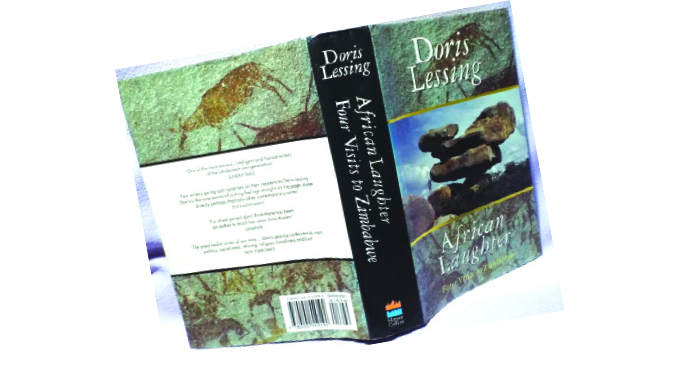
Elliot Ziwira
At the Bookstore
White Rhodesians called it the bush war, while to indigenous people it was a struggle to liberate themselves from the shackles of colonialism.
Doris Lessing portrays this analogy of one war, two different ends in “African Laughter: Four Visits to Zimbabwe” (1992).
The book reveals more about what the African thinks about himself and his environs than what those who purport to understand him do.
Effectively exploiting the autobiographical mode, Lessing chronicles her own experiences through a combination of stories, poems, anecdotes, obituaries, newspaper cuttings, songs, historical allusions and sojourns.
Having been banned from Southern Rhodesia for 25 years, because of her criticism of the then white government, Lessing visited Zimbabwe in 1982, two years after independence.
She made three other subsequent visits in 1988, 1989 and 1992.
Her first visit reveals the euphoria reminiscence of independence, as the majority black populace celebrates their freedom from the colonial yoke of oppression and subjugation.
Challenges associated with teething as the young black Government learns the ropes of governance are also revealed.
The depression, despondence and frustration of the defeated whites, who feel hard pressed to not only accept the outcome of the protracted war, but to submit to their former “bossboys” now in charge, find a vent out in Lessing’s first visit after Independence.
She soon realised that there is something unique about the African people.
Instead of being burdened by sorrow and disaster underlining their existence in a world where the superiority of race is evoked at every corner of its precincts, they let out a hearty laughter and let things be.
They have learnt over eons of toil, oppression and subjugation that laughter is the best weapon to unseat adversity and to replenish the soul.
Unfortunately, or fortunately, it is this nature of the African that is construed for docility and naiveté. It is this that is used against him. Ironically, this construed docility is his strength, his abode, his resolve.
A brief history of colonialism and how it displaced the original owners of the land and forced them to eke out a non-existent living on the periphery of rich arable land, now occupied by the alien gangs from the West, led to two liberation struggles; the First Chimurenga and the Second Chimurenga.
Lessing gives the white man’s perspective of the land, and the war, which he calls the ‘Bush War’.
Whites were fighting to preserve the legacy started by Cecil Rhodes and his Pioneer Column said to be on “an adventure for the sake of the Empire, for Cecil Rhodes, whom they knew to be a great man, for the Queen. . . “
Colonists believed that “Salisbury, a white town, British in feel, flavour and habit,” was theirs for keeps, because “the conquered were inferior, that white tutelage was to their advantage, that they were bound to be the grateful recipients of superior civilisation.”
Settlers cared more for the land and its animals than they did for the Africans.
They would rather protect animals and allow them to roam freely in vast tracts of arable land than give the same to blacks, who were packed in reserves in what they (whites) derogatorily called “kraals”.
Africans were fighting for what was rightfully theirs.
They were fighting for equal opportunities; against repressive laws that relegated them to arid lands, robbed them of their humanity, castrated their sense of worth and stunted their dreams.
Theirs was a struggle for liberation and not a mere bush war.
The picture that the writer conjures evocatively questions the essence of freedom in a situation where the predatory nature of Man bares itself in the reversal of the roles of the hunter and the hunted.
The defeated whites, whose erstwhile zealot, Ian Smith, conceitedly believed that there would never be black majority rule “in a thousand years”, fail to swallow the reality that stares at them.
As a result they play the blame game on the ruling Zanu PF Government.
As Lessing captures, some decide to “take the Gap” in apartheid South Africa, because they cannot endure a “black government.”
She depicts the bitterness at the core of the white progenies made to play second fiddle to the true owners of the land that they so much adore, through the veranda gatherings, which have become their pastime, as they recite The Monologue.
Lessing’s brother, Harry, who talks ceaselessly “about the innate inferiority of blacks”, and yodels about how the country used to be beautiful when it was under white administration, finds it unreasonable to “give free lifts to people who had just unfairly beaten his side in the War.”
The olive branch of reconciliation that is extended to them by the new black Government is frowned at, as doom is prophesied.
The colonialist’s dream remains etched in the past, where events seemed to favour his lot.
Therefore, progress remains clogged in the world of yore, with spanners wedged in the wheels of developmental projects.
Because of sabotage, individualism and deceit, the majority finds itself in no better a situation, as poverty continues to gnaw at them.
However, the people remain resolute and find respite in laughter.
Theirs, as described by the writer, as: “The marvellous African laughter born somewhere in the gut, seizing the whole body with good-humoured philosophy. It is the laughter of poor people.”
There are several other incidences in the book where laughter is used as a form of escapism from the restrictive and oppressive inclination of lack.
On the flip side, however, Africans who are referred to as “our Affs” by white settlers are determined to haul themselves forward even in the face of adversity.
Aware that only knowledge has the capacity to turn the wheels of fortune in their favour, they prioritise acquisition of skills.
Through construction of more schools and vocational centres, the Holy Grail is put in focus.
Independence sees labour laws, which favour those that toil, being enacted. Minimum wages are introduced.
Nonetheless, the issue of the land remains thorny since it remains in the hands of a few.
Prophets of doom are quick to point out that the newly constructed schools lack books and trained teachers; that the O-Level pass rate for 1988 was a mere five percent.
The question remains: is that not an achievement considering that the bottlenecks in education during Smith’s regime saw to it that very few blacks acquired a secondary qualification?
The expatriate teachers funded by the donor community also find the terrain steep. As a result they end up receiving enlightenment from the same people they purport to guide to the light.
One Extension Worker observes: “They send us these young people. They are supposed to be teaching us. . . But we have to teach them what they are supposed to be teaching us. . . These young people are paid to come here and teach us. But we don’t get paid for teaching them everything.”
However, there are some whites who genuinely believe that Zimbabwe is their country, and that they should work for its development. They work at par and in harmony with their fellow men regardless of colour, creed or race.
On the other hand, there are fellow blacks who derive glee in overburdening others as they corruptly line their pockets at the expense of the common good.
The book spans over a decade, capturing a plethora of socio-economic and socio-political issues.
The AIDS pandemic and the stigma associated with it, is also highlighted. The extent of its prevalence and effect is somehow exaggerated as “half” the police and the army is said to be infected.
Due to lack of knowledge on the condition, alienation, stigmatisation and accusations of witchcraft are rife.
On the political landscape, Lessing highlights how Zimbabwe plays a pivotal role in the stabilisation of the region as Mozambique is ruined by Renamo, sponsored by apartheid South Africa.


 Online Reporter