

 admin
admin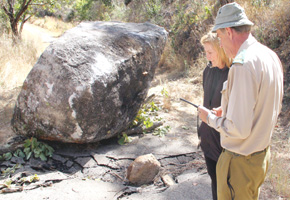
The strange incident occurred a couple of weeks after a group of what were described as “renegades” by the chairman of the Zimbabwe National Liberation War Veterans Association, Cde Jabulani Sibanda, and as members of a gang by Zanu-PF Matabeleland South chairman, Cde Andrew Langa, had unceremoniously tried to access Njelele, the venerable adobe of Zimbabwe’s traditional deity, Mwali, Mwari, uNgwali.
That group of what we may call cultural vandals was stopped by the area’s Chief Masuku, and several Matabeleland South provincial cultural activists. The renegades would have been visiting the sacred shrine for the third time and they had not been stopped. They were about 150. The first visit comprised some 750 and the second numbered 650. On all the occasions, they came without prior warning.
They said their mission was to be cleansed of the spirits of their dead colleagues who were killed by the Rhodesian white minority regimes’ forces during the liberation struggle which ended in 1979.
They also wanted to remove the mortal remains of Cecil John Rhodes from his grave that is in another part of the Matopo Hills and send them to Britain.
Rhodes died in June 1902 and was interned in a huge boulder a short distance from where the rock fell. The particular huge boulder where Rhodes is buried is in a Matopo Hills locality originally called “Malinda Badzimu”, which is TjiKalanga for “the keepers of the gods,” (abagcini bakoMlimu).
An attempt was made by some early London Missionary Society (LMS) clergymen after the founding of Hope Fountain Mission in 1870 to change the name to “Malinda Ndzimu” (the keeper of God) in keeping with the Hebraic Christian monotheistic religion but it failed. The original name’s meaning has a polytheistic connotation.
The place where the rock fell is nearer Rhodes’ grave than it is to Njelele. The question asked by all Zimbabweans and foreigners interested in that most unusual incident is; What caused the rock to fall and to roll for 100 metres, crushing all that lay in its wake before it stopped with a smack right in the middle of a road down below?
Answers to that are diverse and culturally subjective. The religious-traditionalist does not, I should think have any doubt that the rock was brought down by Mwali’s, uNgwali’s, Mwari’s invisible hand as a sign that what has been happening at Njelele is as destructive as that rock rolling from up atop the hill.
The traditionalist will also say that the meaning in the rock’s position lying in the road is that something must be done to appease Mwali before the rock is moved from the road to make way for motorised means of transport such as that used by the renegades.
How the appeasement should be carried out is a matter for the venerable Njelele keeper, an elderly woman who on the second visit by the vandals was humiliated, harassed, insulted and utterly belittled. It was incidentally, surprising that when the concerned chiefs and other authorities met to discuss this matter at Esigodini, the people responsible for the cultural mess were not at all represented, nor was the Matobo District Administrator’s Office nor the rural district council. Is there no councillor for that area? An MP?
Why were the meetings held outside Matobo district so that the relevant police station could be asked to explain its lack of appropriate action? These are some of the questions any reasonably intelligent person is asking about the issue. Now, back to the rock.
Christians of the old mould are most likely giving the event the same old explanations their pioneers gave to their early converts about Mwali. The missionaries said that the voice people heard from either the shrine’s cave or from a tree or a solid rock or from the sky was a product of ventriloquism.
This ventriloquism is a skill of making vocal sounds so that they seem to come from a source other than the speaker. The words or any other sound may seen to be from a dummy the speaker is holding.
However, in this case we are not discussing sounds but a movement of a huge rock. There had not been any earth tremor in the area or a full bloodied earthquake. Matopo Hills are not known for any of those geological phenomena.
So, the old fashioned syncretic church-goers will attribute the event to someone’s magical or witchcraft powers. Syncretic Christian church-members mix biblical precepts with traditional beliefs and practices. They hold the bible with the left hand and a gourd (nkombe, inkezo) with the right and proceed to recite Psalm 23 through one corner of their mouths while singing praises of one or other of their dead ancestors through the other corner to make sure that if one does not respond positively to their supplications, the other will.
Another cultural community that is most likely to look at the event with a dismissive shrug of their shoulders is the born-again Pentecostal church members. If they do not think that the rock was brought down by the mischievous hand of Satan, they are probably attributing the event to a natural phenomenon such as an earth tremor. The trend among Christians is to deny the existence of Mwali.
That should be so as it is in general keeping with that religion’s monotheistic doctrine and belief. This doctrinal position excludes, of course, the syncretic church-goers as already stated above.
However, a look at the Book of Exodus shows us the God of Israel’s place of abode being the mountains. There is a similarity in that with Mwali’s Njelele Shrine. We also hear the God of Israel talking to Moses, first from a burning bush and later from Mount Sinai and other rocky heights. The Mwali of the Matopo Hills is or was reported to be communica-ting also vocally from similar rocky structures.
Christology shows us how powerful prayer can be. Jesus Christ (Mark 11 vs 23-26) taught His disciples that prayer can move mountains.
Should those who believe that the rock tumbled down as an answer to the prayers of those who felt deeply aggrieved by the highly deplorable deeds of what Cde Sibanda calls renegades not celebrate and praise their deity whom they call Mwali, Mwari, uNgwali? As a free thinker, I should hold that opinion.
A group of worshippers who are most likely to be of the same opinion are Guta RaMwari members. They attach a great deal of importance to the existence of Mwali. They do not believe, however, that Jesus Christ was a biological or spiritual son of God but that he was just a prominent prophet.
Guta RaMwari members most probably believe that there is no difference between God (Yahweh, Jehovah) and Mwari, hence their sect’s name.
That view was held by the LMS clergyman the Rev George Cullen Harvey Reed, the founder of Dombodema Mission (1895). He regarded the Mwali wosana, Njenjema Tjabulula Nleya who was resident at Dombodema as a prophet of God. Incidentally, “Njenjema” was Mwali’s name for that man. His real name was Mbengwa.
Before winding up this discussion, let us briefly examine whether or not there are any doctrinal differences between Christianity and “Mwalism.”
A major similarity is that both deities’ origins are a voice. Mwali is a voice in a rock or cave. Jehovah’s recorded origin was also vocal as recorded in Genesis. A second similarity is the place of abode which was originally rocky mountains, even for Greek gods.
The third similarity is that both Mwali and Yahweh (Jehovah) protected their people against their enemies and natural calamities; that is to say during wars and natural disasters. The fourth similarity is that both deities are for fertility and natural reproduction.
The fifth similarity is that both are invisible but audible, or at least they used to be heard (but were certainly never seen.)
The sixth similarity is that both deities cause objects such as water and rocks to move to show their support for or their disapproval of a cause or development or trend. The parting of the waters of the Red Sea during the Exodus could be compared, albeit only in terms of motion, to the falling rock. Noah’s flood is another good example.
A look at the belief in salvation of the soul after death, the Roman Catholics ask saints who died centuries ago to pray for them (Sanctus Canisius Miserere nobis) which in English means, Saint Canisius pray for us). They even have a holy day known as “All Saints Day.”
Mwali worshippers also pray to the spirits of their deceased fore-bearers to intercede on their behalf to solve whatever problems they are facing. Other Christian denominations tend to use Christ pray for them or to intercede on their behalf.
There are other doctrinal differences and similarities that would require a much more detailed soteriological analysis of both religions than can be exposed in such an opinion article as this one. By soteriology we mean the doctrine of salvation which in the Bible is mentioned by Christ (not by Moses) and in the Zimbabwean traditional religion seems to feature prominently through the use of ancestral spirits as intercessors.
It is through these ancestral spirits that most Mwali worshippers access their deity. They believe (and I mean believe) that if properly approached, ancestral spirits guide, protect and bless their lives. It is in this context that the importance of shrines such as Njelele, Manyangwa, Dula and others must be protected by the State and all its security machinery and cultural developmental processes.
In all this, the traditional leadership responsible for and answerable to Mwali ought to come forward and play its role. That leadership is the house of Lubimbi of the Malaba (Ncube) clan. Chief Malaba belongs to the ruling house and so does Rev Griffiths Malaba of the Methodist Church in Harare and, I should think, Hay Malaba now living in Mashonaland East. The house of Lubimbi is responsible for Mwali and the shrines.
Another Malaba house relevant to this matter is that of headman Hhobhodo of the Mangwe District. These Malaba houses and their cousins, the Mbedzi of Beitbridge have a duty to organise the house of Lubimbi so that the rightful persons can shoulder their responsibilities at Njelele and elsewhere. Chief Malaba ought to lead in this.
Meanwhile, those responsible for this deplorable cultural mess must be brought to book by the Zimbabwe Republic Police (ZRP) lest we suspect that ZRP had a hand in the matter. One wonders whether ZRP would have been so quite if Njelele were located in say, Mashonaland East, Mashonaland West or Central, and the disrespectful group were from Matabeleland. Come ZRP; please act to protect Zimbabwe’s cultural interests.
*Saul Gwakuba Ndlovu is a Bulawayo based retired journalist. He can be contacted on cell 0734328186 or through email [email protected]



 Online Reporter