

 Moffat Mungazi
Samuel Kadungure
News Editor
THE sun-kissed communal fields of Chiendambuya in Makoni District — all along a keystone of Manicaland’s agricultural sector — are witnessing a transformative shift.
As climate change, soil degradation, and water scarcity increasingly threaten traditional farming methods, innovative farmers are embracing regenerative agriculture techniques and organic fertilisers to ensure a sustainable future.
A quiet revolution is taking place as a growing number of farmers turn to regenerative agriculture techniques and organic fertilisers to boost yields, improve soil health, and enhance biodiversity.
The farmers have taken Pfumvudza a gear up, with a combination of infiltration pits, tied ridges, and mulch in their plots, addressing key challenges of soil erosion, water scarcity, and declining soil fertility.
By adopting these practices, they have improved crop yields, enhance resilience to climate change, and contribute to sustainable agricultural development.
Ms Thandiwe Jordan Mukonyora is one such farmer who has witnessed the transformative power of regenerative agriculture first hand.
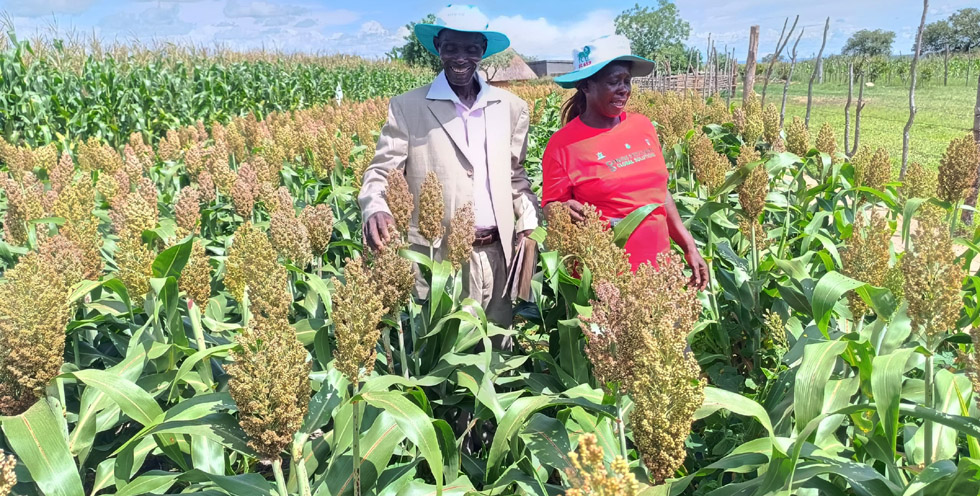
Despite the recent loss of her husband, Ms Mukonyora has persevered, tending to eight plots of maize, paprika, sorghum, and pearl millet with unwavering dedication.
Her secret?
A combination of organic fertilisers, conservation tillage, and meticulous crop management.
The results are nothing short of remarkable – healthier crops, improved soil fertility, and increased yields that have enabled her to send her daughter to university.
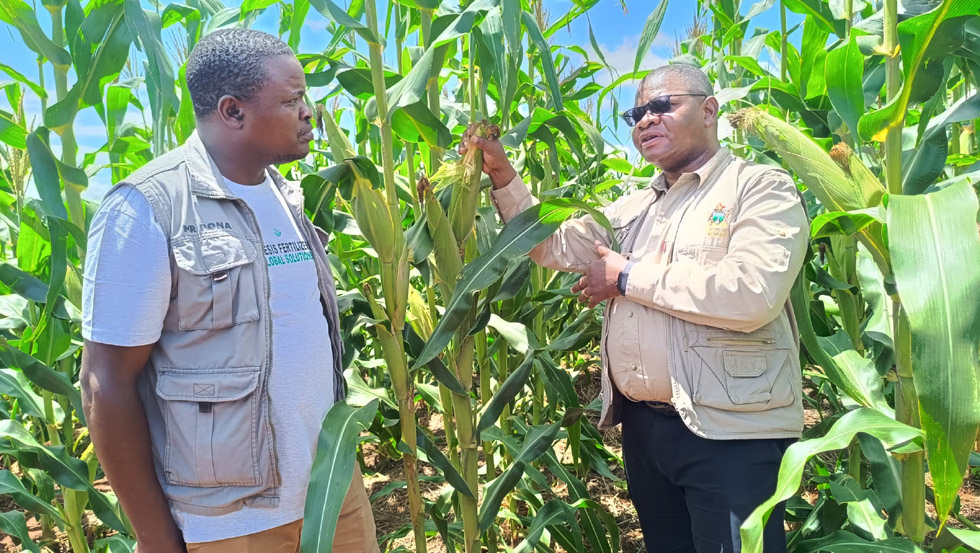
A stroll through her plots– with a delegation led by Permanent Secretary in the Ministry of Lands, Agriculture, Fisheries, Water and Rural Development, Professor Obert Jiri, revealed stark contrast between organic and synthetic fertilisers.
Side-by-side plots, planted on the same date, using the same seed variety and crop management practices, tell a tale of the two fertilisers.
The organic plot bursts with vibrancy – its crops robust and resilient – while the synthetic plot struggles to keep pace, its crops yellowing, weakened and stunted. The evidence is clear – organic fertilisers, carefully crafted from natural materials, hold the key to unlocking the full potential of her fertile soils.
As rural agriculture continues to evolve, experiences of pioneering farmers like Mrs Mukonyora offer a beacon of hope for sustainable future. By embracing regenerative agriculture techniques, farmers cannot only boost yields and improve soil health, but also contribute to a resilient food system, better equipped to withstand challenges of climate change.
As the seeds of this revolution take root, one thing is clear – the future of Manicaland’s rural agriculture has never looked brighter.
“I have, not only maintained our farm’s productivity, but have also continued to invest in my children’s education. Regenerative agriculture has been a game-changer for me. This approach has also helped me to cope with the challenges of climate change, which is essential for ensuring the long-term sustainability of our farm.
“As you can see, the plots with organic fertiliser have robust and healthier crop growth, with greener leaves, stronger stalks and huge cobs. In contrast, the plot with synthetic fertiliser appears to be struggling, with yellowing leaves, weaker stalks and smaller cobs. The results speak for themselves, and I am convinced that organic farming is the way forward for sustainable agriculture,” she said.
Her competitor is Mrs Mary Mudiwa, also a student of Chiedza Farmer Field School.
She was the host of this year’s field day in the area after – Ms Mukonyora and Mrs Shuviso Vangisai Chapo – were graduated, having dominated the Pfumvudza competition for the past four years.
She has eight plots of maize and sorghum, beans.
She has constructed an asbestos roofed house – which by rural standards is a symbol of status and all her children are going to school, with their levies and fees fully paid up – after diligently adhering to all principles of Pfumvudza to achieve impressive yields.
“I attribute my success entirely to my adherence to all the Pfumvudza principles. By following the guidelines meticulously, from potholing to the use of organic solutions like Relict P, I have been able to achieve remarkable results. Pfumvudza has truly transformed my farming experience, and I encourage all farmers to embrace these principles for improved productivity and sustainability,” she said.
Mrs Mudiwa took the opportunity to thank the Government and the private sector for providing Pfumvudza inputs and extension services right at their doorsteps.
With the support received, she optimistic about a bountiful harvest of at least two tonnes per plot.
Mrs Chapo has also refused to be outdone.
“Since adopting regenerative agriculture practices and using organic fertilisers, I have seen a significant increase in Pfumvudza crop yields and noticeable improvement in soil health. More importantly, I have been able to reduce my production costs and improve my family’s income, which has had a positive impact on our livelihood.
“I dug the infiltration pits and prepared tied ridges by myself, and the results have been amazing. The infiltration pits have helped to harvest and conserve rainwater, reducing soil erosion and increasing moisture retention in the soil. The tied ridges have also improved soil fertility and structure, allowing me to grow a more diverse range of crops. I am proud to say that I have been able to achieve all of this through my own hard work and determination, technical assistance from my extension officer (Mrs Lynette Samudzi-Muhle), Practical Action and Genesis Fertilisers. I am excited to see the long-term benefits of these conservation agriculture techniques,” she said.
Professor Jiri attributed the superior performance of organic fertilisers to their ability to improve soil health, structure, and fertility, leading to more robust and resilient crops.
“The benefits of organic fertilisers extend beyond just higher yields. They also promote sustainable agriculture practices, reduce environmental pollution, and contribute to climate change mitigation. One of their primary advantages is their slow-release mechanism – they provide a steady supply of nutrients to plants over an extended period, rather than a sudden surge or quick fix that can lead to imbalances. This slow release also encourages healthy microbial activity in the soil, which is essential for maintaining a balanced ecosystem. They are derived from natural sources which are rich in essential nutrients, meaning they are easily assimilated into the soil, where they can provide benefits to the entire ecosystem,” he said.
In contrast, Professor Jiri said, synthetic fertilisers, manufactured using non-renewable resources can have detrimental effects on the environment and human health.
“By choosing organic fertilisers, farmers can reduce their environmental footprint, while promoting sustainable agriculture practices and improving crop yields. Unlike synthetic fertilisers, which provide a quick fix, organic fertilisers offer a more sustainable solution that promotes long-term soil health,” he said.
Organic fertilisers are, by definition, part of the natural ecosystem, made from natural materials such as compost, manure, or green manure, which are rich in nutrients and beneficial microorganisms that help to break down organic matter, solubilise minerals, and fix nitrogen, making nutrients more available to plants.
The farmers are using Relict P fertiliser introduced to them by Government, Practical Action and Genesis Fertilisers – that contains residual phosphorus (P) from previous fertiliser applications – which phosphorus remains in the soil for extended periods, providing a slow release of nutrients to plants over time.
Relict P, produced by Genesis Global Fertiliser Solutions, a Russian company, whose director, Mr Ponaindimwi Mutsenyengwa said the fertiliser also plays a critical role in promoting soil biota and ecosystem services.
Soil biota, such as earthworms, insects, and microorganisms, are essential for decomposing organic matter, fixing nitrogen, and solubilising minerals.
“By using organic fertilizers, regenerative agriculture helps to create a favourable environment for soil biota to thrive, which in turn supports the growth of healthy and resilient crops. The integration of organic fertilisers into regenerative agriculture also has economic benefits for farmers.
“Organic fertilisers can help to improve crop yields and quality, increasing farmers’ incomes and competitiveness in the market. By promoting the use of organic fertilisers, regenerative agriculture offers a holistic approach to sustainable agriculture that benefits both the environment and farmers,” he said.
Mrs Samudzi-Muhle said the integration of infiltration pits, tied ridges, and mulch in Pfumvudza offers a holistic approach to conservation agriculture, helping farmers to address key challenges like soil erosion, water scarcity, and declining soil fertility – resultantly improving crop productivity, and enhancing resilience to climate change while contributing to a more sustainable food system, improving livelihoods and promoting environmental stewardship.
“The use of water harvesting techniques have shown a significant increase in crop production and productivity in Chendambuya Ward Five. These technologies collect and store direct rainfall and run-off water from the fields, and this water slowly seeps down the slope benefiting the crop, improving soil moisture retention, prolonging the period of moisture availability and enhancing crop growth and yield increase. Also the use of organic fertilisers like Relict P, reduces production costs, increases crop growth by promoting efficient use of nutrients by plants and tolerance to heat stress,” she said.



 Online Reporter