Online Reporter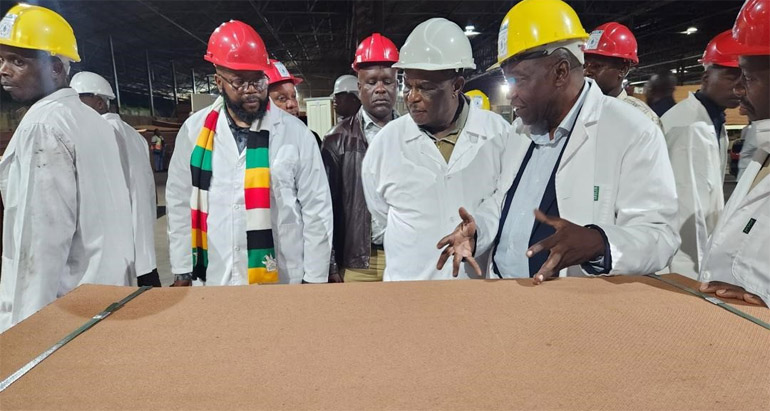
Samuel Kadungure
News Editor
THE country’s timber industry is reeling under crippling challenges, with key players blaming the sector’s decline on over-harvesting, costly imported seedlings, and regulatory hurdles that are pushing companies to the brink, The Manica Post can reveal.
Speaking at a recent meeting with Vice President Constantino Chiwenga—who was touring high-impact projects in Manicaland—Manica Boards and Doors managing director, Mr Kurai Matsheza, highlighted the burden of a US$185 export fee per truck.
He said the levy significantly inflates operational costs and urged Government to review it.
VP Chiwenga’s visit focused on assessing flagship projects with national impact, encouraging stronger cooperation between the private sector and Government.
He underscored the importance of addressing industry challenges to accelerate growth and drive economic development.
Mr Matsheza noted that the industry is also grappling with the aftermath of over-harvesting, which has forced companies to import seedlings from South Africa at exorbitant prices.
He added that the absence of local research facilities and the collapse of the Forestry Industry Technical Cooperation (FITC) have worsened the situation, leaving the sector vulnerable and dependent on external supplies.
“We are also bringing timber from Mozambique. As timber companies, we have been over-harvesting and not matching harvesting with planting. Because of other challenges, we used to have the FITC here, which used to do research for seedlings, but that has also died down. Currently, seedlings for plantations are brought in from South Africa. So these are the challenges we are faced with.
“As Manica Boards and Doors, we have been evaluating expanding our business, with the possibility of having an additional line in Mozambique because of the timber resource. We have done the numbers here, and at the current levels, we will not be able to carry out that expansion. So we are actually evaluating – as you know, it takes seven years for our operation; at eight years, we can start harvesting the timber for our operation. For others, yes, we have got to wait a bit longer, maybe 15 or 20 years.
“We have also got issues with Statutory Instrument (SI) 170 of 2024, which was to do with smart cities. When the smart cities concept came in, the SI was made to say anybody who goes into the construction business is allowed to import whatever they need for the smart cities. The building materials can be imported from outside Zimbabwe. We were not consulted to see if we have the capacity to do these things that are required, and we were shocked to see it there.
“The other issue I want to highlight is exporting – we get charged US$185 for every truck that leaves these premises going outside Zimbabwe, and it increases the cost of production. These things should be looked at as they affect our business,” said Mr Matsheza, adding that the timber sector is facing issues with grey imports, and called for tighter border controls to level the playing field. The sector is also pushing for export incentives to boost their business.
On a more positive note, Manica Boards is investing in a 5MW solar project to tackle electricity challenges, aiming to energise it by June this year.
“The issues of grey imports are also affecting us. These imports are coming through, and we believe that these products are not coming through any unofficial border post or point because these are 30-tonne trucks. There is no way anybody driving a 30-tonne truck can come through an illegal crossing point, but only through official border entry points. So it must be a weakness within the system that is allowing those things to happen. There is a need to tighten the systems.
“Obviously, as exporters, we also look for incentives to ensure that as we export more, we get some incentives to encourage us to do more exports. I did not mention the challenges of electricity, but to help ourselves, we have invested in a solar project of five megawatts, which is 10 kilometres away from here on the way to Feruka. We expect to energise that plant in June,” he said.
VP Chiwenga said the private sector leads the growth of the economy.
“Government acts as an enabler, defining policies that will enable our companies to grow, opening the doors for companies to do business. However, there must be collaboration and coordination between the two parties because we are all working for one person – our citizen – to raise their standard of living. We must think outside the box. We have taken note of the SI on smart cities, and will review it to ensure it takes into account what we produce locally. We cannot afford to procure locally-produced goods from outside the country; we need that money for other commodities. Also the security sector should look into the issue of grey imports and address it. We need to know where the trucks are coming from, and who is behind them. We cannot allow that to happen when you are there. This must stop.
“Regarding the levies you mentioned, I am aware that a committee led by the Minister of Finance, through the OPC and Minister of Industry, is reviewing the ease of doing business. The levies are being charged by various ministries, entities and agencies, and we are taking this seriously to see how we can ease the way of doing business, as some of it is affecting growth of companies,” said VP Chiwenga, adding that resources must be effectively used to benefit citizens.
“We must now put our minds together and work together. Each company, individual or institution must ask itself: what contribution am I making to the country? What contribution am I making to the growth of our economy? You are a strategic partner in our national vision for industrialisation, value addition and economic transformation. The Government is ready to support your growth as the local industry. Your problems are our problems. Let us work together,” he said.