Tendai Gukutikwa
Post Reporter
LAUGHTER, live band performances, the unboxing of meals from popular fast-food outlets, coupled with a range of entertainment activities filled Mutare Farm Prison last Sunday.
While music played, children laughed and families embraced their incarcerated loved ones during the official closing of Family Week, another scene unfolded quietly in the shadows.
For a number of prisoners seated quietly around the grounds, the sweet aroma of the food remained just that – an aroma.
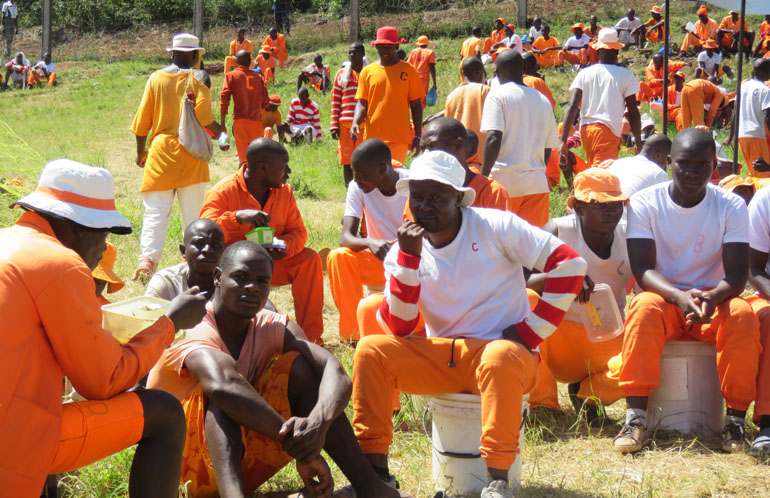
In one corner of the prison grounds sat a group of men in orange shorts and shirts and prison jumpsuits. Some perched silently on plastic buckets. Others stared into the distance.
Their eyes drifted repeatedly towards the celebration before them, mothers unpacking groceries, wives sharing meals, children clinging to fathers they had not seen in months.
For this group of men, no one came. No names were called for them. No parcels were delivered. No embraces awaited them.
As laughter echoed across the yard, they swallowed loneliness and watched other inmates enjoy what they themselves longed for most – to be remembered. For many of them, prison bars have not been the hardest punishment – being abandoned has.
“I feel like a reject,” said Adam Mhlanga, who has been in prison since 2017, and set for release in 2031, having been convicted of unlawful entry and robbery.
“During a week like this, the pain becomes heavier. I sit alone and watch others receiving visitors.
“It is not even about what they bring. A visit alone means everything. It tells you that you still matter to someone,” said Mhlanga, adding that his grandparents were the only people who once visited him.
His grandfather has since died, while his grandmother last came in 2022.
“I made mistakes and I accept that. I know what I did was wrong. I just want forgiveness. I am no longer the person who came here years ago,” he said softly, as he further spoke of another struggle often hidden behind prison walls – illness.
“I am asthmatic and sometimes I need medication, but more than medication, I need to know there is still someone outside who remembers me. It is so painful knowing that no one there is even thinking of me,” he said.
Nearby sat Gift Mazvimba (34), from Avilla Mission, in Nyanga, serving time for theft until 2031.
He watched families share food under the trees and lowered his head.
“No bloodline relative has ever come to see me. The correctional officers here are now the closest thing we have to family. I call them vana gogo nana sekuru, not just out of respect, but because that is how much they have replaced the family out there that has forgotten about me. Calling them that makes me feel that I still have someone loving and taking care of me,” said Mazvimba, adding that he was married and had children before his imprisonment, but contact from home has disappeared.
“I do not know if my wife is still there, and if my children still remember me, or if they have moved on. Sometimes I wonder whether they are still alive. That silence is painful. I have been serving for years now, but no one has visited. I will be out in 2031, and I do not think my wife will ever bring my children,” he said.
He paused before adding: “Please, to my family members, I ask for forgiveness. Let go of the anger. Come and see me, even once, and tell me how everyone, including my children, are doing.”
For Abbiott Masunda, remorse has become a daily companion.
Convicted of rape in 2017, and with four years left to serve, he said no one has visited since the day he was incarcerated.
“They are angry because of what I did, and I understand that, but I am sorry. I have had years to think about the harm I caused,” said Masunda, who suffers from ulcers and often struggles without support.
“Sometimes I need clothes, medicine, and encouragement. But most of all, I need reconciliation. I just want my family to hear me say I am sorry,” he said.
James Chishakwe carries a different kind of grief.
“In 2016, I assaulted my friend. He died days later. I was arrested and convicted. Since then, I have lived with regret,” he said.
He was held at Chikurubi Maximum Prison before being transferred to Mutare in 2024.
“I no longer expect visitors. My relatives do not respond when officers try to contact them. Maybe the pain is too much. Maybe they cannot forgive me,” he said.
Yet even in rejection, he still thinks of home.
“I only want them to know that I think about them every day, and hope life has been kind to them,” he said.
Emmanuel Murimba, jailed in 2024 after attempting to murder a friend in Marange, said his mother last visited him before sentencing.
“I know I wronged many people, but before prison, I used to help my family. I wish they could remember me too,” he said.
Across the yard, one mother offered a different message.
Mrs Tashupika Kamusa had travelled from Nyazura to visit her 41-year-old son, Farai Maranji.
She believes families should not abandon relatives behind bars.
“People must understand the power of visiting. It gives them peace of mind. It reminds them they are still human and still loved,” she said, while glancing towards the inmates sitting alone.
“It breaks my heart seeing some men by themselves while others celebrate. Being incarcerated is not the end of life. Sometimes it is the beginning of change,” she said, who visits monthly and brings supplies for her son.
“More important than food is presence. We should learn to forgive,” she said.
Minister of State for Manicaland Provincial Affairs and Devolution, Advocate Misheck Mugadza, who officiated at the closing ceremony, said rehabilitation succeeds best when supported by family ties.
“Prison must not be seen as the end of one’s life. For many, it is the beginning of a new chapter. We are seeing people being transformed, learning discipline and preparing to return to society,” he said.
Officer Commanding Manicaland Province for the Zimbabwe Prisons and Correctional Service, Commissioner Spetosomusa Chinobva, said family contact plays a critical role in reform.
“When inmates maintain healthy family bonds, their emotional well-being improves and reintegration becomes easier after release. We encourage communities not to permanently define people by their worst mistakes,” she said.
As the afternoon ended, families slowly packed up and said their goodbyes. Some inmates walked back smiling, carrying groceries, soap and clean clothes.
Mhlanga and his friends returned empty-handed as they drifted back to their cells.
They had no parcels, hugs, updates of the outside world and no promises to return next month.
They only carried two things, the fading sound of laughter of fellow inmates and their families as well as hope that one day, someone will come.
Pain of being forgotten behind prison walls