

 admin
admin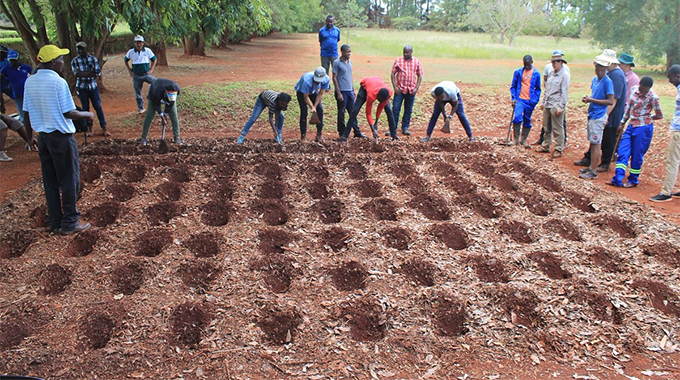
Elton Manguwo
GOVERNMENT’S Zunde raMambo programme targeting 35 000 villages will be modelled around the farmer field schools’ concept with a view to give experts a platform to impart basic farming knowledge to farmers.
Chief director Agriculture Advisory and Rural Development Services (ARDAS), Professor Obert Jiri explained the modalities of the programme saying the Zunde raMambo projects would be sited at the village head’s place, which would be used as a farmer field school for the lessons.
“The farmer field school concept is an elaborate extension services approach that strives to educate farmers on the specifics and tenets of the adoption of Pfumvudza/Intwasa as a model for maximum crop production. The approach for ARDAS in the upcoming summer cropping season is to involve everyone and every place in the production process,” said Prof Jiri.
These village field schools will provide a centralised point where farmers will interact with extension agents with these gatherings assuming a knowledge mobilisation role, which cannot be tapped into from any other setting.
Farmers are then expected to put what they would have learnt into practice upon returning to their individual five plots.
Farmer field schools are a participatory education approach that brings together a group of small-scale farmers to solve production problems through sustainable agriculture. The approach offers space for hands-on group learning, enhancing skills for observation and critical analysis and improved decision making by local communities.
All the 35 000 villages in the country will have one farmer field school each for the Zunde raMambo sub programme as a complimentary component to the Presidential Pfumvudza/Intwasa programme.
Zunde raMambo is a traditional method of food production where able-bodied men of the community come together to produce food for the community and the food would be used in times when supplies would have depleted.
Amid the current vagaries of climate change and the poor crop performance from previous season, that manifested itself through a 43 percent drop in food production, the Government aims to bounce back better by rolling out various robust programmes aimed at sustaining and protecting the food production sector.
Therefore, it is important for the agriculture sector to perfect conservation farming, which thrives on minimal input usage for maximum production.
Minister of Lands, Agriculture, Fisheries, Water and Rural Development, Dr Anxious Masuka once said: “If we are to ensure food security for the country there is need to adjust and treat every year as a drought year through the adoption of Pfumvudza/Intwasa, as a climate smart farming system.”
The Zunde raMambo scheme will support 10 plots for the chiefs, seven plots for headmen and five plots each for village heads.
The Government is set to accommodate 3, 5million households under the Presidential input scheme (Pfumvudza/Intwasa) this year compared to previous season’s 2, 5 million as part of efforts to capacitate them to produce effectively. The Pfumvudza/Intwasa project is an aggressive effort meant to bolster food security at both household and national level.
The standard input package that will be provided to farmers will comprise fertiliser, seed, water retention enhancers and herbicides as well as fall armyworm remedy. The distribution of inputs according to agro-ecological regions is already under way as one of the critical key principles towards the adoption of conservation agriculture is timeliness and preparedness.



 Online Reporter