Online Reporter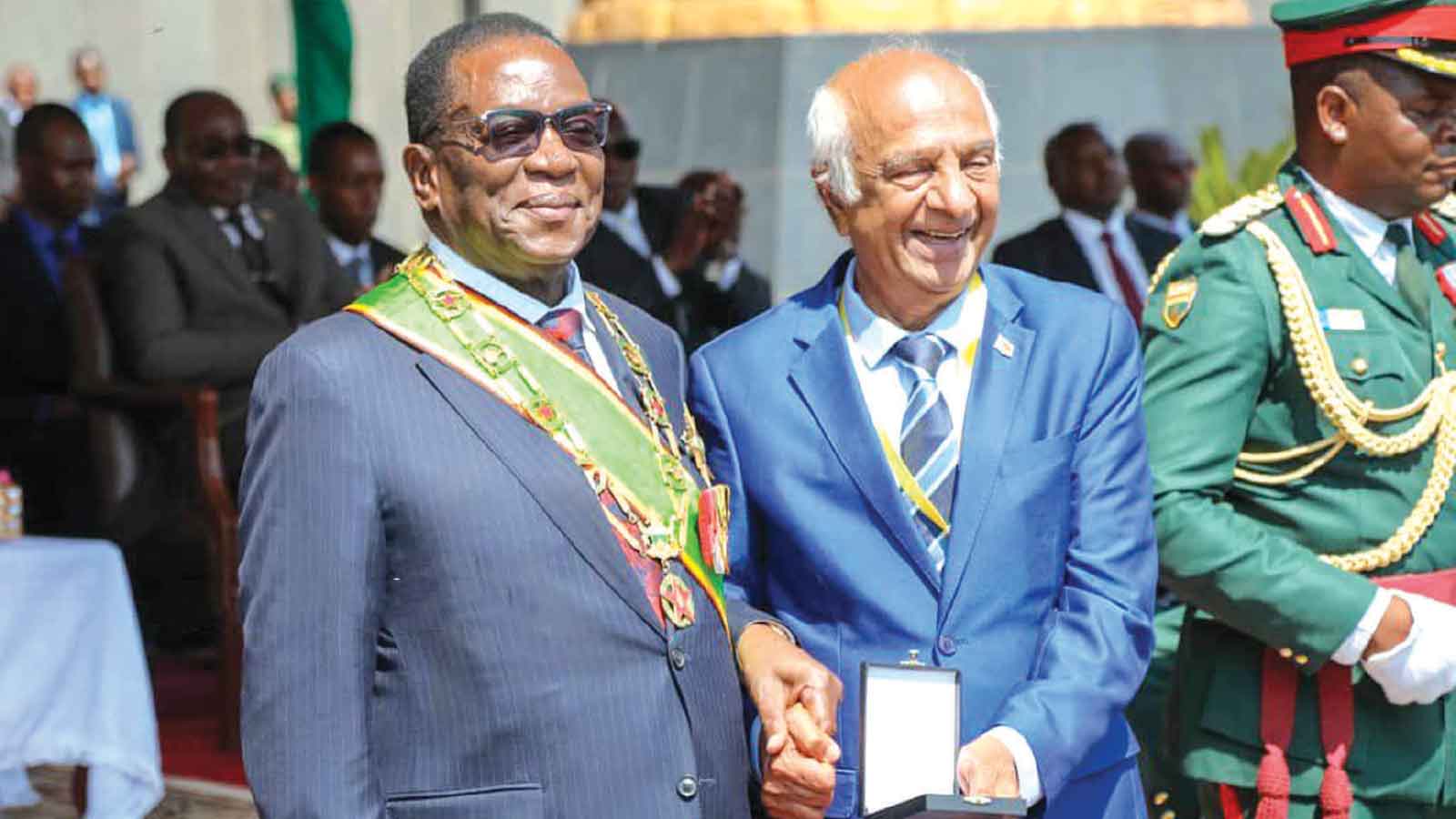
MR DEVNANDA POPATLAL, a Mozambican born in 1942, became the eighth person to be awarded the Royal Order of Munhumutapa, a special award for non-Zimbabweans, including leaders of Frontline States who played a crucial role in the liberation of Zimbabwe. He played a pivotal role when ZANU relocated to Maputo during the war, providing all the logistics for freedom fighters in Maputo. Deputy Editor of The Sunday Mail LOVEMORE CHIKOVA sat down with Mr Popatlal for his insights on independence, as well as his role during the liberation struggle.
*******************
Q: Zimbabwe is celebrating its Independence Day on April 18. What are your reflections on the occasion?
A: Independence should be celebrated with great significance because it represents the breaking of colonial chains and the opening up of new opportunities for all Zimbabweans across all generations. To build a great Zimbabwe, we must remain connected to the principles of the liberation struggle. We must remember the sacrifices made by our comrades, those who gave their lives and those who endured great suffering. Some were tortured in the most brutal ways. These experiences must never be forgotten because they define the value of the freedom we enjoy today.
There is need to inject a new sense of political consciousness into our youth, beginning at family level. Parents must educate their children about the liberation struggle. From there, it should continue through the education system — from primary school to secondary school, and even to university level. At the moment, this knowledge is largely missing, and that is a serious concern. I can confidently say that many people, even within families, do not fully understand the liberation struggle.
So, the question becomes: How do we build a new generation without this foundation? This is why I say political consciousness is a wake-up call for our nation.
While I respect the role of journalism, I believe there must be a balance. Too much focus on negative narratives can undermine the appreciation of our national achievements. We need responsible journalism that promotes the values of the liberation struggle and contributes to nation-building. In public service and corporate institutions, I have also observed a lack of understanding of the political and historical foundations of our country.
Many leaders focus only on technical aspects, without appreciating the ideological background that shapes governance.
This creates a gap that affects decision-making and national progress. Many chief executives and managers today lack a sense of political and historical awareness. They make decisions purely based on technicalities, ignoring the lessons of our struggle. That is why I constantly stress that political consciousness must begin at the grassroots, at home, in schools and continue into professional life. Without it, we risk creating generations that are technically skilled but morally and socially disconnected from the values that built this nation.
Q: Having noticed the gaps existing in the understanding of the liberation struggle, especially by the youths, what is your message to the young generation as Independence Day approaches?
A: My message to the youth is very clear and very important: I want to emphasise that the majority of our society, especially the young people, have no real understanding of the liberation struggle.
This is something that deeply concerns me because it is fundamental to who we are as a nation. Through your profession, particularly in your position at The Sunday Mail, I want to make a strong appeal. I would like the newspaper to help promote my idea of visiting schools and speaking directly to students about the liberation struggle. I believe that, together, your institution and my contribution can provide a great service to the nation. We need to prepare future generations so that they are fully conscious of where we are coming from.
If they do not understand our past and what we went through, they will not be able to evaluate the present or shape the future meaningfully.
My desire is that this idea is developed further, and with proper support, we can organise programmes where we move from one school to another, sharing these experiences. It would be a powerful and impactful exercise.
This has always been my dream — to go into schools and speak directly to young people about the liberation struggle.
I wish someone or some company could support my intention to visit primary and secondary schools to promote principles of patriotism. When we do that, it will inspire someone out there, who will listen to it and it will be sort of a wake-up call because we need that information spread into the education system.
Through such engagements, we may even discover young people with exceptional potential, individuals who will be inspired by these stories and go on to do something great for the nation.
These liberation struggle stories have the power to shape minds and inspire future leaders. I also want to emphasise that my vision goes beyond simply speaking to students; it is about building a culture of understanding and responsibility. We must make young people appreciate that the liberation struggle was not just about battles and politics; it was about the very foundation of our freedom, our rights and the opportunities we enjoy today.
Without this awareness, they risk growing up detached from the sacrifices of our forebears.
When I think about those who gave their lives for our independence, it fills me with both pride and sorrow. There were comrades who endured unimaginable torture, yet they never wavered.
I remember the stories of those arrested and subjected to brutal treatment — beaten, hanged, humiliated — yet their courage never broke. Sharing these stories with the youth is not meant to shock them unnecessarily, but to teach them resilience, patriotism and the value of freedom.
Q: What needs to be done to ensure Zimbabwe continues to build on the gains of independence?
A: I want to stress the importance of integrity and positivity. Too often, we focus on negatives without highlighting the courage, sacrifice and success that exist alongside them. We need to inspire, educate and motivate.
That is the essence of the message I want to carry to schools, families and the public at large: that knowledge of our past empowers us to create a better Zimbabwe.
By sharing these lessons, we not only honour those who fought for our freedom, but also prepare a generation capable of leading our country with wisdom, courage and vision.
I strongly believe that the fight against corruption should not only be about punishment. It should also focus on detection, prevention and education.
We must highlight that corruption is not necessary and that we can move forward as a country without it. This aligns with the broader vision of our leadership, which is firmly against corruption in all its forms.
In terms of development, I have also been involved in initiatives that ensured continuity in commercial and agricultural activities. These efforts contributed to long-term institutional growth and helped build sustainable structures. Everything is connected — one effort leads to another, and over time, it contributes to national development.
Q: What have been the major highlights of your stay in Zimbabwe?
A: When I was recognised by the Zimbabwean Government, especially being given the letter of invitation to independence celebrations in 1980, I felt deeply honoured.
That question leads us to something very important. I was granted the Royal Order of Munhumutapa by President Mnangagwa on August 12, 2024 at the National Heroes Acre on Heroes Day.
This is a top medal given to Heads of State, mostly those who formed the Frontline States in the region. The recognition is my greatest honour, my greatest privilege. The first five awards of this nature were made to President Julius Nyerere of Tanzania, President Sir Seretse Khama of Botswana, President Kenneth Kaunda of Zambia, President Samora Machel of Mozambique and President Agostinho Neto of Angola.
Q: Tell us about how you got involved in the liberation of Zimbabwe as a Mozambican?
A: Let me start by saying following my contribution to the liberation struggle in Zimbabwe, at independence in 1980, I received a letter from the ZANU leadership officially inviting me as a guest for the independence celebrations of Zimbabwe on April 18, 1980.
When I decided to support ZANU, that was at the beginning of 1977, from the end of 1976.
In the beginning of 1977, ZANU was already operating in Chimoio, but they were then officially given headquarters in Maputo. At the same building, ZAPU had a nominal office where Cde Phelekezela Mphoko operated from.
By that time, I was working for a construction company as an accountant. The full operationalisation of ZANU from Mozambique meant there was a lot required, a lot of activities and supplies.
And at that time, I opened my shop, starting with 13 shirts only. My wife played a very important role in helping us all because she was taking more care of the shop, and I was busier with the comrades, attending to their needs and the office of ZANU.
The party’s Department of Administration led by Cde Edgar Tekere played a big role in our working relationship. But I worked with all the other departments, including the Department of Health, led by Cde Herbert Ushewokunze, deputised by Cde Sydney Sekeramayi; the Department of Transport, supervised by Cde William Ndangana; and the Department of Education, led by Cde Dzingai Mutumbuka, who worked with Cde Fay Chung and Sister Janice McLaughlin.
I supplied whatever the Department of Education needed, items like blackboards, exercise books and all stationery for children.
The idea was that the comrades who came into Mozambique as refugees needed education. Women also needed assistance, personal assistance, in terms of their health, in terms of clothing. So, all those things, personal clothing and so on, I was supplying them.
Q: How was your working relationship with the ZANU comrades?
A: There was 100 percent discipline among the comrades in Maputo. We never saw any person recklessly going out on drinking or smoking binges. So, one of the most important instruments was discipline. My activities became complex as I got more involved. You know, from morning up to late night sometimes,
I was at work, overseeing that all was well with the comrades in Maputo.
I organised residential houses for everyone. Cde Machel had nationalised all properties at Mozambique’s independence, so I had to negotiate to buy these properties. I was overseeing the trips of comrades going in different directions at different times of the day or night.
So, we became part of the ZANU family, and that is one of the reasons I believe the letter was written to me when we were going to Zimbabwe. The letter of invitation to independence celebrations was meant to place on record a deeper appreciation of all comrades who played a part.
I also faced some risks and all this work had to be done under cover; it was not public.
Comrades used to come discreetly into our shop and offices. Sometimes we used to open our doors late at night to supply them with the logistics. We didn’t have a timetable of operations.
It was any time, so we were aligned with the needs and safety of operation.
We didn’t want to be seen, or them to be seen, especially those who were coming and those who were going out.
At one time I was ambushed by some guys who forced me to appear in a certain place and they said if I informed anyone I would be killed.
At that time, I said goodbye to my family, and I went to the place where these people told me to come on my own, driving my own car.
I informed those in ZANU about this, and I also informed the Inspector of State of Mozambique. Everybody said, “Don’t worry, cooperate properly, you know better how to handle this issue.”
I also informed the counter-intelligence of Mozambique and they said, “Don’t worry.”
Those people were arrested when they approached my car. They were found to be linked with the army, possibly they just wanted some money. We didn’t find any link to Rhodesians.
Q: Why did you choose to associate with Zimbabwe’s liberation struggle?
A: In December 1960, there was a war between Portugal and India. This was after India took away areas that were colonised by the Portuguese within India. As a result, Portugal resorted to persecuting Indians in its colonies outside India, including in Mozambique, as retaliation.
They opened a concentration camp in Mozambique, and there were thousands of Indians who were there. They started persecuting Indians in Maputo, taking away their properties and businesses. Only Indian passport holders were being persecuted.
I was lucky because I was born in Mozambique, which meant by birth I was Portuguese. Most of the Indians were detained for nearly six months in those concentration camps and they were eventually deported to India without any compensation. My parents were also deported; that is, my father and my family. After five years, I managed to fight the case against the Portuguese authorities in the courts. I managed to win the case and my parents were authorised to return to Mozambique.
That experience inspired me to support anyone fighting for their freedom. After I understood how politics worked, how we were exploited, discriminated against and humiliated, it made me aware that I should help anyone against this kind of treatment. That was the pivotal point which made me aligned with the Zimbabweans and assist them in any way possible, whether logistically or financially.
I also had a friend, a comrade in FRELIMO, and I was highly connected with the Minister of Defence of Mozambique, General Alberto Chipande, the first member of FRELIMO who shot a Portuguese administrator in Mveda on September 25, 1964, officially starting the liberation struggle of Mozambique, led by FRELIMO.
This was important to my activities because that was how FRELIMO started its war of liberation. This culminated in the June 25, 1974 independence of Mozambique. That little fraction was fundamental as a template for the liberation struggle of Zimbabwe.
ZANU went on to establish its bases and headquarters in Mozambique and the assistance given, with one day of salary donated by all civil servants to the liberation struggle of Zimbabwe, was a result of Mozambique’s independence. That was the bridge to Zimbabwe’s independence.