admin
admin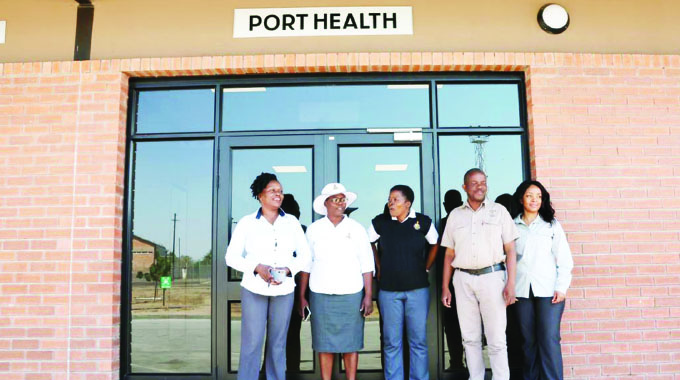
Thupeyo Muleya
Beitbridge Bureau
The completion of a state-of-the-art port health facility at Beitbridge Border Post has marked a major milestone in the country’s efforts to protect its citizens and visitors from the threat of infectious diseases.
Through a Public Private Partnership (PPP) project worth US$300 million, the Government and the Zimborders Consortium completed the construction of a new port health complex within the private vehicles and pedestrian terminal.
Port health services are facilities provided at ports of entry, such as airports, seaports, and land borders, to prevent the spread of communicable diseases and protect public health.
These services may include, health screening of travellers, vaccination and medication administration, disease surveillance and monitoring, inspection of food, water, and sanitation facilities, vector control measures (for example, mosquito control), health education and promotion and emergency response and preparedness.
Beitbridge now has three terminals dedicated to commercial, buses, pedestrians and private vehicles.
With its cutting-edge equipment, advanced diagnostic capabilities, and team of expert medical professionals, the facility has become a beacon of excellence in health security.
Before construction of the facility, public health officials and grieving families bringing in bodies for burial by road from South Africa had to endure a hard time, with the inspection of and the completion of processes being done in the open just outside a makeshift container.
Ideally, bodies of the deceased should have a special inspection facility and be treated in a dignified manner.
The complex also has offices of the Registrar-General that offer related births and deaths services on a 24-hour basis.
For decades, however, this had become an elusive dream at Beitbridge Border Post, a nexus for regional and international trade which sees through over seven million travellers annually until the coming in of the Second Republic that gave the border post a facelift.
Travellers that pass through Beitbridge are usually from countries north of the Zambezi River including Malawi, Tanzania, DRC, Zambia and Angola among others.
An average of 100 bodies of Zimbabweans dying of various causes in South Africa are arriving for burial in the country weekly through Beitbridge Border Post.
Beitbridge Port Health Officer, Ms Silibiziso Nkala confirmed this during a recent media tour of the port of entry sponsored by the Zimbabwe Revenue Authority (ZIMRA) for Southern Region Journalists.
Most bodies, she said, arrive on Fridays and Saturdays.
Ms Nkala said they had tightened screws to ensure people do not smuggle goods in and out of the country under the pretext of ferrying corpses for burial.
“We are happy with this new facility and we process documents for at least 100 Zimbabweans arriving for burial every week and a few others passing through in transit to other countries including Malawi, Mozambique and Zambia.
“On the export side, we process several bodies mainly of crew members or truck drivers who die during their journeys through Zimbabwe, but on a very low scale”.
She said the facility was also used to screen travellers for selected illnesses and offer health education guided by several public health protocols.
Besides the Ministry of Health and Child Care clearance for repatriating remains of Zimbabweans, a birth certificate or national identification documents of the deceased are needed at the consulate for documentation.
The goal of port health services is to prevent the introduction and spread of infectious diseases, such as Covid-19, Ebola, and yellow fever, and to ensure that travellers are aware of health risks associated with their destination and take necessary precautions.
“Apart from inspecting human remains, we carry out other services which include, conducting health screenings, such as temperature checks and medical evaluations, providing health information and education to travellers, administering vaccinations and medications and food imports inspections among others” said Ms Nkala
“We now have a dedicated mine-laboratory, consultation and treatment rooms, medicine storage facilities, bodies inspections bay, isolation rooms for those with infectious diseases and we have more workers following the construction of a new staff village by the Government”.
“Previously, it would take us longer to complete all the processes because of limited resources. Now we are able to clear every client in less than 30 minutes. We now have 49 workers, up from eight before the Covid-19 pandemic,” she said.
The processing of bodies for burial in Zimbabwe, Ms Nkala said, had been made seamless through the introduction of the Electronic Single Window facility whereby funeral parlours pre-clear bodies before reaching the port of entry.
Upon arrival, they are only checked for compliance and the concept was introduced in 2022 as part of measures to enhance efficient clearance of legitimate traffic and trade facilitation at ports of entry.
The main objective of the ZESW is to improve trade facilitation and to achieve efficiency to boost revenue collection, enforcement of trade laws, social protection, and providing business intelligence to the Government.
A South Africa-based funeral service provider, Ms Vivian Nenhunzi, said they were excited by the completion of the port health complex.
“The introduction of pre-clearance systems and merging of services at the border and the construction of a port health complex was a smart move by the Government of Zimbabwe,” said Ms Nenhunzi.
“Under the new order, now we can do all the port health clearances a day before moving bodies and make payments online, and only go through compliance checks upon reaching the border. This is a compassionate move considering that most grieving families do not wish to go through the agony of delays at the border.”
Chairperson of the Inner City Funeral Directors Association of South Africa (IFDA-SA), Mr Nkosi Kwanike Nare, said the port health facility had enhanced the ease of doing business for most of their members.
The repatriation of the human remains had improved since the introduction of the online system, and the availability of the port health complex.
“We are so excited, this is wonderful, we have had hard times before, but now we are repatriating human remains with fewer hustles which we believe will be addressed soon. Thumbs up to all parties that were involved in the transformation of the Zimbabwean border post,” said Mr Nare.



 Online Reporter