

 Online Reporter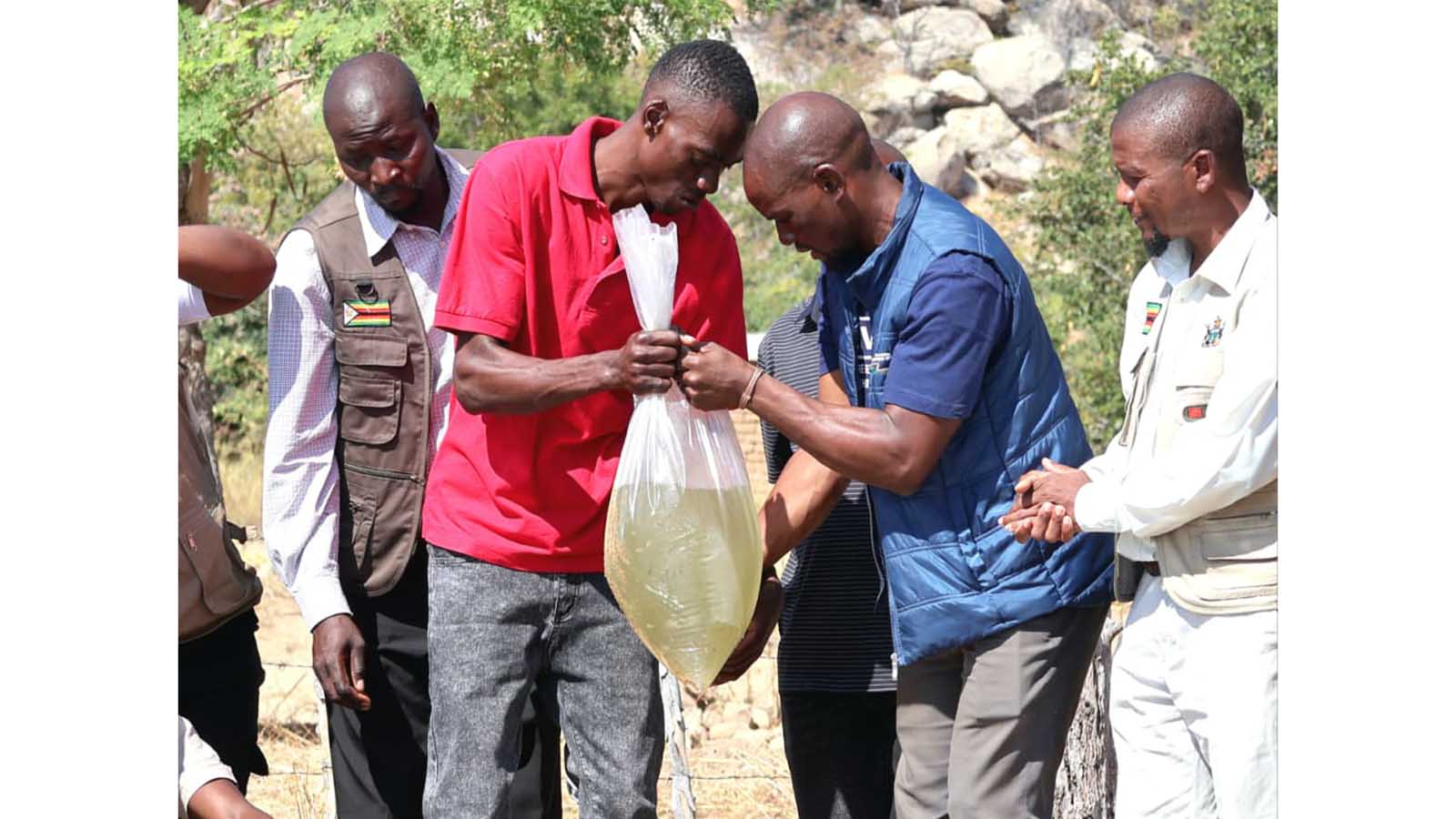
Theseus Mauruki Shambare in MUDZI
THE presidential Community Fisheries Scheme continues to gain momentum in Mudzi District, with farmers having stocked 32 000 fingerlings and harvested 3,6 tonnes of fish since the beginning of the year as Government intensifies efforts to promote aquaculture as a driver of food security, nutrition and rural economic transformation.
Under the Presidential Community Fisheries Scheme, farmers receive fingerlings for free, technical support in fish pond construction and management, and, where resources permit, assistance with borehole drilling to support year-round aquaculture production.
The latest milestone was marked at Mr Emmanuel Charehwa’s homestead in Muchero Village, Ward 5, where a newly constructed fish pond was stocked with 2 000 fingerlings during a fish stocking event attended by Government officials, traditional leaders and local farmers.
The fingerlings are expected to reach between 400 and 500 grammes each after six months, providing both a source of protein and income for the household.
Speaking during the event, Director of Livestock and Fisheries Production in the Ministry of Agriculture, Mechanisation and Water Resources Development, Mr Milton Makumbe, said aquaculture was becoming an increasingly important component of Zimbabwe’s Blue Economy agenda.
He said Mudzi District had established 94 fish ponds across several wards, with 32 000 fingerlings stocked and 3,6 tonnes of fish harvested since the start of the year.
“Through these efforts, a total of 32 000 fingerlings have been stocked, yielding 3,6 tonnes of harvest since the start of the year,” said Mr Makumbe.
“Even more encouraging is the growth in farmer participation, from 43 farmers last year to 71 farmers today.”
He said fish farming was helping communities build resilience while contributing to national food and nutrition security.
For Mr Charehwa, the venture represents a shift towards climate-smart agriculture and a new approach to utilising available water resources.
“We have been relying on producing small grains and horticulture,” said Mr Charehwa in an interview.
“However, due to climate change, we have been taught by our Agricultural Business Advisory Officers (ABAOs) how we can utilise underground water for fish farming.”
Mr Charehwa said the project seems to have potential to open a new pathway for income generation while improving household nutrition.
Ward 4 Agricultural Business Advisory Officer Mr Mark Tsabora, who has been driving the blue economy initiative beyond his ward, said fish farming was proving that rural communities no longer have to depend solely on rainfall for their livelihoods.
“Gone are the days when rural livelihoods were determined by rainfall patterns. Farmers can study their agro-ecological conditions and do what can thrive there,” he said.
“As you can see, we are stocking out of the traditional fish production season, but this is due to the conditions of the area.
“Our farmers are now investing in boreholes as the Government is encouraging taking agriculture as a business. We are targeting nutrition security as well as economic transformation from the household level up to the national level.
“This can only be achieved if farmers are equipped with knowledge of what can be produced and how it can be produced in their area.”
Mr Tsabora said the growing adoption of aquaculture demonstrated how communities could adapt to climate change by taking advantage of locally available resources and appropriate technologies.
In a move aimed at broadening participation in aquaculture, Mr Makumbe pledged support for the establishment of six additional fish ponds in Ward 5.
The ponds will be distributed among community groups and local institutions, with two earmarked for local schools, two for a women’s group and another two for a men’s group.
“As the department, we have committed ourselves to supporting the establishment of two ponds for the two local schools represented here today, two ponds for a women’s group and another two ponds for a men’s group,” said Mr Makumbe.
He said the initiative would help expand fish production while creating learning platforms for young people and empowering community groups to participate in income-generating aquaculture projects.
Mr Makumbe said the Government would continue supporting fish farmers through training, technical assistance and the Aquaculture Business School model, which is designed to transform aquaculture from a subsistence activity into a commercially viable enterprise.
He said the recently rebranded Livestock and Fisheries Production Department was working closely with Agricultural Business Advisory Officers to equip farmers with skills in fish production, value addition and processing.
“Continued expansion of the Presidential Community Fisheries Scheme must strengthen local fish production, create sustainable livelihoods and advance Zimbabwe’s broader Blue Economy vision,” said Mr Makumbe.


 Bongani Ndlovu