tawandamusarurwa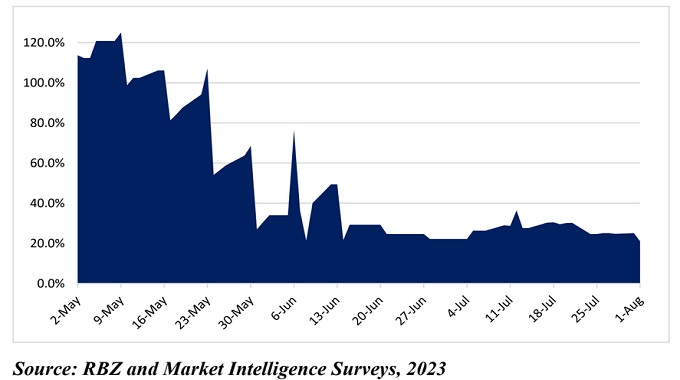
Golden Sibanda
Prices of goods and services will continue to fall this year, according to the Reserve Bank of Zimbabwe (RBZ), and this will be anchored by exchange rate stability following the cocktail of policy measures implemented by fiscal and monetary authorities since early May to rein in resurgent inflation.
This augurs well for Zimbabwe’s economic growth, which the Ministry of Finance and Economic Development has projected at 5,3 percent this year, driven by strong agriculture and mining output.
RBZ Governor Dr Mangudya said on Thursday the positive impact of policy interventions by the Government since May was now manifesting in a sharp decline in monthly inflation, which retreated by minus 15 percent in July.
Prices have been responding to the appreciating Zimbabwe dollar after policy interventions rolled out by the authorities.
When prices started rising in response to the weakening local currency, the Government directed that all import duties, except for luxury goods, be paid in the local currency.
It also demanded that 50 percent of corporate tax payable in foreign currency be settled in the domestic currency. The policy interventions were designed to strengthen demand for and use of the local currency in transacting.
In the same vein, the central bank hiked the bank policy rate, which benchmarks the minimum commercial bank lending interest rates, from 140 percent to 150 percent, to curtail speculative borrowing, which drives the creation of excess liquidity.
Treasury also transferred the obligation to service external public debt obligations from the central bank to the Ministry of Finance and Economic Development, in efforts to plug all loopholes that increase the creation of excess liquidity in the economy.
Addressing a team of journalists from the Southern African Development Community (SADC) who were invited by Information, Publicity and Broadcasting Services Minister Monica Mutsvangwa, to promote Brand Zimbabwe, Dr Mangudya said, in light of the prevailing stability, the bank expected August inflation to remain negative.
The central bank chief said the measures put in place by the Government were largely focused on restraining the growth of excess liquidity, which is used by economic agents to chase after US dollars on the parallel market, resultantly driving exchange rate volatility and inflation.
Zimbabwe uses a dual currency regime comprising US and Zimbabwe dollars, which will remain in place for the duration of the National Development Strategy 1 (2021-2025).
The country adopted the US dollar as a medium of exchange after scrapping the domestic unit in February 2009 due to hyperinflation.
Zeroing in on the current inflation developments, Dr Mangudya said the authorities expected inflation to continue to go down.
“Month-on-month inflation in July was minus 15,3 percent. We are expecting inflation in August to be minus again. We expect inflation in September to be a smaller minus and between 1 and 2 percent in November and December.
“That’s why the AfDB (African Development Bank) was saying that Zimbabwe is going to have the highest decrease of inflation in 2024 because we are coming from a higher base going to a lower base,” he said.
Zimbabwe’s inflation climbed to 175 percent in June 2023, when prices skyrocketed due to the steep depreciation of the Zimbabwe dollar against the greenback, before decelerating rapidly to 101,3 percent in July, following the raft of policy measures rolled out by the Government to halt local currency volatility.
“Because the base is very high in 2023, therefore, next year, inflation will be so low because you will be dividing a higher base into a lower base, so, it’s called the base effect in economics.
“Our anchor of inflation in this country is that we need to use open-market operations to ensure that we do not put extra money (liquidity) into the economy; that we remove it and we use non-negotiable certificates of deposits to mop up excess liquidity,” he said.
Dr Mangudya said excess liquidity was now being put into buckets of seven days, 14 days, and 30 days.
“What does it mean, it means when money is put into those buckets or instruments, you cannot take it. It means it stays with us (RBZ) and ,therefore, it removes (excess) money from the market, as a strategy to ensure that money does not chase foreign currency (US dollars on the parallel market).”
The central bank will also use its gold-backed digital tokens (GBDT), broken into milligram values to eliminate excess liquidity, which may be used to attack the domestic currency.
According to the central bank, the GBDT represents the digital form of the equivalent value of the physical gold reserves held by the central bank in its vaults.
The central bank chief said in Zimbabwe, exchange rate volatility was the “elephant in the room” for a dual currency economy that uses both Zimbabwe and US dollars for transacting.
He said historical factors relating to the hyperinflation in 2008 and currency reforms of 2019 resulted in the loss of value for depositors, which now causes Zimbabweans to prefer to hold the US dollar, a strong and stable currency used by many across the world as a reserve currency.
During the hyperinflation era, Zimbabwe’s annual inflation rate peaked at 208 percent at the last official count in August 2008, although the International Monetary Fund (IMF) puts the highest rate for the year way above that level.
The central bank chief said behavioural issues, informed by experiences of the traumatic hyperinflationary era, explained the discord between strong economic fundamentals and volatility of the domestic currency.
Zimbabwe’s economy has been growing over the last three years, 8,5 percent in 2021, and 6,5 percent in 2022, while growth is seen above 5,3 percent this year. The growth represents the fastest economic expansion in Africa and the rest of the world, Dr Mangudya said.
Last year, Zimbabwe achieved its highest-ever foreign currency inflows at US$11,8 billion and is firmly on track to repeat the feat.
Dr Mangudya said the country’s current account balance was positive while foreign currency deposits held by banks, at US$1,5 billion, were at their highest in the history of independent Zimbabwe.
In his 2023 Mid-Term Policy Statement, Finance and Economic Development Minister Professor Mthuli Ncube said domestic economic growth was forecast at 5,3 percent this year. He said ZimStat estimated the economy to have grown by 6,2 percent in the first quarter and 6,5 percent last year.
“The revised growth of 5,3 percent is on account of strong performance in agriculture (9,7 percent), ICT (4,9 percent), accommodation and food services (20,5 percent), as well as substantial improvements in the electricity supply situation, following the successful commercialisation of Hwange units 7 and 8,” he said.
Agriculture, initially projected to grow at 4 percent in 2023, is now expected to expand by 9,7 percent.
“The total production, excluding the winter crop, is estimated at 2,6 million tonnes for 2023, 40 percent above the production levels achieved last year,” Minister Ncube said.
“Overall, growth in the mining sector during 2023 is now projected at 4,8 percent, benefitting from increases in the production of lithium, chrome, diamonds and PGMs (platinum group metals).”
Growth in manufacturing is projected at 2,2 percent, Minister Ncube said.


 Online Reporter