Online Reporter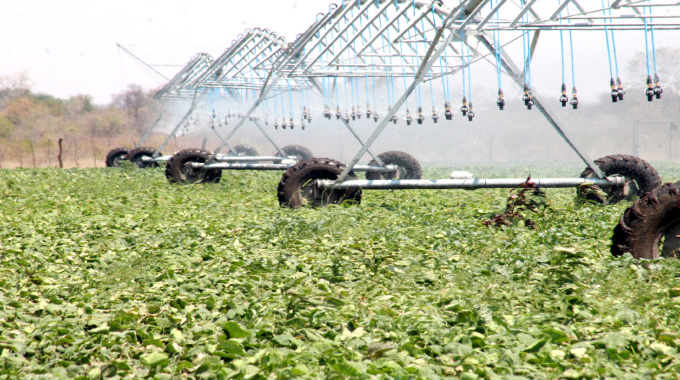
Tapiwanashe Mangwiro, Zimpapers Business Hub
IN a decisive move to climate-proof Zimbabwe’s agricultural sector, the Minister of Finance, Economic Development and Investment Promotion, Professor Mthuli Ncube, announced a landmark decision to have the 2026 national budget pivot on a major private-sector-led irrigation expansion, targeting an ambitious 25 000 hectares of new capacity.
This strategic commitment aims to reduce the country’s dependence on increasingly erratic rainfall, transforming food security from a vulnerability to a resilient strength.
Presenting the budget last month, Minister Ncube said the irrigation and water harvesting agenda remained fundamental to Zimbabwe’s long-term food and income security.
He reported: “The ongoing efforts to rehabilitate and expand irrigation schemes across the country are vital for building climate resilience and improving food and income security in vulnerable communities.”
The Minister highlighted progress achieved so far, noting that during the year 2025, a total of 13 016 hectares was achieved, with the Government and development partners contributing 2 025 hectares and the private sector, through the Irrigation Development Alliance, contributing 10 876 hectares.
However, Minister Ncube cautioned that significant gaps remained among communal and small-scale farmers who still depend on rainfall.
He warned: “There are some small-scale farmers who are still relying on rain fed agriculture practices and are also facing numerous challenges emanating from the adverse effects of climate change.”
The Treasury chief added that the scope of investment needed for irrigation was beyond their means.
“The development of irrigation facilities for use by small-scale farmers requires some level of investment, which exceeds their capacity to support themselves,” he said.
Against this background, the Minister positioned 2026 as a decisive year for transforming agriculture away from climate vulnerability. He said the budget would actively pursue growth in water infrastructure in drought-prone areas.
“The 2026 budget will pursue measures aimed at up-scaling irrigation and water harvesting infrastructure development in semi-arid regions to reduce dependence on erratic rainfall and enhance all-year-round agricultural productivity,” he said.
To support this plan, the Minister allocated substantial resources.
“The budget is setting aside ZiG823,9 million towards irrigation development, with priority being given to ongoing irrigation schemes, at the same time ensuring that the irrigation models being implemented are sustainable,” he announced.
Minister Ncube further outlined additional areas of focus in the 2026 programme, explaining that the budget would support operation and maintenance critical for maximising efficiency of existing irrigation infrastructure during dry periods and introduce co-funding of irrigation projects with development partners, leveraging climate finance mechanisms and green bonds.
The Government will also channel resources towards upgrading our facilities for research and technology development at ZITC and Fels Farm, focusing on climate-smart irrigation technologies, drought-resistant crop varieties and water-efficient farming systems. He added that capacity development remained a priority.
“The budget will strengthen the irrigation department by prioritising training in climate risk assessment, water resource forecasting and adaptive irrigation management,” he added.
He also reaffirmed the Government’s policy direction on water use efficiency, stating that authorities would continue to give priority to water-efficient irrigation systems (drip, sprinkler) over flood irrigation, alongside integrating weather forecasting into irrigation planning and developing schemes linked to major dams for multi-year drought resilience.
Minister Ncube said: “Through Rida, the Government will concentrate on supporting surveying, designing, construction of small earth dams, construction of canals, as well as laying out of laterals for village irrigation schemes in our communities.”
He concluded: “The private sector will be incentivised to develop a total of 25 000 hectares.”
Agronomist Ms Pamela Macheka said the 25 000 hectare private sector target could significantly strengthen Zimbabwe’s resilience against prolonged drought spells.
She noted that the Minister’s commitment to water-efficient technologies and climate-smart systems reflects the reality that the country’s rainfall patterns are increasingly unpredictable.
Ms Macheka said, “Irrigation expansion provides a lifeline for small-scale farmers who cannot continue depending on rainfall that has become unreliable.”
She added that all-year cropping enabled by irrigation brings stability to households and improves food availability even during climate shocks.
“The private sector’s involvement is essential because the scale of infrastructure needed goes far beyond what public resources alone can deliver,” she said.
Ms Macheka emphasised that modern systems, especially drip irrigation, ensure every litre of water is used productively, an imperative in arid and semi-arid regions.
Economic analyst Mr Namatai Maeresera said the incentives outlined by the Minister represent a structured economic intervention aimed at stabilising agricultural output and strengthening food security.
He noted that assured water supply is the foundation of predictable production, which benefits manufacturers, agro-exporters and food processors.
Mr Maeresera said the 25 000 hectare target provides a strong signal to investors that the Government is committed to climate-proofing the agricultural sector.
“It reduces weather-related risk, which in turn improves investor confidence. When output becomes more predictable, industries reliant on agricultural inputs can plan ahead, secure contracts and maintain stable pricing,” he said.
He added that irrigation infrastructure also stimulates rural growth by encouraging out-grower schemes, contract farming arrangements and agro-industrial investment.
“The multiplier effects are large. Once the private sector is incentivised at this scale, you get improved land values, better financing conditions and stronger local economies,” he said.
Mr Maeresera said the national food security benefits are equally important. With more countries in the region experiencing drought cycles, Zimbabwe’s ability to maintain production through irrigation protects the economy from import pressures and price volatility.
He noted that the Minister’s proposals, if fully implemented, position the country for long-term resilience in an era of climate uncertainty.