malvernmugadzikwa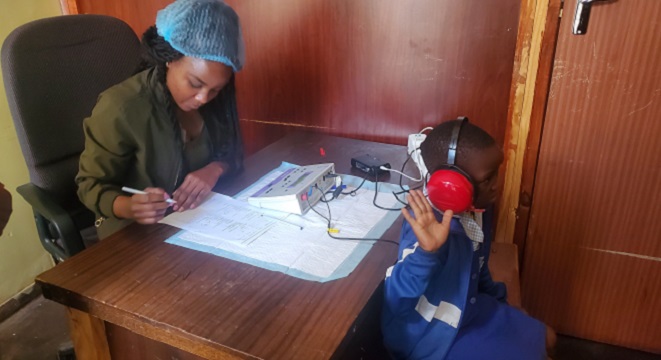
Theseus Shambare
TAKUNDA Mutero (36) nearly lost his life when a car veered off the road and almost ran over him at the Harare-Murehwa turn-off in Musami following a tyre burst.
Apparently, the hearing aids he was wearing had low sound detection, which made it impossible for him to discern the lurking danger from the out-of-control vehicle.
“I nearly got hit by a car after one of its tyres burst. It veered off the road and headed towards me from behind. I was wearing my hearing aids, but I failed to hear anything. I could have been killed that day. Luckily, the car missed me,” he said.
Mutero, who was hard of hearing, had engaged in self-diagnosis and bought himself the hearing aids — electronic devices worn by people with hearing impairment to amplify sound.

He later got the shock of his life.
“Later on, doctors told me that there was a build-up of earwax that was blocking my ear canal, giving temporary hearing loss and discomfort.
“They cleaned it and discovered that the over-the-counter hearing aids were now piercing my ear. The fluid that was flowing from the wound was also accumulating in the ear and blocking my hearing,” he said.
After cleaning, his hearing was restored.
He no longer needed the device.
Experts say one needs to be medically examined in order to get a prescription for a suitable gadget for hearing.
Mutero’s situation is, however, not isolated.
Reports show that there is a huge increase in the number of people who are buying over-the-counter hearing aids in pharmacies around the country.
Some are even resorting to purchasing the gadgets online.
But most of the purchases are worryingly being done without consulting medical specialists.
“Some of the devices may be defective and harmful to them. As directed in Section 3 (13)(4) of the National Disability Policy of Zimbabwe (2021), hearing aids must not be randomly given, but they must be prescribed on the basis of audiological assessments by qualified audiological technicians who are registered with the Health Professions Council. Such a practice can create more health problems or further disabilities,” said the director of disability affairs in the Ministry of Public Service, Labour and Social Welfare, Dr Christine Peta.
Harare-based audiologist Ms Tinashe Nhokwara said hearing aids are not one-size-fits-all gadgets.
“Our ears are of different sizes and so is the level of hearing impairment. While over-the-counter devices may help many people with mild or moderate hearing loss, they might not be appropriate for all types of hearing losses,” warned Ms Nhokwara.
“We have four classes of these impairments. Those who may be scientifically referred to as deaf would be those that have a profound hearing impairment, and these use sign language as a mode of communication and have no need of using hearing aids.
“In cases of severe or profound hearing loss, one needs to see an audiologist for a full examination.
“While a prescription for hearing aids can be individually fine-tuned and fitted, people prefer over-the-counter aids and have to rely on generic sizes that cannot be altered.”
Self-prescribing hearing aids is considered risky as some might result in hearing loss or even damage to the ear.
Causes of hearing loss
Ms Amanda Mukonoweshuro, who is attached to the Department of Primary Health Care Sciences at the University of Zimbabwe, said knowing the causes of hearing loss in each individual is crucial for prescribing remedies.
“Hearing loss could be a symptom of an underlying condition that requires evaluation. A number of conditions can cause hearing loss. People often cannot tell the cause of hearing loss without undergoing an evaluation,” she said.
Causes of hearing impairment, she added, include heredity, age, noise, medication, middle-ear infections and diseases such as meningitis and jaundice.
Children born prematurely are also at a high risk of developing hearing loss.
“So, even if you benefit from a hearing aid, you should see your doctor if you have symptoms like ear pain, dizziness, hearing loss in only one ear or ringing in the ear, which could represent a condition other than just simple hearing loss,” she said.
“The safest bet is to get a hearing test to confirm your type of hearing loss to ensure that hearing aids are an option for you.”
Experts say people with normal hearing can detect sounds less than 25 decibels (dB).
Mild to moderate hearing loss is in the 26dB to 55dB range.
Costs
A snap survey by The Sunday Mail Society showed that hearing aids cost from as low as US$6 to as high as US$100 depending on the quality and market.
However, one would need to part with US$1 800 to US$2 000 for prescription hearing aids.
There are no companies that manufacture hearing aids in Zimbabwe, a situation that forces people to import the devices from South Africa, Germany and India.
The gadgets are then fitted with locally manufactured and custom earmolds, which is the part of the hearing aid that fits inside the ear.
In Zimbabwe, it is reported that approximately 38 000 people have hearing problems, with 5 percent being under the age of 18.
According to the World Health Organisation (WHO), one out of four adolescents are at risk of having hearing impairment by 2030, with fears that the number may reach 1,1 billion globally.
The Ministry of Public Service, Labour and Social Welfare has partnered WizEar Trust Zimbabwe to offer free hearing health services countrywide, including marginalised communities.
WizEar is a private voluntary organisation that manufactures and distributes hearing aids through the Hear The World Foundation and World Wide Hearing.
The initiative is targeting to provide free hearing services to 1 200 people with hearing impairments countrywide under Phase One, which is expected to end in 2024.
“We are happy and proud that with these partnerships, we are able to close the gap,” said Dr Peta.
WizEar programmes director Mrs Lucia Nkomo praised the Government for supporting the initiative.
“We appreciate the great support we are getting from Government and the President — through our collaboration with the Department of Disability Affairs.
“However, our concern is on the selling of hearing aids. We need the Government’s support on this one. There are dangers associated with this.”
According to Mrs Nkomo, fitting of the gadgets is a delicate process that involves different specialists such as audiologists, hearing aid technicians and acousticians.


 Online Reporter