Chronicle Editor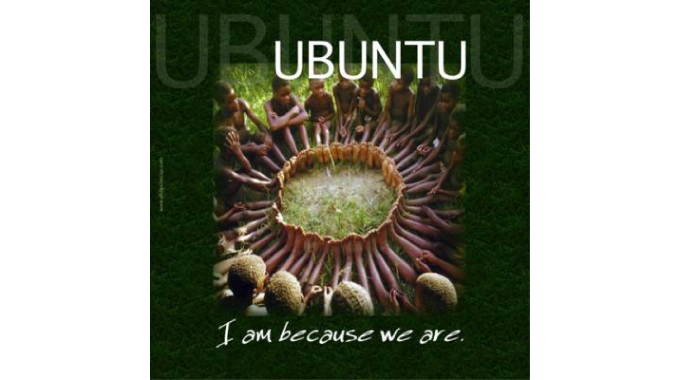
UBUNTU is a philosophy of life that pervades, embraces and spans the whole of black Africa. The term may be of Nguni origin and yet it applies even where Nguni is not the spoken language. Through observations and lived experiences, humankind develops hypotheses that over time become proven theories that guide and inform ways of life.
In my long lasting literary endeavours, I commenced the joyous and yet arduous journey by describing cultural practices such as burials, weddings, bringing home ceremonies (umbuyiso) and the rites of passage. I confined myself to the Ndebele communities before venturing to other ethnic groups in Zimbabwe. I accumulated a vast corpus of knowledge. Over the years, I began feeling some sense of inadequacy. Something was missing. My narratives dealt more with answering the questions, what, how and when?
The missing question was why? I would, after many years of literary toils, get to a point where I realized that people do what they do with reference to their beliefs. For example, they build, as they believe. They sculpt and pot, as they believe. It was becoming clear to me that behind cultural practices there was some more fundamental cultural essence, something that underpinned, guided and informed communities as they went about engaging in cultural practices.
I would also learn that confining ourselves to cultural practices limited and handicapped our understanding and appreciation of African culture. What we see and deal with is undressed, unclothed or nude culture. The tragedy is that those who do not have a strong understanding and appreciation of what drives, informs shapes, directs and determines the complexion and anatomy of cultural practices will not take kindly to what they do not understand.
In the end, they will trash, rubbish and attach some unwarranted, undeserved and uncalled for negative mouthing about what they do not understand. In most instances, such people work from a viewpoint and premise that their ancestors were not educated. What they mean by that is that their ancestors did not attend western schools where western education was imbibed.
What is not western, in their view, cannot constitute knowledge. Knowledge, from their perspective is acquired through five senses. This is not the case in Africa where there is recognition of the existence of extra-sensory cognition.
This awakening in me saw my enquiries into the arts, culture and heritage take on a new trajectory. I was no longer content with the mundane and the routine. I was no longer deriving joy, satisfaction and gratification from dreary and lackluster accounts of cultural practices and historical narratives. I was headed towards meaningful and evocative expressions that underpinned and informed the cultural practices that I had been dealing with for several decades.

Unpacking and excavating the essence of culture was a source of joy, satisfaction and contentment. A newfound pursuit added a new dimension to my perpetual search for the African past and identity. Knowledge accumulates in a spiral rather than a linear form. One who keeps his mind busy never stagnates. Rather, one scales new heights of accumulated knowledge and ideas only to discover there are more alluring vistas awaiting exploration, analysis and interpretation. In the process, one realizes it is time to move on and leave behind one’s comfort zone. Knowledge acquisition has no limits or boundaries. A mind is elastic, pliant and pliable.
While I have not abandoned the essence and substance of culture, I see a new field emerging and beckoning from the blue horizon. Cultural essence just cannot be the alpha and the omega of culture that we tend to take for granted. This is particularly so when it comes to African culture that is taken for granted and regarded as simplistic, unsophisticated and narrow. I hold a different view following my long stint dealing with matters cultural.
I came to the realisation that the cosmos was important as the source of a bigger part of the African cultural landscape. I saw some cosmic stamp on many aspects of African culture, from architecture, performances and indeed, the crafts. At the Kalulu Kreativez Cultural Centre in Lusaka, I had a rare opportunity to scrutinize, document and interpret a wide range of paintings, crafts and ‘curios.’
Cosmic fingerprints were everywhere for me to sample. I likened myself to a creature that suddenly developed wings. With the newfound contraptions, I began to soar high and get a bird’s eye view of African cultural practices. “As above, so below.” Up above, were cosmic bodies; the stars, planets, and moons.
I gazed these and saw they were beautiful and eternal. Did I not coin an adage, “Individuals perish. Humanity is forever?” I was beginning to interrogate issues relating to eternity, continuity, perpetuity and endlessness. I could not seek an informed dissection of the issues without reference to the cosmos. I initiated a new writing series, “Journey to the Stars.” It was not a physical journey. Instead, it was a cognitive and symbolic journey to understand the nature of citizens of heaven and their behaviour that influence terrestrial cultural practices.
That inquiry saw me excavating African Cultural astronomy. Who are in heaven and how do they relate to the citizens on earth? For the past sixty-two weeks now, I have been churning out articles whose import has been to search for some indication of how African communities perceive the heavens and how they seek to replicate the cosmic traits on earth.
I was in a vantage position to view the two realms, one for the living and the other for the living dead and the ancestral spirits. It occurred to me that the two worlds were somewhat linked. I could not help inferring that once upon some ancient times, the two were one. Unity between heaven and earth existed. The unified world later experienced centrifugal forces. In the end, there was some circumscribed divorce. It was circumscribed and partial in the sense that there continued to exist linkages and relatedness between the two. I am yet to grapple with the nature of the partial divorce.
It occurred to me that the senior citizens who called the tune after paying the piper were those in the cosmos, the heaven. The inferior and lesser citizens were resident on the planet. The hegemonic hold on earthly citizens led to them seeking to replicate the ways of heaven on earth. The much hyped African adage, “As above, so below,” captures the essence of the relationship that is informed by the modified and moderately mutilated marriage.
I observed this continuing relationship and sought its architecture and anatomy. Citizens on earth are probably right to seek replication of heavenly reality on earth with its characteristics and traits. Citizens on earth have stomachs that must be filled with food. That food is manufactured in green factories known as leaves of grasses and plants. The magical green matter called chlorophyll traps the energy from the sun, in the form of light. That energy is stored in several forms: grain, tubers, fruits, roots, inter alia.
The stored energy is what matters. However, energy is not easy to handle or domesticate. It mutates or transforms from one form to another. All we can do is to transform and domesticate it in a form best suited for the task. It is indestructible. Things tangible are required to deal with energy. This has been a new chapter in my continuing search for natural phenomena in this world and beyond.
The take home deliverables have been the realization that energy has power over things material. Like spirituality, it is eternal and has power of things tangible. The two are linked and are phenomena that span and embrace and span the cosmos and the earth below. This new and crystalizing idea takes me to the stage where I am poised to deal more effectively, more sustainably and more meaningfully with Ancient African Science (AAS). Some readers of this column may recall I almost made a false start in the study of so-called witchcraft.
Then I was not philosophically mature enough, nor grounded enough to deal with the subject that is maligned and yet not fully grasped. I had erroneously assumed there was a stand-alone field of study called witchcraft. I am now of the opinion there is no such. Instead, there is a whole broad field that I have named Ancient African Science. The Egyptian Book of the Dead shares common ideas and forms of knowledge with. AAS subscribes to the view and notion that even the traditional healers are drawing knowledge and professional skills from the same field that has clear rules, principles and laws that are the same as those existing in Physics and Chemistry.

I have covered a lot of ground in terms of rendering African cultural astronomy a worthwhile endeavour targeting the understanding, nature and operations of the cosmos. In all my research, I render an unapologetically Afrocentric approach and perspective. Equipped with some ideas regarding the two worlds, I am in a position to isolate commonalities that link and relate the two realms, one to the other.
It would be the opportune time to commence the inquiry into the exciting world of witchcraft. This will be more so that the University of Zambia (Unza) was not given a grant by Unesco to study the phenomenon that has a wide range of ramifications on the lives of Africans. I had been misled into believing that Unza had received some grant to tackle the subject. It was not true. Dr Gankhanani had tried to embark upon the study of the scientific field but some Government minister would not brook that.
I posit that the social philosophy is informed by relatedness between the cosmos and the earth, the terrestrial and extraterrestrial realms. The cosmic bodies themselves display interrelatedness and they singly and severally relate to the earth.
In fact, it may be engaging in futility to think the earth is not part of the cosmos. If the earth is part of the cosmos that some prefer to call heaven, then we are living in heaven already. I do not wish to invite upon my head excommunication and ostracism. Africans learnt from the cosmos. Otherwise, they would not have embarked on the agenda to replicate the heavens on earth if they did not understand and appreciate the reasons for doing so.


 Online Reporter