Moffat Mungazi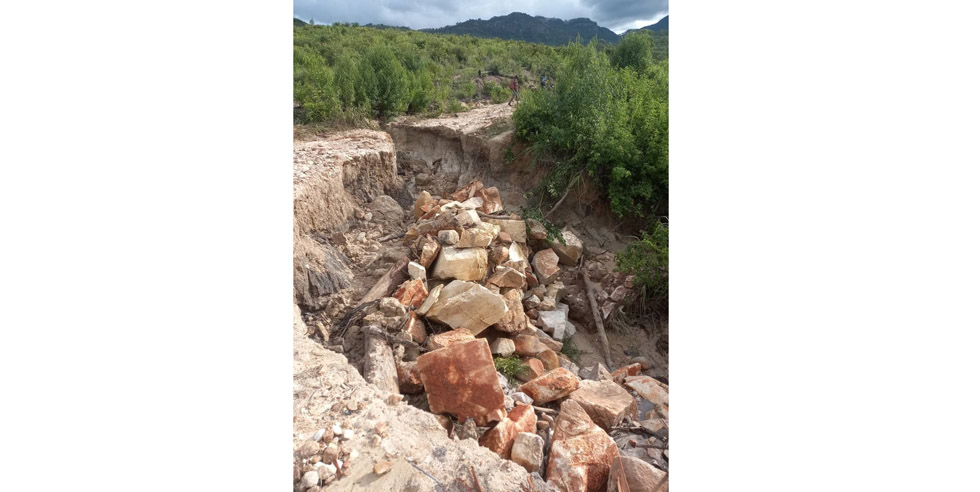
Tendai Gukutikwa
Post Reporter
AS Tadiwa Makolo stood poised at the water’s edge, the raging Nyamukwarara River stretched out before her like an impassable barrier, its churning waters a formidable foe.
The Grade Seven learner’s eyes welled up with tears as she clutched her school bag, the weight of her disappointment palpable.
Across the river, the path to her education – Nyamukwarara Primary School – beckoned, yet remained tantalisingly out of reach.
The rainy season has transformed the river into a relentless sentinel, guarding the village and holding its children hostage, denying them their fundamental right to learn.
The rain from the previous night had turned the already swollen river into a raging torrent, making it impossible for her to cross. Her heart sank as she realised that she would miss another day of school.
“I love school, but when the rains come, I know I will not be able to go for weeks because there is no bridge, and if we cross, we will be swept away. I do not know how I will pass my exams when I continue missing lessons.” she said, her voice barely above a whisper.
Every morning, she wakes up with hope, dons her uniform, and walks to the river’s edge, praying that the waters would have receded enough for her to cross.
Her story is not unique. It is the story of an entire community yearning to be reconnected.
Tadiwa is one of the 247 learners enrolled at Nyamukwarara Primary School, a satellite school under Stapleford Primary School in Mutasa District.
The school sits on the Zimbabwe-Mozambique border, in Nyamukwarara Village where the nearest proper road is a six-hour journey away.
When the rains come, Nyamukwarara is transformed into an island, cut off from the rest of the country by a flooded river with no bridge and impassable roads.
The absence of a bridge over Nyamukwarara River means that during the rainy season, children are unable to attend school. At times, the water level rises so high that attempting to cross will be fatal even for the tallest person.
In a phone interview on Tuesday, Nyamukwarara Primary School headmaster, Mr Amos Chimbo said lack of roads has also affected the school’s ability to receive necessary resources, including textbooks and teaching materials.
“There is no way that we can receive resources when there is no road and bridge. There was a time when we only had 21 learners at school because the rest could not cross the river as it was flooded. This is a common sight during the rainy season because the river will be flooded and it is risky for people to cross, much worse learners.
“It is heart-breaking because these children want to learn, but nature, coupled with lack of infrastructure stand in their way. Even as teachers, we face the same challenges. I have a meeting in Watsomba tomorrow, but I do not know how I will get there, other than walking 27 kilometres to Stapleford,” said Mr Chimbo.
Worse still, the local clinic, which serves the entire community, has no reliable supply of medicines.
“There is no way that our clinic can be adequately stocked with medicines when the road is this bad. Who will bring it and how?” he asked.
The villagers, who were resettled here after being displaced from various areas where they were illegally squatting, now find themselves isolated in their new home.
The challenges facing Nyamukwarara villagers are many, but chief among them, lack of infrastructure.
The only road leading to the village was rendered impassable after recent heavy rains, leaving the community of over 1 000 people completely isolated.
The only means of transport to the area is a single lorry, owned by a well-meaning businessman, who saw the plight of the people and decided to help. However, with the road now damaged beyond repair, even that lifeline has been severed.
“We are cut off from the rest of the world. When it rains, we are trapped. I have not been able to go sell my produce for two months now. The only way out is through Mozambique, and this means risking being arrested for illegal crossing or being overcharged at the border,” said Ms Rutendo Mhere, a mother of four who depends on selling bananas and yams at Sakubva Market in Mutare.
The proximity of the village to Mozambique has forced villagers to depend on the neighbouring country for supplies.
With no access to Zimbabwean markets, villagers are now selling their produce in Manica and Chimoio, where small pickup trucks and motorbikes are readily available to transport them from Nyamukwarara.
Another villager, Mr Joseph Thomas shared how the community’s isolation has affected their farming activities.
“This land is fertile. We grow tobacco, bananas and tomatoes, but this year, we might not even sell anything in Zimbabwe as the produce is already ripe. The safest and easiest way for us to travel to Mutare is to go through Manica and then cross back into Zimbabwe through Forbes Border Post because the road here is inaccessible.
“We end up selling our produce in Mozambique and come back home. It is like we belong more to Mozambique than Zimbabwe,” he said.
Representative for Ward 18 in Mutasa Rural District Council, Councillor Johan Mandiringana acknowledged the community’s struggles, and assured them that efforts are being made to address their plight.
“While the council is responsible for part of the road, the major part falls under the District Development Fund. However, roads cannot be maintained during the rainy season, otherwise we will worsen the damage. We know that there is an urgent need for this road to be rehabilitated. Right now, we are mobilising community members to come together and help maintain the road so that it becomes at least passable. As their councillor, I will support them with food as they work.”
He also acknowledged that due to poor road infrastructure, many villagers are unable to access Government aid programmes, including the Presidential inputs.
“The people have trouble accessing even Presidential inputs and programmes because of the poor road network, but Government is working tirelessly to ensure that people in Nyamukwarara are connected,” he added.
He said having a bridge over Nyamukwarara River and proper road rehabilitation will, not only connect the village to the rest of Zimbabwe, but also improve access to education, healthcare, and economic opportunities.
“The river is our biggest challenge. We need a bridge to connect us to the other side. We have been asking for help for years, but nothing seems to change.”



 Online Reporter