admin
adminFarayi Matondo
In commemorating our history, the power of our stories help Zimbabweans to teach the young and old about where we came from in order to shape our minds, mentoring the children and helping them learn useful concepts such as reading and writing.
Storytelling is a life force that connects human beings; “This is the Great Zimbabwe I know… I remember, the night vividly, the eve of total happiness, as all Zimbabweans welcomed a new baby state of Africa on that glorious independence night on April 18, 1980.”
Tears of joy, streamed down our jovial faces, our hearts vibrated with happiness and our emotions electrified as this signalled the birth of a new era. We all cheered, danced, burst into song and whistling as we waved our new tiny hand flags as the Union Jack was being lowered and the new flag rose to the joy of all present.
The liberation struggle we so hard fought for, culminated in the ‘death of colonialism and imperialism ‘in the then Rhodesia. Thousands were killed, maimed, displaced and tortured during the protracted war.
“Tomorrow we shall cease to be men and women of the past and become men and women of the future. It’s tomorrow then, not yesterday, which bears our destiny. As we become a new people we are called to be constructive, progressive and forever forward looking, for we cannot afford to be men of yesterday, backward-looking, retrogressive and destructive. Our new nation requires everyone of us to be a new man, with a new mind, a new heart and a new spirit. Our new mind must have a new vision and our new hearts a new love that spurns hate and a new spirit that must unite and not divide, “ said the then Prime Minister Cde Robert Mugabe, in his independence day speech in 1980.
I remember, the pounding vibrating sounds of The Wailers with Bob Marley chanting. . . Ooh Africa can liberate, Zimbabwe . . . Marley supported the struggles of African people through his music. This added to the glamour and the spirit of camaraderie which was strong amongst the crowd, I still remember thit and will cherish it for a long time to come.
I remember, 1980 to 1989 as the decade of pure transition of power from white racial domination, suppression and inequality, to equality and democracy. Democracy was indeed achieved, new nation building on its course. Our leaders strived in implementing reconciliation, Zimbabwe belonging to all races, despite atrocities, injustices, oppression and inhuman treatment to the marginalized majority blacks which had been the order of the day.
Reconstruction, finding our feet in motion, reconciliation and healing from the ill treatment received ever since the land scramble for Africa by European settlers in 1800s was the norm for the new Zimbabwe.
A lot of achievements, l acknowledge, restoration of human dignity through massive infrastructure development; sanitation, housing, expanding the education and training sector started to occur. Illiteracy levels were reduced, many professionals were trained and empowered out of vocational, technical training colleges.
A robust health system was rolled out by building of clinics in communities, districts and national hospitals across the country.
I remember, our agricultural economy, being the backbone of Southern Africa Development Community (SADC)region, labelled the ‘breadbasket of the continent’ mainly because of the abundance of the production of maize, sugarcane, tobacco, cotton and flowers. New industries flourished in turn. 1990 to 1999 was the decade of consolidation of the people’s power and emancipation of the majority. As a growing teenager, keen on acquiring knowledge, l posed questions to my father and friends such as; What is the role of The International Monetary Fund (IMF) and The World Bank? Why are the economic structural adjustment programmes a failure? Why were outsiders interested in our domestic issues? Why were economic sanctions imposed on our country?
I remember that at the end of the decade there was the beginning of mass actions, mass stay aways which were led by trade unionists. Spontaneous endless strikes and the commencement of a very large downturn of the economy.
The people’s revolution began with toy-toying for land heritage repossession which was started by the Svosve people. On the other hand, food shortages were then becoming a daily challenge.
People started to queue for basic foodstuffs such as cooking oil, bread, sugar, flour, rice and mealie meal, some could sleep on queues.
Our educated population left the country in huge numbers headed for Southern African countries, United Kingdom, America, Asian to mention but a few.
In the huge brain drain were nurses, doctors, teachers, engineers, musicians and artisans who deserted the motherland. The abnormality of economic chaos took its toll. Our fathers were retrenched and left jobless as our giant firms such as Mutare Board and Paper Mills and Karina closed their doors.
I remember the hype of the arrival of the new millennium, the coming of the solar eclipse in 2001 and the belief predictions of African elders that envisaged a bad omen of the eclipse as the ‘sun that had rotten’. I witnessed this rare spectacular view of afternoon and evening eclipse in Sakubva.
However, the 2000 to 2010 was a decade which l believed was characterized by political wars. ATMs were cashless, petrol stations ran dry and in fact our currency also fled the country. The detractors of the country dreamt of waking up one day and hearing that the country had collapsed, but unfortunately for them and fortunately for us life went on, Zimbabweans found a way as they have always done. A multi-currency regime is being used in country.
On July 21 2008, a Government of National Unity, was brokered by Mr Thabo Mbeki the then President of The Republic of South Africa. The ‘brothers’ united to rebuild a society free of violence, fear and intimidation. Leaders committed to end polarization, divisions and conflicts.
The supermarkets unexpectedly began to fill again with stock. The media reported that European sanctions were lifted. The Zimbabwe Agenda for Sustainable Social Economic Transformation (Zim-Asset) is here to empower society and help grow the economy.
The extraction of rich mineral resources in Chiadzwa diamonds fields, the Chisumbanje bio-fuel industrial projects, the resuscitation of the Zisco Steel firm, the Great Belt mineral resources particularly platinum, gold and iron ore should anchor economic growth.
President Robert Mugabe led a delegation to an historic signing of three landmark agreements; two memoranda of understanding will establish a positive bilateral trade, relations between South Africa and Zimbabwe to enhance development growth economically and socially.
Our stories help define who we are and where we are going as a nation. We indeed have come a long way since 1980.
This 35 years old — Great Zimbabwe is celebrating another milestone.
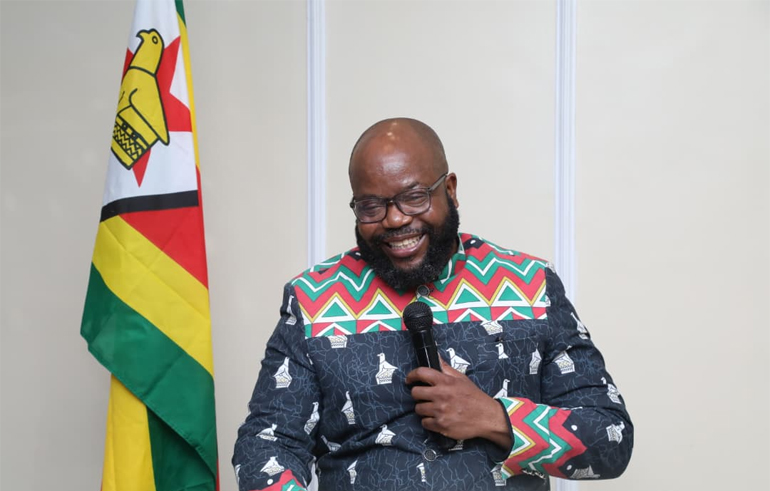
Farayi Matondo is a budding writer born in Sakubva township.


 Online Reporter