admin
admin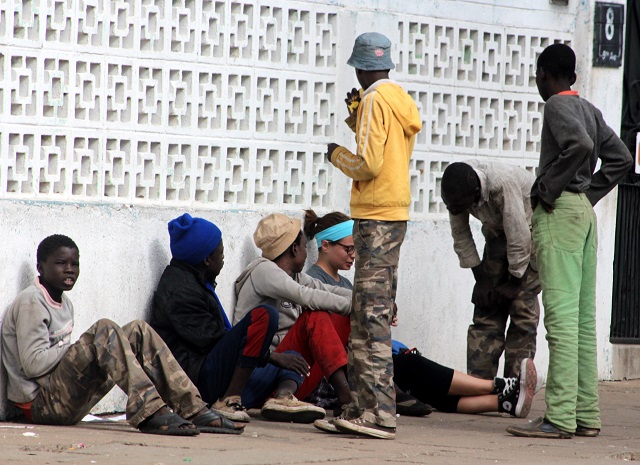
Obey Sibanda
SUNSET to the working class might mean a time to leave the office, go to the pub, home or any other place of interest, but for Mpoeng Ngulube, a street kid, it is the most terrifying time of the day.
Depending on the weather, he sleeps on the verandas or under the tunnel without warm blankets.
Wandering up and down the streets of Bulawayo with no place to call home has become a lifestyle for Mpoeng.
Born into a poor family, his father a gambler, mother visually impaired, all his childhood memories are sombre.
His two sisters, along with him at some point were cared for by relatives.
At the age of 15 he has never been inside a classroom but knows how many dust bins are in Bulawayo.
a�?I left home when I was 12 years old and came to the city with hopes of earning a better life on the streets. I hung around a�?cool kidsa�� (street kids) and they introduced me to alcohol and drugs. This was our way ofA� dealing with the pressures of being on the streets. Hunger, violence, pain a�� you name it,a�? he said.
He has learnt street survival skills. To get food from rubbish bins and snacks out of discarded food scavenged from inside is a craft.
The order of the day is that people walk past ignoring him a�� since he is none of their business anyway..
It is no surprise that he is mostly shunned by women. They dona��t even look at him twice.
a�?The majority of women dona��t dare glance in my direction or make eye contact. They fear violent tendencies associated with us,a�? he said.
There is also need for one to earn money other than raiding dust bins the whole day. He, like others, resorts to piece jobs.
a�?At times I make money washing or guarding cars at car parks. The money is enough to buy stale bread and milk,a�? he said.
Stale bread is bought at bakeries as left overs from the previous production day. It is sold at half price.
Mpoenga��s case is not an isolated one but a graphic indication of many children living in the street.
Mandlenkosi Dube is the director ofA� Hope For Children a�� a non-governmental organisation that deals with street kids. He said without organisations like his, there would be more street kids out there.
a�?Without help from organisations, street-children are trapped in a cycle of poverty and neglect that only a few are able to escape,a�? he said.
Sniffing glue and petrol is a common way to dull hunger pains and blot out the violence they face on a daily basis.
According to studies, if street children grow up into adulthood, their chances of developing a stable life and family are low.
Without the skills and stability that come from a normal childhood, finding and keeping jobs is extremely difficult; as such, for a lot of former street children, a life of poverty awaits.
Most of these street children, when they grow up leave the street and join scores of destitutes in infamous settlements such as Ngozi Mine near Richmond in Bulawayo.
These squatters too dona��t have proper accommodation or jobs. They spend the day on empty stomachs.
Like street children, squatters do not have proper documents, which makes them lesser citizens.
Richard Sibanda and his wife Servy Ncube of Ngozi Mine failed to bury their daughter in time because they had no proper documents. This is a couple made up of two former street kids.
a�?Our baby died on May 13, we approached the police for a burial order but we were denied. The police told us to produce the childa��s birth certificate but we couldna��t as we hadna��t obtained it for her.
a�?We also dona��t have identity cards. I lost mine and my wife has never had one. We were told to approach the Registrar Generala��s offices before we were given a go ahead to bury the child,a�? said Sibanda.
Sibanda and his wife said getting identification particulars had not been a priority for them but they realised its importance after the death of the child.
Although Zimbabwe joined other African countries in celebrating Africa day on Wednesday, street children and the destitute have nothing to celebrate during the annual celebrations.
This year the holiday is honoured under the theme: a�?Building a better Africa and a Better World.a�?
African Freedom Day as it was formerly known was founded in 1963 during the first conference of Independent African States which attracted African leaders and political activists.
Only six countries observe Africa Day as a public holiday. The countries are Zimbabwe, Ghana, Mali, Namibia, Zambia and Lesotho.



 Online Reporter