tawandamusarurwa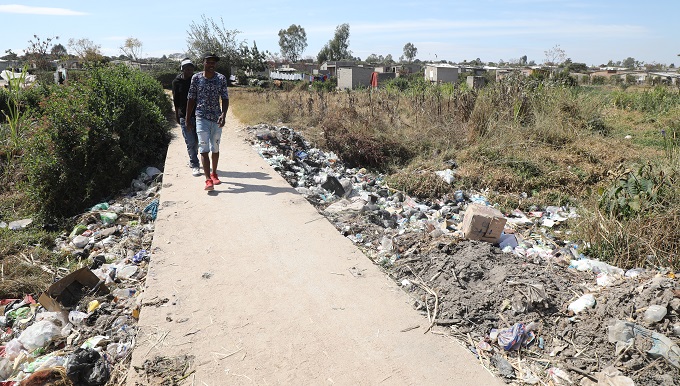
. . . EMA tasked to clear mess
Theseus Shambare
DOMBORAMWARI, Domboremaziso, Balancing Rocks and Quarry Dam — also known as the Pool of Death — complete the picturesque landscape that Epworth is known for.
The dormitory town, which is less than 20 kilometres east of the Harare Central Business District (CBD), has been developing in leaps and bounds over the recent past.
Without doubt, the former shanty suburb has been transformed into a respectable neighbourhood. Roads have been resurfaced, modern market stalls set up, and clinics and schools built.
However, the pleasant development will come to naught if heaps of uncollected refuse continue to pile up.
A foul stench greets you as you pass the iconic Balancing Rocks.
The rocks, which are a national monument and tourist attraction, have been partly obscured by mountains of uncollected waste.
Domboramwari, loosely translated as God’s Rock, is a top attraction in Harare.
Legend has it that one day, God loved Zimbabwe so much that he physically walked on a rock on the outskirts of what is now Harare, while the stone was in its semi-solid state, leaving behind imprints of his footsteps.
He is also said to have carved out a rough map of Zimbabwe on the rock, adjacent to His footprints, and the two features remain as a reminder of the event, according to the tale. Such myths and attractions naturally draw visitors.
However, some misguided elements are fast turning the area into an eyesore through reckless dumping of garbage.
The Quarry Dam (Pool of Death) is also under siege, as some residents have turned it into a dumpsite for all sorts of trash, including diapers and household waste.
The man-made dam is a recreational area — where some youths swim, especially during the summer season — while others use it as a source of water for different purposes.
Jacha River — which flows into three major locations of Epworth, namely, Overspill, Makomo and Domboramwari — has since dried up due to heavy litter deposits.
In fact, one can hardly notice it was a waterway due to the loads of waste.
Blame
Veronica Kamuteyo (49) expressed disappointment over the mess and blamed the Epworth Local Board for the situation.
“This is all due to poor service delivery. The local board used to send its tractors and garbage trucks to collect refuse at Solani Shops. This is actually a central collection point in our area.
“But they have since stopped, forcing business owners to block us from placing our garbage at the collection point since it was now piling up, uncollected,” revealed Kamuteyo.
Some residents, she added, have now resorted to dumping garbage in the Pool of Death. But the move has become a source of acrimony as residents who reside close to the area are against the idea.
Fumed Tawanda Simbarashe: “Our houses are close to this dam. People frequently come and throw all sorts of waste here, which creates health problems for us.
“We try to stop them but some are coming during the night. Each morning, we wake up to see ‘fresh’ heaps of dumped litter.”
It gets worse!
According to Mai John, the rubbish dump includes dead animals like dogs and, in rare instances, human bodies.
“This area has literally become a mortuary of some sort. It is not uncommon to find dead dogs. But some months ago, we woke up to find the body of a man in a sack. Nobody knew how long it had been there,” said Mai John.
When contacted for comment, Epworth Local Board secretary Dr Wilton Mhanda said he could not respond to questions posed to him as he was attending a funeral.
Crisis
Uncollected refuse has become a challenge in most parts of Harare.
President Mnangagwa recently declared a “state of disaster” in four Harare Metropolitan local authorities — Harare City Council; as well as Chitungwiza, Ruwa and Epworth town councils — due to their failure to collect and dispose of waste.
Mounds of rubbish are becoming an ugly sight at most shopping centres and in residential areas.
Resultantly, the Environmental Management Agency (EMA) was mandated to manage refuse collection and waste management within the Harare Metropolitan province, under the recently gazetted Statutory Instrument (SI) 140 of 2023.
Addressing the media after a Cabinet briefing last week, Environment, Climate, Tourism and Hospitality Industry Minister Mangaliso Ndhlovu said funds from Treasury would mainly be used by EMA to coordinate the clearance of dumpsites across the province.
“The ministry, through EMA, will not hesitate to apply provisions of the law on all offenders, both at the individual and institutional levels.
The immediate goal is to make Harare Metropolitan province clean through clearing waste dumps and ensuring sustainable waste management, going forward,” he said.
Combined Epworth Original Residents Development Trust spokesperson Mr Tendai Sitole notes this could be a solution.
“We are witnessing illegal dumping — which, on its own — is a crime. However, the local authorities have turned a deaf ear to us whenever we try to engage them. Our hope is now on EMA to bring sanity to our area,” said Mr Sitole.
Harare Residents Trust director Mr Precious Shumba weighed in.
“This will certainly enhance service delivery. The move was long overdue. The City of Harare has dismally failed to execute its waste management mandate.
“The policymakers and senior bureaucrats have wasted resources on unfruitful workshops, often outside Harare, where they are paid huge allowances, fuel and other benefits while the council’s bloated workforce is not paid on time and refuse is not being collected in the residential, industrial and Central Business District areas,” said Mr Shumba.
He added that EMA should help build the capacity of the City of Harare’s waste management division.
“The HRT proposes the establishment of waste transfer stations where residents can dispose their domestic generated waste and sorting of the waste can take place.
“That has the impact of employment creation and significant reduction of the waste to be conveyed to the Pomona Dumpsite for power generation,” said Mr Shumba.
Diapers, he said, are a necessity given the widespread shortages of water to wash nappies.
“What is needed is continuous education to the communities in partnership with private businesses and citizens,” said Mr Shumba.
Zimbabwe has an Integrated Solid Waste Management Plan, which envisages “a safe, secure and sustainable solid waste management system that (will) transform Zimbabwe into a clean, healthy and environmentally friendly country.
There are also many legal and policy frameworks relevant to plastic and waste management.
Health catastrophe
In Hopley, there is a popular bus stop named “Pamarara” (Garbage) because of heaps of uncollected waste at the site.
Similarly, one can be pardoned for mistaking Lusaka shops in Highfield for a dumpsite. In fact, residents in the area have since christened the place “Pomona”, equating it to Harare’s largest dumpsite.
Tichagarika Shopping Centre in Glen View, popularly known as PaTichaz, has for long suffered the effects of poor service delivery by the Harare City Council.
The situation is equally bad in the Harare CBD. Heaps of garbage have been piling up, particularly at bus termini like Copacabana and Market Square. Streets like Leopold Takawira and Bank (near Bata) are also filthy.
According to a United Nations Habitat survey conducted in 2021 titled “Waste Wise Cities Tool”, Harare generates 762 tonnes of refuse daily, but only 27 percent is collected and 2 percent is managed in controlled facilities, leaving the rest to flow into water bodies or remain on the streets.
In some instances, contamination of water bodies has often contributed to outbreaks of water-borne diseases such as typhoid and cholera, killing thousands.
The spilling of chemicals into water bodies also threatens livestock and aquatic life, as rivers and dams are connected.
Mazowe Rural District Council environmental technician Mr Mywonder Mombe is concerned about the situation.
“Any water body you see is directly linked to the underground storage (including boreholes) and that needs to be protected.
“Although we say soil is the greatest water purifier, the level of garbage concentration on uncountable illegal dumpsites
has reached alarming levels that are overwhelming the natural means,” warned Mr Mombe.
He described the intense use of disposable diapers as dangerous to water bodies and the environment in general.
“Diapers are non-biodegradable and are made from wood pulp and polyethylene plastics. It affects the aesthetic value of the environment. In Zimbabwe, the use of diapers is a total mess for the environment as the accumulation of this solid waste in dumping sites depletes the natural beauty of the environment.”
Medical and Dental Private Practitioners of Zimbabwe Association president Dr Johannes Marisa reckons uncollected garbage is a threat to human life.
“There are many diseases that can arise as a result of environmental and marine contamination. Cholera, typhoid, dysentery and hepatitis are examples.
“Garbage has a high tendency of blocking water bodies and natural flows, thus becoming unwanted breeding sources for vectors such as mosquitoes that are stubborn in malarial transmission. We pray for better service delivery to avert a health catastrophe,” said the public health specialist.



 Online Reporter