Online Reporter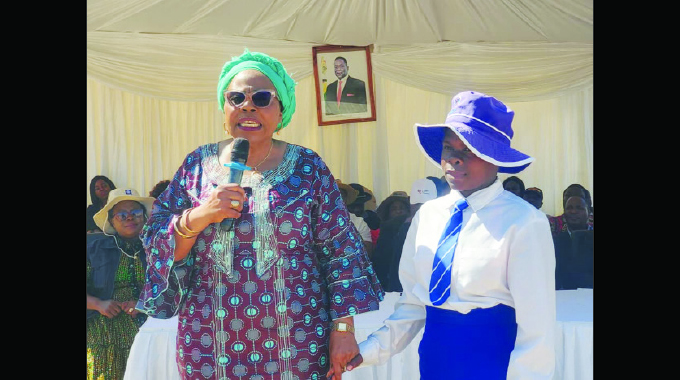
Theseus Shambare-Features Writer
Imagine fleeing your home. Fleeing from your sweetheart — the very person you once trusted — as he or she raises an axe, presses a flaming log against your skin, or hurls words and fists that cut deeper than wounds.
This is not a story from a warzone.
It is everyday life in Chindenga, a rural community in Mutoko, Mashonaland East Province, where gender-based violence (GBV) has been leaving scars – silent, painful and often invisible.
For years, GBV stories in Zimbabwe have overwhelmingly featured women and children as victims.
But during a recent Mobile One-Stop Centre (MOSC) outreach in Chindenga, one man’s testimony shocked many.
“She pressed a burning log against my arm. I could smell my skin roasting. I screamed, but no one came. How do you explain to people that your wife is the one abusing you?” said the man.
He still bears the raw scars. Beyond the physical pain, he wrestles with the stigma of being a male survivor in a society that rarely acknowledges men as victims.
“That type and level of gender-based violence against men is something they are usually embarrassed to talk about,” said Ms Chidochashe Mugangiwa, a legal officer with the Zimbabwe Gender Commission.
“What we are seeing through the MOSC is men opening up for the first time. It shows us that violence is not one-sided; it affects everyone.”
Yet his story is not isolated. Women in Chindenga recounted forced marriages, brutal beatings, and controlling partners.
A mother of three described marriage as “a cage,” where every attempt to leave ended in further violence.
Even children have not been spared.
A 14-year-old girl whispered how her family exchanged her for goats and forced her into marriage.
“I wanted to stay in school,” she said. “Instead, I became a wife.”
These stories underline a painful truth: GBV cuts across age, gender, and status, shattering lives and futures.
What happens in Chindenga mirrors a national epidemic.
According to Ministry of Women Affairs, Community, Small and Medium Enterprise Development officials, at least 20 GBV cases are reported monthly in every district of Mashonaland East – more than 240 annually per district.
National surveys show nearly one in three women in Zimbabwe has experienced physical violence, while one in four has suffered sexual abuse.
Yet men’s experiences, like the Chindenga man’s, remain largely invisible.
Across the region, similar trends persist.
According to Afrobarometer’s 2022 Round 9 survey, intimate partner violence is the most prevalent form of violence against women in Malawi.
In Zambia, UNFPA reports that, as of 2024, 36 percent of women aged 15 to 49 have experienced physical violence, while 29 percent have suffered sexual abuse.
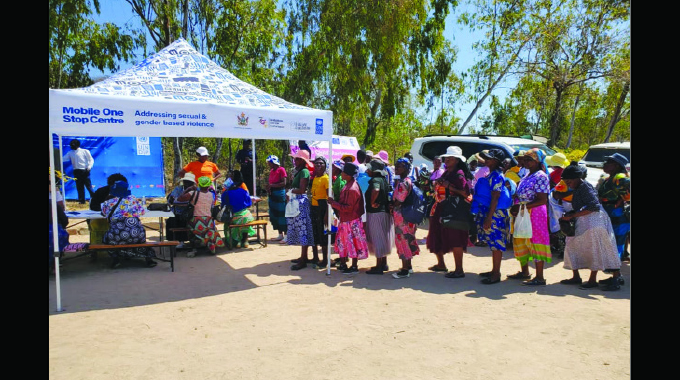
People queue to get registered to access services at One-Stop-Centre at Chatiza Secondary School in Mutoko recently. – Pictures: Theseus Shambare.
GBV is, therefore, both a silent health emergency and a development crisis, deepening poverty, cutting short education and fuelling cycles of trauma.
Recognising the scale of GBV in rural communities, the Government, in partnership with the Zimbabwe Gender Commission, UNDP and the Judith Neilson Foundation, launched the Mobile One-Stop Centre (MOSC) initiative.
The programme responds to male and female survivors, children and other vulnerable groups, translating regional commitments like SDG 5.2 and the SADC Gender Protocol into tangible action.
“The MOSC initiative operationalises the National GBV Strategy, which aims to reduce violence by 20 percent by 2030,” said the Ministry of Woman Affairs, Community, Small and Medium Enterprise Development provincial development officer for Mashonaland East.
The US$446 581 programme provides healthcare, legal aid, psychosocial counselling, economic empowerment, and civil registration services to GBV victims under one roof.
Since January, MOSC teams in Nyanga, Mashonaland West and Matabeleland South have reached 5 717 people, including 223 legal aid cases, over 1 600 civil registration documents issued, 1 300 reproductive health clients (most first-timers), and 600 counselling sessions.
The recent official launch at Chatiza Secondary School in Mutoko marked the next phase of expansion into rural districts. Funding includes US$446 581 from the Judith Neilson Foundation, US$60 000 from the INTEGRA window and US$30 000 from the UN Partnership on the Rights of Persons with Disabilities.
UNDP Resident Representative Dr Ayodele Odusola, represented by Ms Tafadzwa Muvingi, Team Leader for the Transformative Governance Unit, emphasised that the initiative reflects a new model of service delivery.
“Mobile One-Stop centres are not just about assistance after harm. They are about prevention, empowerment, and building communities where everyone can live free from fear,” she said.
For the man from Chindenga, scarred by fire, MOSC offered medical treatment and legal options.
“For years, I thought men had no right to speak about abuse. But they told me violence has no gender,” he said.
The teenage girl forced into marriage has been placed under child protection and returned to school.
“I thought my life was over. But now I know I can still dream,” she said.
The 19-year-old mother of three has begun counselling and joined empowerment sessions.
“They told me I am not just someone’s wife. I have rights and I am not alone,” she said.
The Zimbabwe Gender Commission chairperson, Mrs Margaret Mukahanana-Sangarwe, said MOSCs were dismantling barriers that had long silenced rural survivors.
“For too long, survivors of violence in remote areas have been cut off from justice, healthcare, and counselling. With MOSCs, we are saying no one should be left behind – not women, not children, not men,” she said.
At the Mutoko launch, Women Affairs, Community, Small and Medium Enterprise Development Minister Monica Mutsvangwa stressed neutrality and inclusivity.
“We cannot allow geography, poverty, or stigma to decide who gets justice. MOSCs are ensuring every survivor is reached, wherever they are,” Minister Mutsvangwa said.
Traditional leaders from the area, Chief Charehwa, Chief Chimoyo, Chief Nechombo and Chief Mutoko, welcomed the launch.
Representing them, Chief Chimoyo said: “As leaders, we see the wounds of our people daily. Some are physical, others are hidden. By bringing services to the villages, the MOSCs are restoring dignity and showing that justice belongs even to the poorest.”
By documenting cases and providing integrated support, Zimbabwe is not only addressing local needs but also contributing to regional and global efforts to promote gender equality and protect women’s rights.
This includes the SADC Gender Protocol, which guides Southern African countries to eliminate discrimination and reduce gender-based violence, and CEDAW, the United Nations treaty that obliges governments to protect women from violence and ensure equal opportunities.
Reports from Malawi and Zambia show that comprehensive interventions, combining healthcare, legal aid, and psychosocial support, significantly reduce the physical and psychological impact of GBV, demonstrating that the MOSC model is an effective approach for the region.
From the hidden valleys of Chindenga to the farmlands of Nyanga, survivors are beginning to speak – and to heal. Their scars remain, but they no longer suffer in silence.
With every MOSC visit, Zimbabwe is moving towards a future where GBV is confronted, survivors are supported, and hope is restored.