admin
adminTheatre In The Park in Harare was “Simudza Mureza” by a Savannah Trust’s four-member cast led by prolific actor and National Arts Merit Award 2010 winner Teddy Mangawa.
“Simudza Mureza” is a very short, punchy and thought-provoking drama driven by conversational songs and dance and rendered in captivating and eloquent Shona grounded on very expressive non-verbal gestures.
The cast that included Judith Tsoka, Nyasha Chagonda and Lloyd Nyikadzino exemplified the brilliance of Zimbabwe’s theatre talent that is a victim of under-exposure and excessively limited access to theatre audience where plays are “killed” after a couple of performance to small audiences normally dominated by theatre practitioners.
“Simudza Mureza” is about a family in a village community in Zimbabwe that was so tormented and traumatised by the politically motivated violence of the 2008 general elections that it struggles helplessly to make sense with what happened to it and to its community.
Many efforts at getting redress from the justice system of the land fizzle out before being initiated either because the family is not aware of the effective means of engaging the legal system or that it is overwhelmed by the view that efforts at seeking redress will be a waste of time.
The family has therefore decided to “withdraw from all communal and national activities” as a survival strategy and a way of retaining sanity.
The head of the family takes it as an expected responsibility of a father to lead the family into a very passive slumber that is somehow expected to regain the family’s confidence in humanity and peace.
To the head of the family, the family’s neighbours can no longer be trusted, once the village is thrown into elections.
Since what motivated the members of the community to engage in such violence against each other cannot be explained and was never witnessed in that area before, the community has become something whose behaviour cannot be predicted once the indications have been made that elections will be held.
The family sees no sign of the security that was always guaranteed by the strong moral standing of the community and its respect for human life and peaceful co-existence.
The head of the family believes that his sacred duty is to campaign against participating in elections or allowing elections to come to his community again.
He takes this unilateral stance after hearing that general elections will be held in the country soon. Since the community cannot be assured of peaceful political campaigns before the actual voting, during the voting and after the announcement of the results of the elections, there should therefore be no elections in their community.
He also believes that his family and the community have a right to choose to avoid elections in order to retain a peaceful co-existence. He persuades his family that in whatever they do, the songs, dances and slogans that dominate should be “no election please” or “there shall be no elections here”!
When their daughter, who was raped by a “political youth” during the politically motivated violence, returns from the university, her father attempts to drive her away from the village back to the university or to the city where she should stay until the elections are over. She is reminded of what happened to her and that the elections will bring back the violence and that she will be a rape victim again.
The young woman tells her parents that it is not possible for the family to exclude itself from communal and national activity and still remain members of the community functioning properly. She tells her family that instead of resigning from participating in communal and national activities, the family should join her campaign of demanding a violence-free political environment. She tells her family that once she heard that elections were coming soon she decided to return to the village to lead the campaign of demanding total communal allegiance to peace as a first step in guaranteeing peaceful elections.
She proceeds to demonstrate her “resurrection” from a victim of politically motivated violence to a campaigner for non-violent politics by confronting the young man who raped her in 2008, convincing him to understand that what he did was wrong and by proceeding to accept his plea for forgiveness and reconciliation. When her parents see that she has transformed the boy who raped her, they accept her advice to re-engage with the community and advocate for violence- free elections.
Two weeks after the performance of this play, President Robert Mugabe, speaking at the grand event to commemorate Zimbabwe’s 31st independence anniversary at the National Sports Stadium on April 18, declared a national stand against politically motivated violence when he said: “I call upon all Zimbabweans to unite in pursuit of a shared national vision and to strive at all times for peace not violence, and to respect the unity and development of our nation.”
In many respects this statement was an invocation for all Zimbabweans to detest politically motivated violence and any violence in whatever form and for whatever reason. Subsequent to the President’s statement, other political, civil and religious leaders advocated for the abolition of politically motivated violence and hate speeches and language from all media including political rallies and mass campaigns.
The President had clearly advocated for a platform of developing Zimbabwe in peace and harmony – a campaign requiring the participation of every Zimbabwean.
The creators of “Simudza Mureza” drama had worked as if they were aware that the President will in his first few words in his speech on April 18 champion the peace that the family in the play was prepared to retain even it meant losing, in the process, its sacred right to vote and to participate in politics.
One hopes that the play, which has been performed in Savannah Trust’s community outreach in Harare, Gweru and Gwanda, will be taken to many parts of the country to engage communities before the election campaigns begin.
Feedback: [email protected]


Online Reporter
- Herald
- July 22, 2026
- 54 views
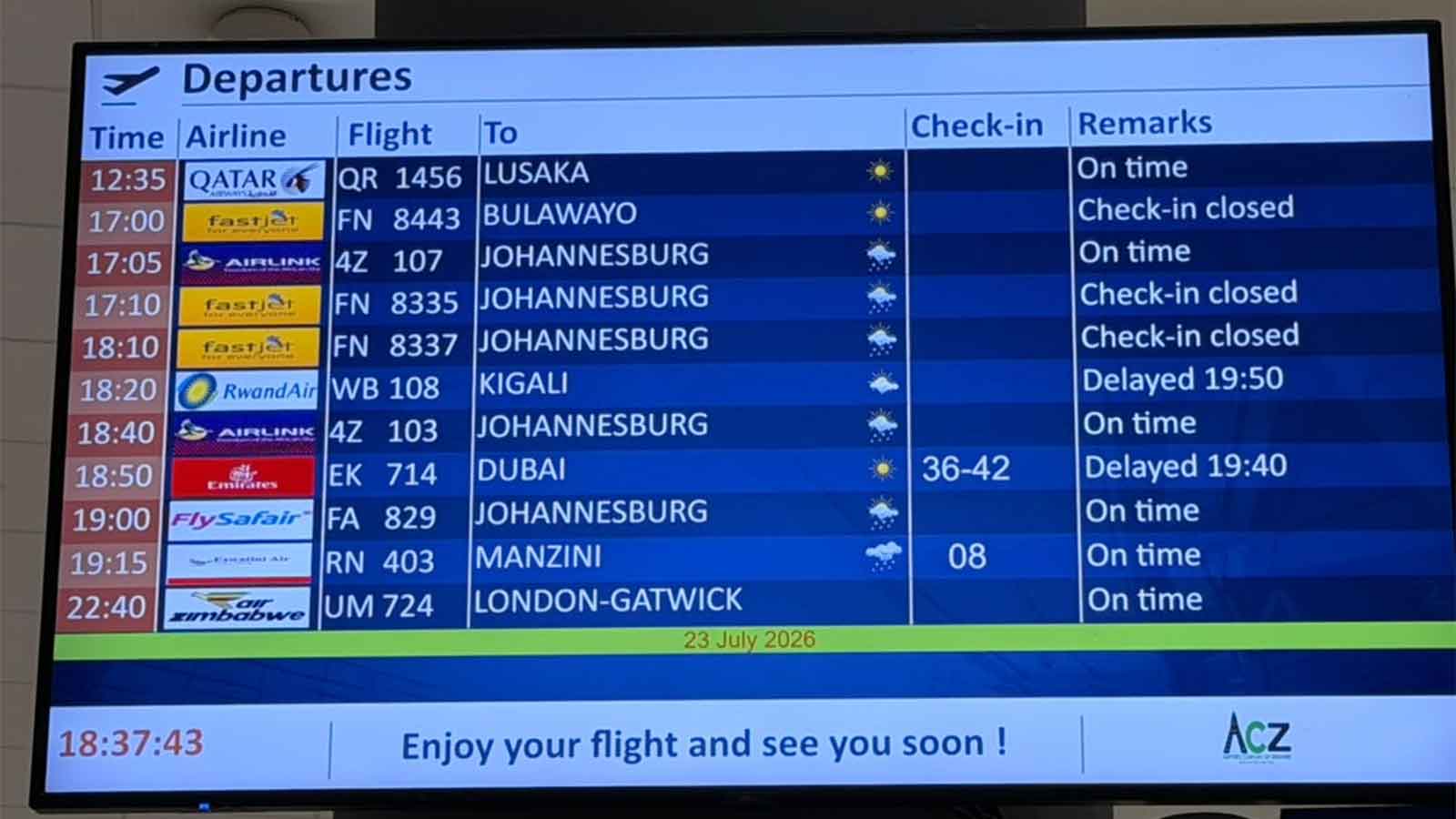
Air Zimbabwe’s Flight UM724 ready to depart for London
Freeman Razemba Senior Reporter The Air Zimbabwe’s Airbus A330-300 aircraft which is plying the Harare–London route is now ready to leave Robert Gabriel Mugabe International Airport in Harare for Gatwick…