Online Reporter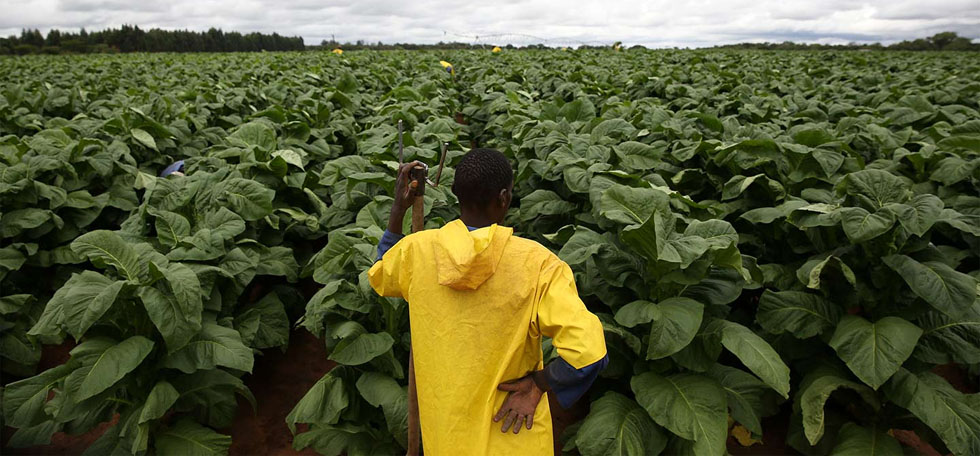
Lovemore Kadzura
Post Reporter
TWENTY-FIVE years after the historic land reform programme, the country is proudly standing tall, having achieved a record tobacco output this season, since the crop’s introduction.
The milestone is thanks to the resilient smallholder farmers who are the driving force behind the production of the lucrative golden leaf, earning the country over US$1 billion annually.
The earnings from tobacco farming have significantly contributed to the growth of Zimbabwe’s national economy and improved the welfare of farmers.
The smallholder tobacco farming sector is primarily anchored by contract system, where wealthy merchants provide farmers with essential inputs, including seed, fertilisers, labour costs, chemicals wood energy for curing, agronomy services, and transportation of the produce to auction floors.
Although this model presents some challenges and heavily favours the contractors, it has proven to be the most effective approach currently, as farmers receive all necessary support to produce.
Thousands of farmers have transformed from peasant farmers in arid areas to proud plot holders in fertile regions, leading decent lives and engaging in mainstream economic activities.
Tobacco farming has provided a vital source of income to many smallholder farmers, enabling them to support their families and improve their livelihoods.
The 2024/25 marketing season has witnessed a significant contribution from smallholder farmers, who have accounted for over 60 percent of tobacco deliveries to auction floors.
Statistics availed by the Tobacco Industry and Marketing Board (TIMB) showed that there were 135 222 registered growers in the just-ended season.
A breakdown of the registered growers reveals that 74 231 are from the communal sector, 45 398 from the A1 sector, while 7 039 are small-scale commercial farmers. Additionally, 8 554 growers are registered under the A2 sector.
To safeguard the gains made in the sector, TIMB has introduced a Contractors Compliance Administration Framework, which outlines the minimum inputs and resources that contractors must provide to farmers, ensuring a uniform contract system across the board.
This move aims to prevent instances where contractors fail to provide essential components to farmers, but still deduct costs from their earnings.
“TIMB’s Contractors Compliance Administration Framework also protects tobacco growers by setting a minimum input land pack every contractor must meet for a contract to be valid. If you are a small-scale grower contracted for one hectare, here is what your tobacco land pack must include – fertiliser (300kg), one-unit insecticide, one unit suckeride, 2kg twine, 20 pairs tobacco paper and hessian, herbicide at the contractor’s discretion and 500kg of coal or equivalent in sustainable wood supplied by the contractor.
“Seedbed pack (Kutsaga approved), 5g seed, 5kg Compound S, 1kg Ammonium Nitrate, insecticide and fungicide. One pair chemical gloves, one pair reaping gloves, one face mask, one apron and one pair of goggles. Growers know your rights and entitlements under your contract. If you are not receiving your full input pack, report to the nearest TIMB offices,” announced TIMB recently.
Youthful farmer, Mr Nelson Madziwa, of Nyahukwe in Makoni, said tobacco farming has changed his life and that of his peers.
He added that he invested in houses, livestock, crop diversification, and solar-powered water infrastructure from the tobacco proceeds.
He attributed the rise in production to increased competition among contractors, farmers’ experience, and the decentralisation of auction floors.
“I have been growing tobacco for the past few years, and my life has changed for good. Tobacco prices are firming up each season. Four years ago, it seemed there was serious collusion among contractors on the pricing, as US$2,50 per kg was the ceiling price for smallholder farmers. This has changed, as the average price is now hovering between US$3 and US$3,50 per kg.
“The coming in of many contracting companies has widened our choices on whom to work with, and some companies that were notorious for shortchanging us have lost clients. The competition for farmers has made contractors change the way they treat us, leading to better prices and improved contracts.
“The decentralisation of auction floors has attracted more people into tobacco, as they will no longer spend days or weeks marketing their produce in Harare. All this has played a huge role in more farmers taking up tobacco and increasing the area under the crop.
“We are now leading decent lives due to improved earnings from tobacco, and our lives have changed for the better. Most smallholder farmers are now staying in decent homesteads with proper ablution facilities, acquiring livestock, and venturing into other crops to supplement tobacco.
“We are investing in water infrastructure, especially setting up solar-powered boreholes, which is a revolution on its own. Smallholder farmers are slowly embracing irrigated tobacco, which was previously the preserve of large-scale farmers, and this is being made possible by investments in boreholes.
“Last season, I was contracted for one hectare, and financed myself for the other two hectares. The earnings were so good. The only issue that needs to be ironed out is the charges being levied by contractors, which are too steep,” said Mr Madziwa.
Tobacco Farmers Union Trust president, Mr Edward Dune said despite operating under skewed and sometimes manipulative contract systems, smallholder farmers continue to hold their own in terms of production.
He emphasised that prioritising the review of the TIMB Act of 1938 is crucial, as it will provide the much-needed farmers’ protection.
“Smallholder farmers have been the driving force behind Zimbabwe’s tobacco production, contributing around 60 percent of the produce this year. Despite their hard work, they remain at the bottom of the benefits ladder, with only 25 percent of the earnings going to them, while merchants reap the lion’s share,” said Mr Dune, adding that tobacco farmers have sold 340 million kilogrammes of tobacco, generating over US$1,1 billion for the economy.
However, he said farmers should benefit more from the value addition of their produce, as outlined in the National Development Strategy (NDS1).
“To address the existing imbalance, there are ongoing discussions to amend the TIMB Act of 1938, which is no longer compatible with the current environment. This move is seen as a positive step towards advancing the interests of smallholder farmers, who were not adequately covered under the original Act,” said Mr Dune, further highlighting concerns raised by farmers regarding TIMB’s contractors’ compliance framework.
Mr Dune expressed concerns that TIMB compliance framework focuses solely on quantity, neglecting the qualitative aspects and value capture.
“For instance, one company is selling 50kg of Compound C fertiliser for US$30, while another company is charging US$90 for the same product. This discrepancy makes a mockery of the compliance framework,” pointed out Mr Dune.
He also questioned why contractors do not source fertilisers from Zimphos, which receives foreign currency allocations from Government.
This will enable contractors to charge farmers in local currency, making the value chain more viable.
As it stands, contractors are taking advantage of farmers.
Meanwhile, environmentalists have raised concerns over the destruction of natural forests by tobacco farmers, who are illegally using indigenous trees to cure tobacco.
National Tree Ambassador, Mr Never Bonde expressed concern over the rampant deforestation, arguing that the tobacco industry’s high demand for wood fuel was unsustainable and threatened Zimbabwe’s forest cover, and also bemoaned the destruction of natural forests by tobacco farmers who are illegally using indigenous trees to cure the golden leaf.