Online Reporter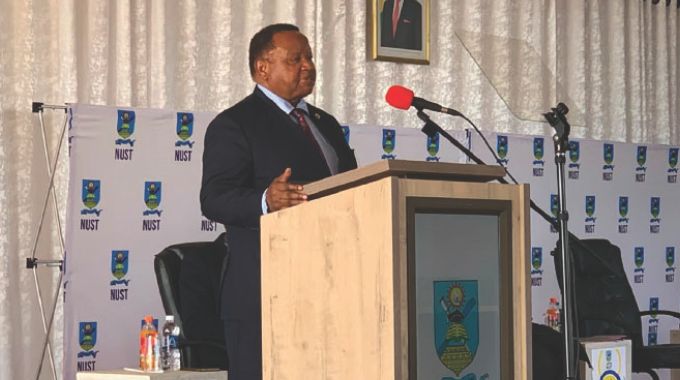
Peter Matika, Senior Reporter
THE rapid advancement of artificial intelligence (AI), robotics and other digital technologies is forcing Zimbabwe’s higher and tertiary education institutions to rethink their curricula, strengthen innovation ecosystems and equip graduates with skills suited for an increasingly technology-driven economy.

This emerged during the opening of the 6th Education for Sustainable Development Interdisciplinary International Research Conference (ESDIIRC) held at the National University of Science and Technology (NUST) in Bulawayo, where Government, academics, researchers and industry leaders gathered to deliberate on the future of Science, Technology, Engineering and Mathematics (STEM) education.
The conference was held under the theme: “Reimagining STEM Education for a Sustainable Future: Fostering Multi-Stakeholder Collaboration.”
Officially opening the conference, Minister of Higher and Tertiary Education, Innovation, Science and Technology Development Dr Frederick Shava said institutions of higher learning must urgently adapt to prepare students for a future shaped by automation, artificial intelligence, digital technologies and green industrialisation.
He said traditional education models were no longer adequate in addressing the demands of the Fourth Industrial Revolution.
“We meet at a time when humanity faces extraordinary challenges — climate change, technological disruption, food insecurity, public health threats, environmental degradation and youth unemployment. These challenges demand innovative solutions and a radical rethinking of how we educate,” said Dr Shava.
He said future workplaces would be fundamentally different from those of previous generations, with AI-powered systems, robotics and automation increasingly taking over repetitive tasks while creating demand for advanced cognitive and digital skills.
“Today’s learners will inherit a world shaped by artificial intelligence, automation, climate uncertainty and rapidly evolving technologies. STEM education must therefore equip them with critical thinking, creativity, digital literacy, adaptability, ethical reasoning, entrepreneurial capabilities and collaborative problem-solving skills,” he said.
Dr Shava said the goal was not only to produce graduates who could secure employment, but innovators capable of creating industries, generating jobs and developing solutions to national challenges.
He said Zimbabwe’s Heritage-Based Education 5.0 philosophy had repositioned universities from being centres of teaching and research into engines of innovation and industrialisation.
“Knowledge must solve societal challenges, create employment, improve livelihoods and contribute directly to national development,” he said.
The minister said universities were increasingly incorporating artificial intelligence, biotechnology, advanced manufacturing, renewable energy and digital education into research and innovation programmes to ensure graduates remained globally competitive.
He said Government’s investments in innovation hubs, industrial parks and university-industry partnerships were helping transform research into commercially viable products while promoting entrepreneurship and rural industrialisation.
However, delegates noted that while AI presents significant opportunities, it also comes with challenges relating to employment, ethics, misinformation, cybersecurity and privacy.
Researchers at the conference said while automation could replace some routine jobs, it was also creating new career opportunities in areas such as artificial intelligence engineering, robotics, cybersecurity, data science, software development, digital manufacturing and smart agriculture.
They stressed that universities should focus on producing adaptable graduates capable of lifelong learning rather than preparing students for occupations that could become obsolete.
Dr Shava said curriculum transformation should remain a national priority, with institutions required to align learning programmes with emerging technologies and changing industry needs.
He identified key focus areas as expanding work-integrated learning, strengthening innovation hubs and industrial parks, using digital technologies to improve teaching and research, and increasing research in strategic sectors such as AI, biotechnology, climate-smart agriculture, renewable energy and advanced manufacturing.
He said Government alone could not achieve the required transformation, calling for stronger collaboration among universities, industry, communities, development partners and professional bodies.
“Government provides policy direction and an enabling environment. Universities generate knowledge and innovation. Industry commercialises research and provides practical experience. Communities contribute local knowledge and real-world perspectives. When these strengths converge, transformative outcomes become possible,” said Dr Shava.
He also called for an inclusive digital transformation agenda, saying women, girls, learners with disabilities and students from disadvantaged communities should have equal opportunities to participate in STEM disciplines.
Dr Shava said an inclusive STEM ecosystem was not only a moral obligation but also a strategic investment capable of accelerating Zimbabwe’s industrialisation drive.