admin
admin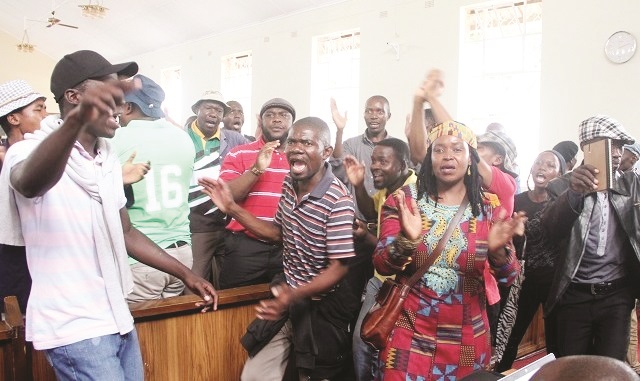

Micheal Mhlanga
The question of institutions of rule has surfaced only recently, in the face of a breakdown of political institutions and an eruption of internal conflict.
In Zimbabwe, it has stimulated an entire genre of literature, generally called the discourse of state creation and ethnic consciousness.
In the meanwhile, Zimbabwe’s ethnic political consciousness is shaped by a central assumption that echo around two clear factors, the law as according to its civil interpretation and the law as according to its cultural interpretation.
The question of state belonging is a significant problem but unknown to a magnitude in Zimbabwe.
It is not possible to predicate how many people deem themselves as unfairly existing within the polity, deductively, the continuous questioning of the non-existence of a legitimate native institution of rule has manifested the impetus to answer this uncommon national predicament.
It is certain that a significant proportion of Zimbabweans is suddenly militant on the question of traditional leadership, committee composition and who is legitimate to address post-independence conflicts however, within this struggle conflicting what they have been demanding for the past 37 years.
A series of events have erupted especially in the southern part of Zimbabwe, chief among these events being the legality of the coronation of the alleged
“Ndebele King” and the composition of legitimacy for the National Peace and Reconciliation Commission. As confusing as the topic is, it has rather prickled an even interesting debate around identity politics and the politics of legitimation.
My objective here is to try to understand the eruption of this rare breed of ethnic consciousness. By breaking from widely held assumptions I will argue that the question of peace and reconciliation generates political identities that are distinct not only from civil law based identities but also from cultural identities. Faced with a growing tendency to root causes of conflict in cultural difference, now worryingly called tribalism, I will differentiate between ethnic and political identities.
The recreation and restoration of the Mthwakazi can be argued to be an informative spiral of self -determination informing politics and traditional culture. In the wake of cultural consciousness, a political movement has emerged to champion an ethnic cause of redressing past injustices, perceived marginalisation and an advancement of isolating the Tebele person from the rest of Zimbabwe.
Tracing its progressive emergence to 2014, one notable movement-cum-political party is found gaining traction in essentialist spaces, firstly calling on the outgone Robert Mugabe to address Gukurahundi and screaming for secession. The groups are firstly in contest among themselves before they compete with others with varying interests.
Mthwakazi movements have been divided on secession, electoral participation, monarchical allegiance and legitimacy of speaking on behalf of the AmaNdebele. From this position, drawings can be made that within the Mthwakazi movement there is a race for monopoly of the Mthwakazi narrative.
The sudden emergence of conflicting groups such as Mthwakazi Republic Party, Mthwakazi Liberation Movement, 1893 Restoration Movement and Mthwakazi Liberation Front plays testimony to absence of a common cause but an unquenchable appetite for ownership of Mthwakazism.
To this effect, the Mthwakazi problems are confronted with a mammoth wall barring conflict resolution because anyone attempting to address marginalisation, negligence and ethnic conflict has to first deal with intra-ethnic contests among groups competing for regional recognition.
There is a struggle within the struggle of abaThwakazi and at this juncture it is difficult for anyone to deal with problems in Mthwakazi which have transformed into a Mthwakazi Problem.
To this effect, I want to reflect on the recent events where interpretations of the law guiding the National Peace and Reconciliation are within the parameters of civil law drawn from the constitution and subsidiary legislation. The Government’s response to its social contract obligations is met by a desisting interpretation of Commission composition which is argued to be biased because of individuals who do not belong to the Ndebele tribe.
Reading from these lenses, legitimacy of a legally constituted body is arrived at if there are no people of Shona origin. Spectacles of civil law are replaced with cultural pedagogues which only respect and selectively identify with “theirs”. Instantly there is the othering of the legally appointed and immediately those championing the exclusion of “others” turn out to fall into Mahmood Mamdani’s reference of When Victims become killers.
Actions and outbreaks in Bulawayo and Lupane become the rightful description of the “victims” who are ready to unleash terror on those they claim to be beneficiaries of past injustices.
In a bid to quell extremism, historical maims and address civil unrests, the path seems “terrainic”, only a reserve of those desired by the victims. The problem in Mthwakazi as intended to be addressed by the NPRC is of 1983-1987 challenges which the AbaThwakazi claim was an ethnic promoted campaign hence their disfavour of the other tribe.
The delayed conversations on the subject germinated tribal essentialists hence to a reasoned degree the vocalised devolution in Matabeleland.
As a response to claims of being “othered” in a country where they are entitled to equal opportunities and rights, one would have thought that the expedited NPRC hearings would be a relief to groups which condemned the Government for not addressing past political violence. Any person who is either a direct victim or a sympathiser would have thought the inception of the Commission will be an outlet of drawing transitional justice models and provide a safe space for victims of political violence without fear of re-victimisation.
With all these aspirations for victims, the euphoria was not given space to flourish as disruption after another emerged at the hearings. Disqualification of Commissioners is hinged on which tribe they belong to and the failure of a hearing is scored as a success to the Mthwakazi Republic Party.
It therefore triggers questions of how peace and reconciliation between the alleged rival ethnic groups will be achieved if those who lengthy demanded such a space cannot accommodate the law and the people who represent it.
It begs questions such as how do people reconcile when they cannot accept individuals from a group they intend to reconcile with? What then is the point of being presided upon by your own kith and kin to discuss reconciliation yet there is no raptured history? If we do not move beyond the first step of respecting individuals installed by the law how then do we reconcile?
Understanding that cultural patriotism is essential, it equally does not entail disrespecting the law and affecting the safe space for some if not many whose experiences they see fit to share in that platform.
At it is, disruptions have been a fungi which has prolonged the suffering of some victims whose reprieve was the legal audience at BICC in Bulawayo and in Lupane.
Self-determination becomes useless when it’s starved of rationality and disregard of a social contract. The disruptive actions by MRP are a coerced affiliation of everyone in Matabeleland who is forced by this group to speak on their behalf. In a democracy as MRP and its Siamese groups want everyone to believe, freedom of choice, association and belonging is a fundamental right and should be respected all the time.
What is only fair is for them to speak for themselves, not everyone. The pain might be the same as well as experiences, but how to deal with emotions is different.
We cannot bar conflict resolution by selectively interpreting the law and barracking progressive nation building.
Firstly, they have to address the Mthwakazi problem, incessant clashes within Mthwakazi are still an impediment to the region’s progress and a common goal, until that is dealt with.
Yikho Khona Lokhu!


 Online Reporter