admin
admin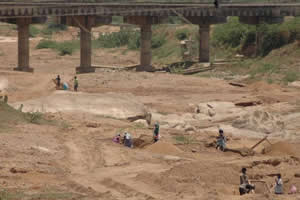
trucks among many others carrying loads of sand have become a common sight on Harare’s streets as they huff and puff their way to residential areas.
This massive construction has seen open pits and holes littered almost everywhere, a clear testimony of the negative effects of sand mining on the environment.
While sand mining has become big business in Harare and surrounding places due to infrastructural development going on, its effects on the crust of mother earth leave a lot to be desired.
Improper mining procedures have left scars within Harare’s environs and many sand extractors have not been moved as they continue looking for new land to dig.
While others have decided to take the illegal route, which often comes with quick money while satisfying the unending demand, a group of young people have chosen to follow the correct mining procedure and help preserve the environment.
The group, made up of 100 youths, is mining sand at Stoneridge farm, owned by businessman and philanthropist Philip Chiyangwa.
The youth have organised themselves into a co-operative and have obtained an Environmental Management Authority sand abstraction licence. Their aim is to prove that the land they are operating on can be used for other uses long after they have stopped working on it.
Chairman of the co-operative Mr Ephraim Pfundukwa said the sand extraction process includes first removing topsoil. After this they begin extracting sand at a depth of one metre before filling the pits and planting trees and grass. For their efforts they have received commendation from the EMA.
“We have been operating legally at this farm since 2009 when were obtained a licence from EMA. As a co-operative, we maintain the stipulated one-metre depth. As you can see all the areas that we have worked have been refilled and levelled so that the land can be used for other things.
“We are also planting trees and grass to minimise soil erosion. We also monitor growth of these trees. Our duty is also to protect the area from sand poachers. We are happy that since we started this co-operative crime has declined in the area as many youths are now spending their time working at site,” he said.
The youths sell pit sand to people who have transporters’ licences only. This is to minimise poaching that is threatening the environment in the environs of Greater Harare.
On a good day each member takes home US$25.
“This was a crime-infested area and sand mining is proving to be a livelihood for many youths. One cubic of sand costs US$35 and business is good since they are many infrastructural developments taking place in Harare and Chitungwiza,” he added.
EMA communications and publicity manager Mr Steady Kangata commended the youths and urged other people involved in sand extraction to practise proper mining in appropriate places only.
“EMA (Environment Impact Assessment and Ecosystem Protection) Regulation, 2007 published in Statutory Instrument 7 of 2007 says in Section 3 (1) no person shall excavate, remove, possess or license the removal of clay or sand deposit for commercial purpose without a licence issued by the agency.
“(2) Any person who wishes to extract, excavate, possess or license the removal of sand or clay shall apply to the agency and inform EMA and the application shall be accompanied by an appropriate application fee.
“Transporter licence fee is US$110 while sand abstraction licence goes for US$173 per point, per every three months respectively. It is unfortunate that although these sand miners are making lots of money they are not willing to pay the fees hence the increase in sand poaching,” he said.
Mr Kangata added that the idea was to make people budget for the environment so that they can attach value on natural resources. However, illegal sand mining in Caledonia and Harare South is taking place and poachers have resorted to a cat and mouse game with EMA.
Illegal sand mining has caused severe land degradation imposing danger to residents and the environment. Most affected areas include Epworth, Mabvuku, Caledonia Farm and some sections of Chitungwiza.
As a way of highlighting the benefits of proper sand mining, EMA conducted a media tour for places where illegal sand mining was taking place. The tour also included areas were proper, regulated sand mining is being practised.
In Caledonia a large dam has developed near homes due to persistent sand extraction which is taking place. This pool is now posing a danger to the community as children risk drowning and nearby homes being swept away.
One of the sand poachers in Caledonia, Mr Innocent Hamandishe, said their fathers who mined before advised them to mine first and get licensed later.
“This has become our source of livelihood and every day we are involved in a cat and mouse game with EMA and police officers. We are on the lookout for another place to sand mine as our clients who are building in Damofalls and Ruwa give us good business.
“There are six leaders and 20 workers on this site. We sell five cubics of sand for US$20 and one can take home up to US$40 on good day.
Another group of sand poachers is camped at Hopley Farm near Irvine’s. This group operates close to a dam that is a tributary of Manyame River thus threatening Harare’s water main source. Poachers mine pit sand yet buyers want river sand.
To satisfy their customers, the illegal miners draw water from the dam and wash the pit sand until it resembles river sand.
“Whenever we arrive one stands guard to lookout for EMA patrol teams. When he spots an EMA vehicle he warns us and we flee,” said one of the poachers.
As we approach the illegal sand mining site in Caledonia, the poachers can be seen running away among them two police officers.
One of their leaders, Trust Madongo (26) better known as Father Goshto in his line of business, gave details of how they operate.
“The police officers you saw are members of the neighbourhood watch. They have stopped going to work and spend most of their time milling around here for bribes.
“We started operating last year and no laws are followed here. People are free to do what they like.
“We are about 70 and we sell 10 cubics of sand for US$50. Anyone can come and buy for as long as he or she has the money.
“On a good day one pockets US$40 and I own the water pump used to pump water to the mining area. I had two but lost the other one during one of these EMA raids,” he said.
Until and only after a way is found to discourage illegal sand mining like the above, the environment will continue to suffer.



 Online Reporter