Online Reporter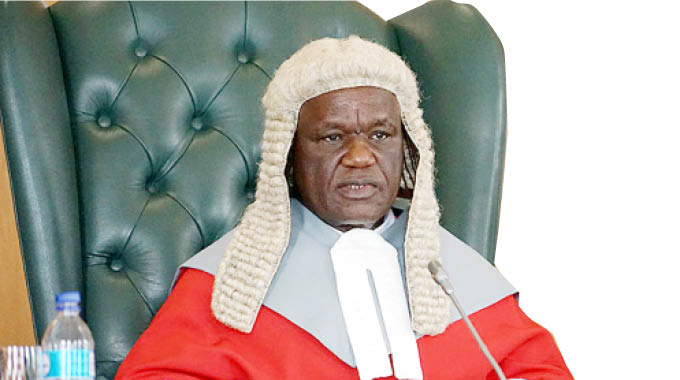
Fidelis Munyoro
Chief Court Reporter
2025 marked a transformative chapter for Zimbabwe’s Judiciary, as it was a year in which tradition intertwined with innovation and the courts sought to redefine justice in a rapidly evolving society.
From the historic opening of the Legal Year in Bulawayo to the rollout of groundbreaking digital systems and the sorrowful loss of a judicial stalwart, the Judiciary’s journey was a compelling testament to resilience, progress and community engagement.
January 13, 2025 marked the historic opening of the Legal Year.
It was the first time in Zimbabwe’s history that the main ceremony was held outside Harare.
This symbolic shift, led by Chief Justice Luke Malaba, underscored the Judiciary’s commitment to devolution, a core pillar of the National Development Strategy (NDS1).
Under the theme “Building Public Confidence in the Judiciary through Multi-Stakeholder Participation”, the Judiciary sought to bridge the gap between the courts and the public it serves.
The ceremony that was in Harare, presided over by Deputy Chief Justice Elizabeth Gwaunza, echoed the same message: justice must be accessible, inclusive and efficient.
Chief Justice Malaba’s address was not just ceremonial; it was a roadmap for reform.
He unveiled ambitious plans to enhance public trust in the Judiciary by expediting judgment delivery and fostering greater collaboration among citizens and legal stakeholders.
The Judiciary’s performance in 2024 had been robust, with high case finalisation rates, and this momentum was carried into 2025, setting the tone for what would become a year of significant milestones.
One such milestone came in April with the opening of the Mutawatawa Magistrates’ Court in Uzumba-Maramba-Pfungwe district.
For decades, residents of this remote region had endured the arduous journey to Murewa for legal proceedings.
But on April 4, the Judicial Service Commission brought justice to their doorsteps.
The new modern court, which also uses the Integrated Electronic Case Management System (IECMS), represented a leap forward in decentralising access to justice.
With partitioned cell blocks for male, female and juvenile detainees, the court was immediately hailed by stakeholders as a beacon of progress.
Traditional leaders, the National Prosecuting Authority and local residents celebrated this development, which promised not only convenience but also a reinvigorated sense of justice for the community.
The month of May brought another landmark event: the public interviews for eight Labour Court judge positions.
Over two days in the capital, candidates underwent rigorous assessments in a transparent process that underscored the Judiciary’s commitment to merit-based appointments.
The public and media were invited to witness the interviews.
By July, the President had appointed six new Labour Court judges — Justices Garudzo Ziyadhuma, Clever Tsikwa, Bianca Makwande, Motion Jaravani, Evidence Gonesi and Rodin Mzyece — who were sworn in by Chief Justice Malaba.
Their appointments expanded the Labour Court’s bench to eight judges, strategically distributed across Harare, Bulawayo and Gweru to manage the growing caseload of labour disputes.
This was a significant step in bolstering the court’s capacity and ensuring timely resolution of cases.
Meanwhile, the Judiciary’s digital revolution continued to gather pace.
The rollout of the IECMS, which began in 2022 with the Commercial Court, reached new heights in 2025.
By May, the system had been implemented in the Constitutional, Supreme and Commercial Courts.
This digital transformation — enabling e-filing, virtual hearings and online case tracking — promised to enhance transparency and efficiency.
Challenges such as connectivity issues and infrastructure gaps remained, but the Judiciary’s resolve to modernise was relentless.
The IECMS was not just a technological upgrade; it was a paradigm shift that redefined how justice was delivered in Zimbabwe.
Zimbabwe’s leadership in judicial innovation attracted international attention.
In June, a delegation from Liberia visited Zimbabwe to study the IECMS and its impact.
Touring courts such as the Commercial Court, the Liberian judiciary sought to replicate Zimbabwe’s success in reducing paperwork and streamlining case management.
This exchange highlighted the growing collaboration among African nations to modernise their judicial systems.
For Zimbabwe, it was a moment of pride and a recognition of its pioneering efforts to integrate technology into justice delivery.
The spirit of cross-border cooperation extended to Namibia in September, when a Zimbabwean judicial delegation, led by High Court judge Justice Tawanda Chitapi, conducted a benchmarking visit.
Namibia’s experience with court-annexed mediation and other Alternative Dispute Resolution frameworks served as a valuable learning opportunity for Zimbabwe, which is in the process of implementing similar systems.
The visit was part of a broader bilateral agreement signed in 2024, aimed at fostering judicial training, reducing case backlogs and sharing best practices.
These exchanges underscored a shared vision among African judiciaries to improve access to justice through collaboration and innovation.
Yet, the year was not without its sorrows.
In November, the Judiciary mourned the loss of Supreme Court judge Justice Feliciah Chatukuta, who passed away at the age of 63.
A trailblazer in her own right, Justice Chatukuta had served for nearly two decades, first as a High Court judge from 2005 and later as a Supreme Court judge from 2021.
Her dedication to justice was unflinching, and her passing left a void in the nation’s legal fraternity.
She was accorded a State-assisted funeral and laid to rest at Glen Forest Cemetery in Harare.
Her legacy, however, endures in the countless lives she touched through her work.
As the year drew to a close, the Judiciary’s focus on infrastructure development remained steadfast.
Construction of the Gwanda Magistrates’ Court, which will also host High Court sittings, was well underway.
This facility, like others before it, will incorporate the IECMS, ensuring that even the most remote areas benefit from modern judicial services.
The expansion of court infrastructure is a cornerstone of the Judiciary’s mission to bring justice closer to the people.
In 2025, Zimbabwe’s Judiciary was a beacon of progress, a proof to the power of reform, innovation and collaboration.
From the symbolic opening in Bulawayo to the digital strides of the IECMS and the international exchanges that strengthened ties across Africa, the year was a vivid portrait of a Judiciary in motion.
It was a year of milestones, a year that reaffirmed the commitment to serving the people and upholding the rule of law.
Even as it faced challenges and loss, the Judiciary’s unwavering dedication to building a just and inclusive society shone through — a legacy for generations to come.