

 admin
admin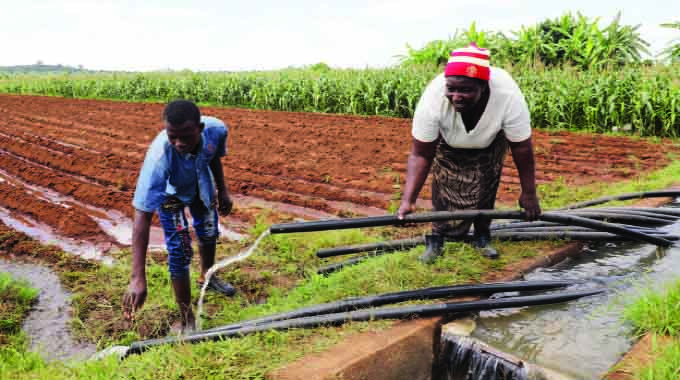
Precious Manomano-Herald Reporter
Tsunda Irrigation Scheme in Bindura continues to transform the lives of over 500 small holder farmers whose livelihoods revolve around agriculture.
Today the scheme has turned the community near Bindura into a greenbelt, contributing significantly to food security for the nation in line with the Agriculture and Food System Transformation Strategy (2020-25).
The objective of this strategy is to ensure that Zimbabwe grows its own food and curb poverty in rural areas.
The community is establishing different types of crops throughout the year such as maize and wheat, mixed gardening with tomatoes, vegetables and butter nut.
The project is complementing President Mnangagwa’s policy that envisages drilling about 35 000 boreholes in the country’s villages and schools as part of efforts to develop rural communities through water harvesting for irrigation purposes.
Over 50 households are participating in the scheme in Bindura South, several people from as far as Harare, Mt Darwin, Shamva, Chitungwiza, Mazowe are visiting Tsunda village to buy tomatoes and vegetables for resale.
This dovetails with the Government’s drive for rural industrialisation and development consistent with President Mnangagwa’s policy of leaving no one and no place behind on development.
A survey conducted by The Herald in the area indicates that through hard work, commitment and dedication, farmers have significantly turned Tsunda irrigation scheme into a greenbelt.
Ward 12 villagers said the farming project has proved to be a game changer for the local communities adding that the Government’s commitment to improving the use of canals to ensure the efficient running of the irrigation is greatly appreciated.
Mrs Trish Murasha indicated that she spends the majority of her time at the scheme to ensure she provides for her family.
“The scheme is my source of income. I grow vegetables , tomatoes, wheat , maize and butter nuts.

Rural communities in Zimbabwe are benefiting from irrigation schemes that are meant to ensure food self-sufficiency.
“I am a widow, my husband died four years ago. I can provide enough food for my family.
“All my four children are going to school and we are benefit from working on this scheme.
“We produce enough to feed the province. Our prices are reasonable, the villagers also come to buy our products at a very low price,” she said.
Mrs Agatha Mawere said irrigation schemes have been sources of empowerment for the majority of women in the area adding that cases of gender based violence in the area have been minimal.
“Empowerment programmes are critical. Women are spending most of their time here doing various farming businesses. They are supplementing their husband’s incomes hence we are seeing a decrease in cases of gender based violence here,” she said.
Mr Amos Bube said the majority of people are relying on farming, adding that the irrigation scheme has totally transformed the area.
“Various productions are taking place here so we are earning a living through farming.
“We grow crops all year round so we are utilising our irrigation scheme wisely to ensure that we feed our families and sell the surplus,” he said.
Tsunda irrigation scheme secretary, Mrs Elizabeth Chivandire, recently indicated that the community is largely benefiting from the Presidential Inputs programme which they always receive on time.
Bindura South Member of Parliament Cde Remigious Matangira said farmers have the capacity to produce good crops if enough water for irrigation is available, adding that the communities in Bindura South are reaping huge benefits as part of the programme to climate proof the country’s agriculture and ensure food security.
“The community members are working hard to ensure that they have enough to feed their families and sell the surplus.
“They are utilising the irrigation schemes that we have in the constituency. We have several irrigation projects including Nhunguza, Muunganirwaa, Kahari, Nyakedyazuva, Semawu, Gwezere and Mundotwe.
“They are all doing very well and farmers are producing crops all year round as a way to ensure food security,” he said.
The National Development Strategy 1 (NDS1) and Agriculture Food Systems Transformation Strategy targets 350 000hectares from the current 217 000 by 2025.
Government is encouraging private sector participation to ensure that more land is put under irrigation in a bid to fight the effects of climate change.



 Online Reporter