Online Reporter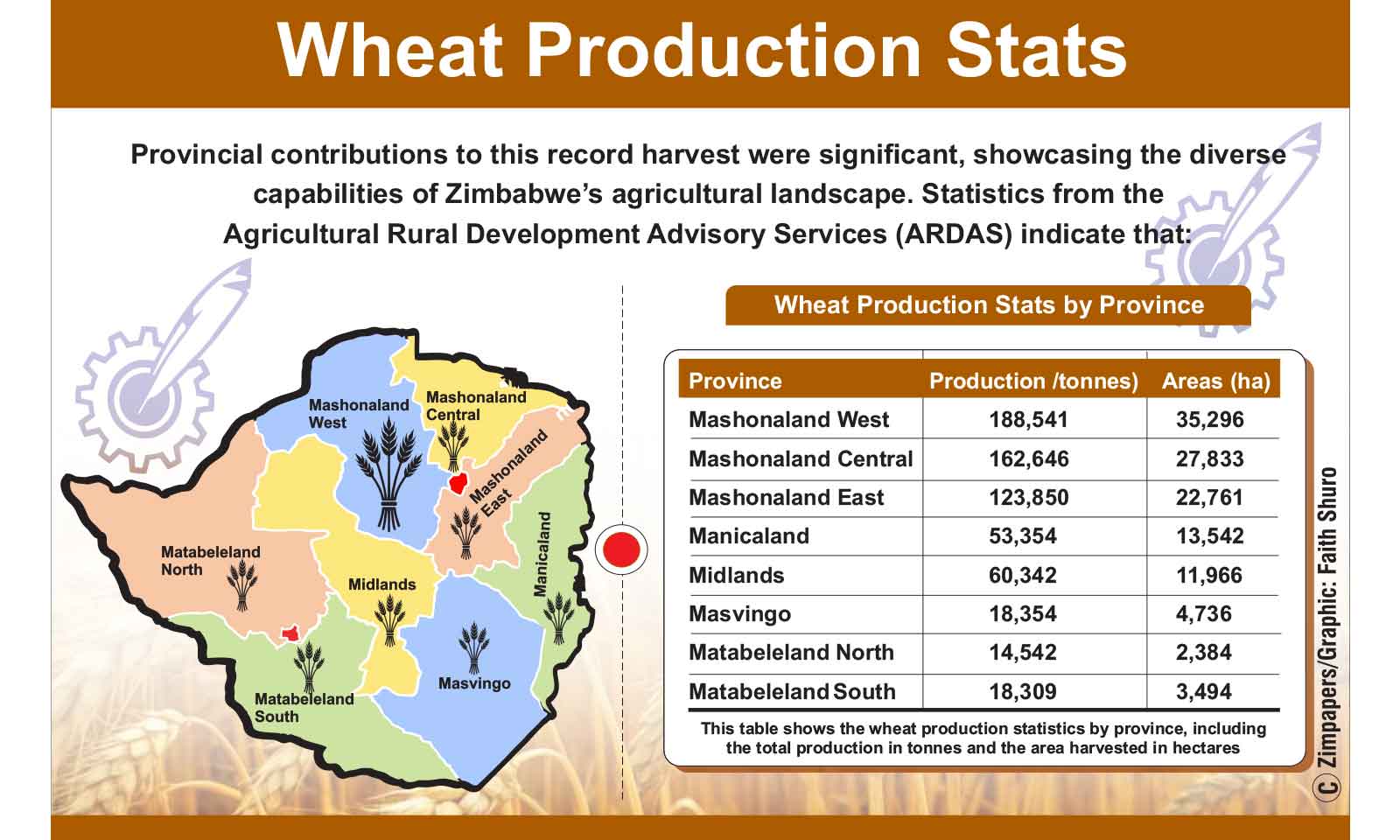
Precious Manomano
FOR Zimbabwe’s agriculture sector, 2025 has been a defining moment after the country achieved yet another record-breaking winter wheat harvest.
It recorded a massive haul of 639 942 tonnes, well above the national target of 600 000 tonnes and comfortably past last season’s 563 961 tonnes.
For the third time since commercial wheat farming began in 1966, Zimbabwe produced more wheat than its annual consumption requirement of about 360 000 tonnes, creating both self-sufficiency and a modest strategic surplus.
Beyond the numbers, the milestone represented a structural shift in the country’s food security outlook, also marking tangible progress in the long-stated goal of reducing reliance on imports.
It also represents one of the clearest illustrations yet of the impact of Government-led agricultural interventions under the National Development Strategy 1 (NDS1).
Strategic interventions
The record harvest was not accidental.
It emerged from deliberate policy choices and sustained support systems designed to give farmers stronger incentives and better tools to produce.
At the centre was improved access to finance, which allowed farmers to secure inputs timeously.
The Government’s early input distribution programme — covering seed, fertiliser and chemicals — removed delays that have historically undermined the winter wheat cycle.
Partnerships with key State utilities added the enabling infrastructure.
The Zimbabwe Electricity Supply Authority (Zesa) prioritised electricity supply to major irrigation clusters, with about 100 megawatts being ringfenced to support production, while the Zimbabwe National Water Authority (Zinwa) guaranteed irrigation water.
With wheat being almost entirely dependent on water and power, uninterrupted supply was arguably the most decisive factor in avoiding potential crop losses.
The Government tracked 17 key enablers during the winter season, including access to seed, fertilisers, finance, irrigation water, electricity, modern equipment, and pest control and extension services.
This framework created operational certainty for producers and gave the authorities real-time oversight of emerging threats such as pests, mechanical breakdowns and electricity interruptions.
On the mechanisation front, more than 300 combine harvesters were mobilised and made available to farmers countrywide.
In addition, grain dryers were deployed to Grain Marketing Board (GMB) depots to mitigate early season rainfall, which has in the past destroyed large quantities of unharvested wheat.
While State intervention was central, Government policy increasingly demanded private sector participation.
Under agreed guidelines, companies were encouraged to produce at least 40 percent of their annual raw material requirement locally, an objective achieved this year.
The blend of public-private partnerships has become a feature of Zimbabwe’s agricultural recovery model, particularly as private contractors invest in irrigation rehabilitation, mechanisation and farm inputs.
Extension services and skills transfer
Perhaps less publicly visible — but equally strategic — was the mobilisation of the Department of Agricultural, Technical and Extension Services (Agritex) officers.
Teams were deployed to wheat-producing areas with motorbikes, digital tablets and mobile data allocations to extend technical knowledge to farmers.
Training focused on calibration of planting machinery, fertiliser application, irrigation scheduling and disease management.
This helped small and medium growers in particular to raise yields and reduce post-harvest losses.
Persistent challenges
Despite the record harvest, challenges remain.
Veld fires, early rains and localised resource shortages threatened some districts, though losses were ultimately minimal.
More pressing are delays in payments for wheat delivered to the GMB, a long-standing grievance among farmers who rely heavily on steady cash flow to prepare for the next season.
Resolving these bottlenecks will be critical to sustaining farmer confidence and keeping production levels high.
At policy level, the authorities acknowledge that irrigation will determine whether Zimbabwe can maintain surplus production over the coming decade.
The Ministry of Lands, Agriculture, Fisheries, Water and Rural Development argues that sustainable wheat production requires a water sector that is transparent, robust and efficiently managed.
The Government is, therefore, prioritising modern irrigation systems and climate-resilient water storage.
With adequate finance and continued early delivery of inputs, Zimbabwe expects to retain surplus output and potentially enter premium regional markets.
Provincial performance
Provincial output reveals the growing spread of wheat-competent zones.
Mashonaland West provided 188 541 tonnes from 35 296 hectares (ha), followed by Mashonaland Central at 162 646 tonnes and Mashonaland East at 123 850 tonnes.
Notably, even traditional low-output provinces such as Masvingo and Matabeleland North made meaningful contributions, underscoring the national scale of the wheat expansion programme.
The 2025 output places Zimbabwe among a very small group of African wheat-producing nations capable of feeding themselves.
It joins Ethiopia as the only African country to achieve meaningful wheat self-sufficiency.
The symbolism is important.
For decades, wheat imports drained foreign currency and left domestic supply vulnerable to global shocks.
Now, wheat contributes to import substitution and positions Zimbabwe as a potential exporter during good seasons.
What emerged from the 2025 season was not just an impressive harvest, but a structural transformation — technical, financial, institutional and psychological.
Farmers increasingly believe winter wheat can be reliably profitable.
If sustained, the momentum will reshape Zimbabwe’s food security landscape, reduce exposure to global price shocks and support expansion of the broader manufacturing value chain — from flour milling and stock feed production to logistics, packaging and bakery industries.
The 2025 winter wheat season was, therefore, a marker of progress, one born out of policy consistency, institutional collaboration and farmer resilience.
This may yet form the cornerstone of Zimbabwe’s long-term agricultural renaissance.