Online Reporter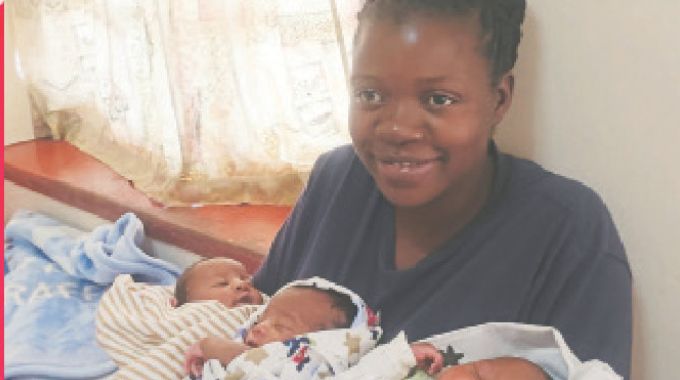
Robin Muchetu, Health and Gender Editor
UNITED Bulawayo Hospitals has successfully welcomed its first set of triplets this year in a move authorities say is enough proof that they have the expertise to manage and deliver multiple births while ensuring that no woman dies while giving birth of this nature.
The triplets, who are all boys were born on 23 July, at 35 weeks versus the usual 39-40 weeks gestation period via Caesarean section.
They were born to Ms Sharon Phiri (28), of Umzingwane District in Matabeleland South Province.
According to statistics from UBH, in 2021, they delivered two sets of triplets, four sets in 2022, five in 2023, two sets in 2024 and two again in 2025.
While most mothers who are involved in multiple births usually display agony and stress over how to care for the newborns, Ms Phiri could barely hide her joy as she spoke about her bundles of joy.
“I am so happy to have given birth to three boys at the same time,” she said with excitement written all over her face.
The triplets weighed 1 880g, 2 125g and 2 140g each.
Ms Phiri said she was proactive and sought medical assistance early thereby avoiding the challenges of reaching far off health centres that many women living in rural settings experience.
“I got to know I was carrying triplets at six months after an ultrasound scan. Initially I could not believe that I was carrying three babies. I was scared of how it was going to work out. I even cried, but I eventually accepted it,” she said.
When she fell pregnant, she said the journey was smooth but on the fourth month mark, it began to change.
“At five months it was so bad now, when we got to seven months it continued to be difficult, I could not walk or even turn while sleeping, it was so difficult because my stomach was so big,” she added.
Like any expectant mother, Ms Phiri said she to prepare the layette for the triplets early —buying a few things at a time with the little that she earned as a hairdresser.
The Ministry of Health and Child Care states that women also experience delays in registering pregnancies and getting medical check-ups which is a contributing factor for maternal and neonatal mortality as some conditions or risks like multiple pregnancies are detected late.
“I was advised by my aunt that since I was now aware that I was carrying triplets I had to go to Esigodini District Hospital and make my case known as the clinic in Mawabeni where I had registered would not be able to deliver and manage triplets. They further referred me to UBH where I was getting antenatal care and seeing doctors too,” she said.
This, they say, helped in ensuring the pregnancy is monitored closely by doctors since it was a high-risk pregnancy, with the aim of ensuring a safe delivery for the mother and better outcomes for the babies.
In Zimbabwe, the Maternal Mortality Rate has reduced from 212 to 137 deaths per 100 000 live births owing to significant infrastructure and human resources investments by the Second Republic. This has given rise to these improved statistics in this area.
Ms Phiri arrived in Bulawayo on 22 July 2026 and delivered the triplets on 23 July in the early hours after she went into labour. She delivered a week before her scheduled caesarean section.
Multiple babies are not new to Ms Phiri and her family, so the pregnancy did not entirely shock the family as there is a set of twins in her family.
“My siblings include a pair of twins, so asimangalanga (we were not surprised),” she said.
She however has some anxiety over taking care of the triplets owing to limited resources and said she could use some help from well-wishers.
“I am a bit scared of how I will take care of them, three is a lot. I cannot even sleep at the moment as they all demand attention constantly. I am kindly asking for help in the form of clothes, diapers, and baby milk as I do not produce adequate milk to feed them all. So, I need to supplement breast milk. I will be grateful if I get this assistance. Going back to hairdressing will be a challenge as I cannot fully juggle going to clients and fending for the triplets,” she said.
To assist, she said an income generating project will transform her life saying if she can get help to start a chicken project, she can do it while staying at home and she can use the funds to raise her children with the help of her mother.
Dr Martin Chandiposha a gyneacologist at UBH said the triplets are under maximum supervision at the hospital.
“We were working as a team and were seeing her at intervals that were not the normal ones, we have been seeing her very often, sometimes every two to three weeks together with other doctors and midwives. We discussed with her that usually multiple babies do not reach the nine-month mark but are delivered early. We are impressed that she was a very jovial person who understood all our advice,” he said.
He further said such multiple births like this are rare in Zimbabwe.
“It’s somehow a rare condition but we do have triplets in Zimbabwe, most of them delivered at major hospitals. Generally, in Zimbabwe we have one set of triplets in every 2700-2800 deliveries. A 10-year study was done at the Sally Mugabe Hospital in Harare and revealed these statistics. Rarely do we get triplets so when we get them, we are happy,” he said.
He encouraged that the mother gets adequate psychological, social, community and resources support to care for the triplets.
Furthermore, he commended Ms Phiri for visiting the correct health facility when she discovered she was having triplets.
“We encourage anyone having multiple births to come to referral hospitals in time, our clinics also generally refer such cases and other major cases regarding pregnancy,” he added.
Dr Chandiposha said multiple births are hereditary, they run in families, so the likelihood of Ms Phiri giving birth to triplets was highly likely as her siblings are twins.
Ms Phisi is not a first-time mother. she has a daughter who is almost three years old.