admin
admin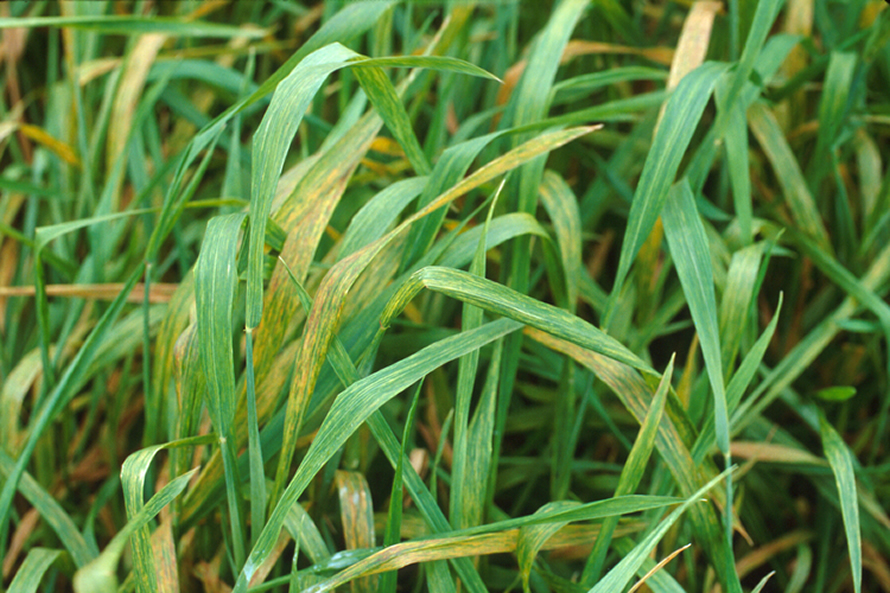 Wheat streak mosaic is a disease caused by a virus that is carried and transmitted (vectored) by the wheat curlmite, Aceria tosichella.
The disease, commonly called wheat streak mosaic virus (WSMV), may cause losses that range from minimal to complete crop failure.
Distribution of the disease may be restricted to a few fields, or the disease may be widespread in a region. The disease usually occurs in areas where both winter and spring wheat are grown.
Disease symptoms
Symptoms of wheat streak mosaic often appear first at the edge of the field or in patches next to wheat volunteers.
Under favourable conditions for development, the mite carrying the virus moves with the prevailing winds, and the symptoms of the disease soon may be observed throughout the field.
Infection of winter wheat often occurs in the fall, but disease symptoms may not appear until spring, when temperatures increase.
Infected plants have a general appearance of yellowing and stunting. If infection occurs early in the crop’s development, the stunting may be severe.
Symptoms on individual leaves appear as discontinuous yellow streaks parallel to the veins.
As the disease progresses, many leaves may become mottled in appearance, and eventually the yellowed leaves turn brown and die.
Confirmation of the disease generally is done through a laboratory test called an Enzyme Linked Immunosorbent Assay.
Losses from WSMV
Yield loss is dependent on the growth stage at the time of the infection, temperature and moisture. The earlier the growth stage at which infection occurs, the greater the loss.
If infection occurs after head emergence, very little grain loss occurs. Cool, wet weather favours crop development and minimises loss, while warm, dry conditions stress the crop and favour mite development and movement, and increased losses.
Wheat curl mites and the disease cycle
Mites: The WSMV multiplies only in living hosts and cannot move from plant to plant without a carrier.
WSMV can be spread mechanically through leaf rubbing, but it is spread primarily by the wheat curl mite, Aceria tosichella. The mite is very tiny (less than 1/100 inch long) and not visible to the naked eye. When viewed under the microscope, the wheat curl mite is white and cigar-shaped, and has four legs near the head. The mite does not have wings, so it is carried by wind from plant to plant and field to field. Although mites can be spread up to several miles, crops within one-half mile of a severely infected field are at the highest risk.
The mites colonise the protected areas of the leaf near the base of the leaf sheaf. If high concentrations of mites occur on the upper surface of the leaf edge, the leaf rolls inward, hence the name wheat curl mite.
The life cycle of the mite, from egg to adult, is completed in seven to 10 days.
The mite requires green plants for feeding and reproduction. If no green hosts are available after hatching, the mite does not survive. At 75 degrees Fahrenheit, the mites can survive only for about eight hours without food or water.
The mites reproduce most rapidly from 75 to 80 degrees F. Reproduction stops at temperatures near freezing.
Disease Cycle: Newly hatched mites pick up the virus in their feeding on infected plants.
Infection of winter wheat may occur in the fall if green plants infected with the virus and infested with mites are present at seedling emergence.
Winter wheat planted into no-till wheat is particularly vulnerable if volunteers have not been adequately controlled with herbicides.
Mites are windblown from these sources to winter wheat seedlings. If the mites are carrying the virus, the young winter wheat plants will become infected. Early seeding of winter wheat favours WSMV epidemics.
At early seeding, air temperatures are generally warm, and the mites reproduce rapidly and have a longer time to build up on the emerged wheat seedlings prior to cold or freezing temperatures.
Infection of spring wheat depends on winter survival of the mite on winter wheat, volunteer winter wheat or perennial grasses and on build-up of the mite population in the spring. Severe losses in spring wheat may occur if the crop is planted late near an infected winter wheat crop.
If the infected crop is turning yellow or brown due to disease or maturity, the mites move to the top of the plant and position themselves to be readily carried by wind to the spring crop.
Hail frequently contributes to the wheat streak mosaic problem by causing head shattering before harvest.
Grains knocked to the ground soon germinate, resulting in volunteer wheat that can sustain the mite and virus between green crops.
Host plants for virus and mites
Wheat is the preferred food for the mite and an excellent host for virus reproduction. However, the mite also feeds and reproduces on various other grasses, some of which also are susceptible to the virus. Grass hosts other than wheat are reservoirs for long-term survival of mites and virus, but severe outbreaks almost always are associated with volunteer wheat where mites and virus have survived and developed.
Severe WSMV also has been found in winter wheat fields that were planted adjacent to late-maturing, still green corn.
Kernels of non-mature corn can be feeding sites for mites, and red streaks on corn kernels are signs of mite feeding.
When the corn matures in the fall, the mites are carried by wind to newly emerged, adjacent winter wheat seedlings or volunteers.
Management recommendations:
The disease is managed by breaking the “green bridge” necessary for the life cycle of the wheat curl mite. This is accomplished primarily by managing volunteers and observing recommended planting dates.
Destroy all volunteer wheat plants and grassy weed hosts two weeks before planting the new wheat crop. Volunteer wheat and grassy weeds can be destroyed either by conventional tillage or by the use of chemical fallow (knockdown) herbicides. Control of volunteers is most effective if practised on an areawide basis so the sources of the mite and virus are minimised.
Plant at the recommended seeding dates. Chances of winter survival increase when wheat is seeded into no-till ground and if winter hardy varieties are planted. Avoid seeding next to green corn fields and late-maturing spring wheat.
Chemicals or biological agents are not available to manage the mite or virus directly. Differences in response to WSMV among current varieties are not well known.



 Online Reporter