Moffat Mungazi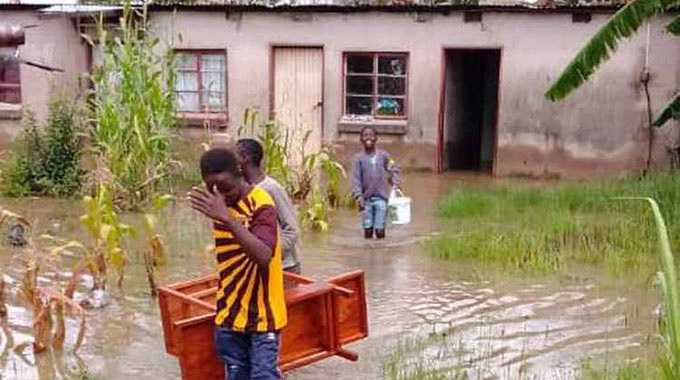
Ray Bande
Senior Reporter
IN elementary development studies, under the disaster management module, there is a disaster cycle section where students are taught that risk mitigation, assessment and prevention involve hazard and vulnerability mapping, as well as congruent structural and non-structural measures.
Similarly, recent floods in areas that have never been traditionally flood-prone, particularly in urban areas, triggered by heavy rains received countrywide, are a worrying trend that requires serious attention and self-scrutiny from all stakeholders, with the aim of reducing risk.
Urban flooding refers to the inundation of a densely populated area due to excess rainfall on a continuous and impervious stretch of land that mostly arises due to an overwhelming capacity of the drainage system and reduced infiltration rate.
Owing to drastic changes in weather patterns, urban flooding is now a common phenomenon.
The 2020/21 rainfall season saw Gweru experiencing exceptional downpours resulting from the unusually high rainfall activity related to the Intertropical Convergence Zone (ITCZ) and several cyclones of different intensities emanating from the Indian Ocean.
In Chipinge Central Business District (CBD), for example, TM Supermarket has become a traditional flooding zone where the grocery shop suddenly turns into a swimming pool each time the area receives heavy rains.
Roads in the south-eastern farming town have been rendered nearly impassable, with deep gullies forming everywhere.
Moreover, bridges connecting residential areas to the town’s Central Business District have been washed away, including the bridge near Dairibord premises that links the town to Mandikisi Prison.
In Mutare, severe flooding has crippled businesses, with warehouses swamped with water, and roads left in a deplorable state, imposing additional costs on motorists and commuters.
Recently, videos circulated on social media showing business grinding to a halt in Mutare, particularly around Grain Marketing Board (GMB) area near Sakubva.
Roads were submerged, rendering them impassable. The increasing frequency of extreme weather events and severe storms has highlighted several factors contributing to urban flooding.
Key among them is the proliferation of new developments in towns, cities, and suburbs.
The expansion of structural development has reduced natural spaces for water to drain, exacerbating the issue. Insufficient drainage systems, small streams, and creeks have further compounded the problem.
As flood waters spread, they pose a significant threat to lives, properties, and businesses, causing destruction of belongings, damage to critical infrastructure, and disrupting access to essential public services.
The aftermath of flooding can have long-lasting, far-reaching consequences, resulting in costly, disruptive, and distressing effects on affected communities.
A pressing question on everyone’s mind is — why are we suddenly witnessing floods in areas that have never before experienced such environmental hazards?
Mutare Town Clerk, Mr Blessing Chafesuka, believes this is a direct result of urban agricultural activities in undesignated areas, including drainage trenches.
Mr Chafesuka said floods in urban areas are not a surprise, given the destruction of vegetation in mountains surrounding cities for urban agriculture.
“It is not surprising that we are now experiencing floods in our urban settings because people have destroyed vegetation in mountains around the city in the name of urban agriculture.
“People are undertaking agricultural activities in areas least expected such as along drainage trenches. How then do we expect water to flow when we receive heavy rains?
Unless mind-sets shift, urban flooding may worsen. While urban agriculture is valuable, its location is crucial. The point is where are we undertaking it.
“In Mutare, for example, some people are even ploughing along the drainage trenches, while some are ploughing along the water pipeline near Golden Peacock and many other areas that ideally should not have any agricultural activities.
“We appeal to residents to see the bigger picture. It is sad and unfortunate that when we intervene, and slash crops along drainage trenches, people try to politicise everything. At the end of the day, we will all bear the brunt when floods affect us,” said Mr Chafesuka.
Mr Chafesuka warned that the worst is yet to come if residents continue with agricultural activities in undesignated areas.
He emphasised that managing flooding in urban areas is a collective responsibility, not that of the local authorities alone.
“The issue of flooding in urban areas is not solely the council’s obligation. Consider what is happening around Christmas Pass or in Dangamvura — people are destroying vegetation in broad daylight to plant maize or gather firewood.
As a local authority, we invested heavily in clearing drainage systems, some of which had not been cleaned in over a decade. Despite our efforts, debris soon clogged the trenches due to these misplaced agricultural activities. If we continue down this path, surely the worst is yet to come,” he said.
In a separate interview, acting Manicaland Provincial Road Engineer Patrick Muropa opined the need to revise infrastructure designs and strategies in light of climate change.
He stressed that local authorities must develop drainage masterplans that account for updated rainfall intensity and frequency patterns.
“Climate change has intensified extreme weather events, leading to flooding. Cities like Mutare must adapt by revising infrastructure designs and strategies.
A drainage masterplan incorporating climate-resilient standards is crucial to ensure that drainage systems can handle increased storm water runoff,” he said.
Echoing Mr Chafesuka’s sentiments, Engineer Muropa underscored the community’s vital role in preventing flooding in urban areas.
“Furthermore, educating the community on proper waste disposal is crucial. Improper waste management clogs drains, worsening urban flooding. A holistic approach, combining infrastructure upgrades with public awareness campaigns, will help mitigate flood impacts and foster a more resilient urban environment,” said Engineer Muropa.



 Online Reporter