admin
admin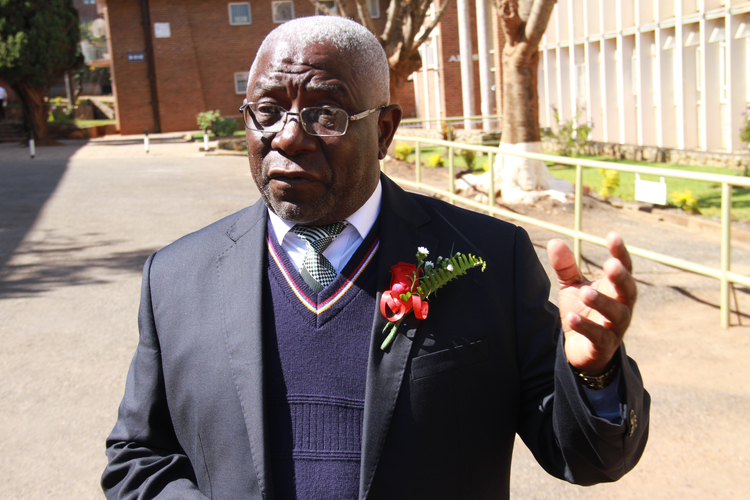

As the University of Zimbabwe celebrates 60 years of existence, the institution’s Vice-Chancellor, Professor Levy Nyagura, is optimistic that the university will become a First World institution and an international academic brand within the next 10 years.
Opening the doors to its first students in 1955, the university is the oldest and largest university in the country.
Prof Nyagura says a bright future awaits the higher institute of learning.
“The future of the University of Zimbabwe looks bright.
“As an institution, we are working towards becoming a First World institution. By 2025, we should be having the capacity to compete with the best universities in the world,” Prof Nyagura said.
Prof Nyagura said within this period, the institution will focus more on creating wealth through the promotion of a business culture at the institution.
“As an institution, we would want to become self-reliant. Within the 10 year-period, we should be able to generate between 65 to 75 percent of our annual budget,” added Prof Nyagura.
As part of the deliberations to mark the anniversary, the UZ main campus is a hive of activity as public lectures and conferences are currently underway.
In a wide-ranging interview, Prof Nyagura spoke about the institution’s milestone achievements, the challenges that the UZ is facing and its future among other issues.
Milestone achievements
Starting off as a tiny structure in 1955, the UZ could only accommodate students from Malawi, Zambia and Zimbabwe during the pre-independence federation era.
From 1963 up until 1971, the institution had an enrolment of 800 students and 600 of them were whites while blacks constituted the remainder.
At independence in 1980, UZ had an enrolment of only 1 000 students.
The institution currently has an enrolment of 12 500 students.
From the single structure, the UZ now boasts of massive buildings that include lecture rooms, halls of residence and offices among others. Since independence, new halls of residence were built and the existing ones expanded.
Prof Nyagura is of the opinion that one of the institution’s post-independence achievements is the introduction of new faculties namely Agriculture, Engineering, Veterinary Science, Law and Commerce.
Colleges of health sciences, pharmacy, dentistry and radiology were also developed. Nursing science was also introduced at a higher level.
The increase in the number of female students learning at the institution is also a notable achievement.
According to Prof Nyagura, 46 percent of the UZ students are female. There has also been a marked increase in the number of female students who are taking up studies in areas that were previously seen as the domain of their male counterparts.
“More and more women are taking up courses that were once regarded as only suitable for men.
“We are having more women in engineering and medicine, among other fields. At one time,
“I had to bend the admission rules so as to admit 66 female students who had attained 14 points,” Prof Nyagura said. The number of female black students studying law has increased gradually and currently 60 percent of law students at the UZ are female.
After introducing the teaching of Chinese at the UZ, the institution is regarded as the best institution that teaches the language in the whole of Africa. Globally, the UZ was named among the five universities in the world that has a high level of excellence in teaching Chinese.
With over 4 000 characters, the Chinese language is very difficult to teach.
Recently, a UZ graduate, Dr Mushangwe, graduated with a PHD in Mandarin, the Chinese language. Seven Zimbabweans are certified to teach Mandarin anywhere in the world. A total of 46 students are also set to study Mandarin in China.
Another milestone achievement by the UZ is the introduction of Swahili at the institution.
After Arabic, Swahili is Africa’s second most spoken language.
UZ graduates who have learnt the language can work in Swahili-speaking countries such as Tanzania, Uganda and Malawi.
Prof Nyagura says the institution’s milestone achievements are too numerous to mention.
“We are the first university in the country to develop a campus-wide computer network, with 6 000 kilometres of fibre connecting the institution. Due to cutting edge research, we are the first institution in the country to construct a real drone. Using tags, we are even monitoring elephants at the Hwange National Parks from here,” Prof Nyagura added.
In recognition of the institution’s high standards of learning, the African Union recently requested that the UZ train its delegation on managing veld fires and floods.
The institution also established a centre of excellence in agriculture where research work has led to the introduction of previously unknown good farming practices.
Challenges
The shortage of student accommodation remains the UZ’s biggest challenge. Of the institution’s 12 500 students, only 4 300 can be accommodated at the Mount Pleasant campus.
“There is urgent need to address accommodation shortages. Every day I ask myself: are those students living outside campus staying in environments that are conducive to learning? The answer to that nagging question is obvious – the environments are not conducive to learning,” Prof Nyagura said. With 46 percent of the UZ students being female, Prof Nyagura said there is need for the institution to provide shelter to the vulnerable girl child.
Self-sustainability
Responding to a Government directive that encourages institutions of higher learning to be self-sufficient, the UZ has made major strides towards weaning itself from Government support. After experiencing serious problems with cadavers that were rotting due to electricity cuts, the UZ made sure that an electricity transformer was dedicated to the institution.
The institution uses the cadavers for their experiments and practical lectures. According to Prof Nyagura, the UZ is self-sufficient when it comes to the provision of water.
“We installed an underground water project and we are currently producing treated water and have also established a water storage system than can store up to 2 million litres of water. By the way, we are the only institution in the country that has a computerised water treatment plant.”
The University of Zimbabwe farm is run as a business and the tobacco that is produced at the farm attracted competitive prices at the auction floors.
Competition from local universities
Over the years, there has been an increase in the number of universities that were established across the country. Asked whether the UZ was not being affected by the emergence of the institutions in terms of competition for the best students, Prof Nyagura said the UZ was “way ahead” of other universities.
“We are the pacesetters and an internationally recognised brand. Wherever you go, UZ is known, other local universities are still to be known. Because of the age and the experience that we have garnered over the years, we are the benchmark,” concluded Prof Nyagura.
Several of Zimbabwe’s universities started as colleges and satellite campuses of the UZ, including Bindura University of Science Education and the Chinhoyi University of Technology.



 Online Reporter