

 admin
admin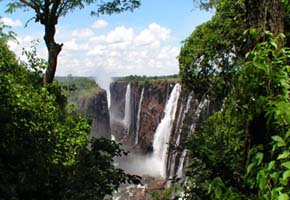
“No individual or grouping can delist it or downgrade it. It is only God who can delist Victoria Falls Rainforest as a natural wonder if the world comes to an end. Fortunately, the world has not ended and therefore we still have the Rainforest as a natural wonder. God as He pleases when the world comes to an end may create the Rainforest somewhere, but for all I know it will be back in Zimbabwe,” said Eng Mzembi.
He said individuals or groups can only grade man-made wonders.
Eng Mzembi also said the publication of the New7Wonders of the World was a result of a private poll of the website, which is not the official position of Unesco.
“We have since established that the status of Victoria Falls has not changed at all. The Rainforest, as a World Heritage Site, is still highly listed as being among the Seven Natural Wonders of the World by the Unesco website and is the only one in Africa,” said Mr Clement Mukwasi, public relations manager for Shearwater Adventures.
He said the mentioning of Table Mountain as one of the new Seven Natural Wonders of the World was simply a marketing gimmick by a website, “The About.com” on the New7Wonders of Nature competition.
“This should not be confused with the long standing ratings of the Victoria Falls Rainforest. These private ratings that are a result of manipulated polls should not be taken seriously. The unfortunate part of it is that sometimes people confuse it with official pronouncements,” said Mr Mukwasi.
He said Victoria Falls Rainforest was among the Seven Natural Wonders of the World and compared well with some of the world’s largest falls such as the Niagara Falls of Canada and the Iguacu Falls, which are found between Brazil and Argentina.
In 1989, Unesco upgraded the Victoria Falls to the status of a World Heritage Site in Zimbabwe alongside Mana Pools, the Great Zimbabwe and Matopo Hills.
Meanwhile, the idea of listing the wonders of the world is hardly a new thing. The historian Herodotus according to the Free Encyclopaedia compiled his own list way back in the fifth Century BC, and from then on many have been unable to resist the temptation of categorising and rating the world’s monuments, both natural and man-made.
The traditional Seven Wonders of the World were the Great Pyramid of Giza, the Hanging Gardens of Babylon, the Temple of Artemis, the Statue of Zeus at Olympia, the Mausoleum of Halicarnassus, the Colossus of Rhodes and the Lighthouse of Alexandria.
These were the monuments the Greeks considered the epitome of man’s creative skill and ingenuity and only the Great Pyramid exists today.
Little wonder then, that in the information age there are moves to make new lists of man-made and natural wonders.
The initiative, New7Wonders of Nature, which is not associated with the Unesco World Heritage categorisation, is the brainchild of the New Open World Corporation, a private company and unsurprisingly in the world of modern technology, the decision was made by public vote.
The New7Wonders of Nature was a follow-up popularity contest to the New7Wonders Foundation, New7Wonders of the World, which were announced in July 2007.
The New7Wonders of Nature, a contemporary effort to create a list of seven natural wonders chosen through a global poll and organised by the same group as the New7Wonders of the World campaign are Iguacu Falls (Brazil), Jeju Island (South Korea), Komodo Island (Indonesia), Puerto Precesa Underground River (Philippines), Table Mountain (South Africa), Halong Bay (Vietnam) and Amazon Rainforest (South America).
Other lists of world wonders include the Seven Wonders of the Ancient World, USA Today’s New Seven Wonders, Seven Natural Wonders of the World, New7Wonders of Nature, the Seven Wonders of the Underwater World, Seven Wonders of the Industrial World. Other Lists of wonders of the world and the Seven Wonders of the Solar System.



 derick.khumalo
 Online Reporter