Online Reporter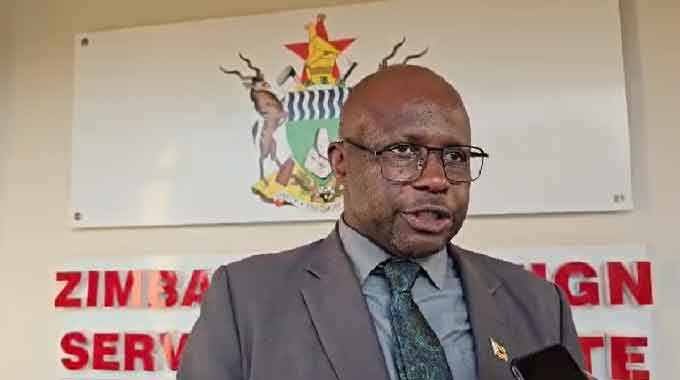
Foreign Affairs and International Trade Minister Professor Amon Murwira had an interactive meeting with media professionals at the Zimbabwe Foreign Service Institute (ZFSI) on Thursday, where he took the opportunity to outline Zimbabwe’s foreign policy doctrine. At the same event, ZFSI announced its initiative to extend training on diplomacy to journalists. Zimpapers Politics Hub reporter GIBSON NYIKADZINO later interviewed ZFSI director of training DR TAPIWA ZENGENI on the idea behind the new initiative. Below are excerpts from the interview.
**********************
Q: What is the background and context of this initiative by ZFSI?
A: The context is that the ZFSI was created through Statutory Instrument (SI) 151 of 2020 from a Presidential decree. So, it has got a dual mandate to train and also to do research and policy advisory for the benefit of the Government in areas to do with foreign relations, international relations, international trade and economic diplomacy, among other elements. Section 14 of that SI clearly outlines the functions of the ZFSI, including to provide training facilities and courses for foreign service officers and other such officers from Government departments.
Then the other chief mandate is to conduct research and analytical studies so as to advise the Government of Zimbabwe on various foreign policy choices and options. This is within the framework that was well-articulated by Prof Murwira in the context of Zimbabwe’s doctrinal values and foreign policy goals because foreign policy issues are very sensitive.
So, the doctrine is the philosophy, is the paradigm, you know, that shapes our relations to design and implement a robust foreign service architecture.
Q: The mandate is to offer training to foreign service officers, and now this mandate is being expanded to media professionals and journalists. How does the media fit in this dynamic?
A: We recognise the media, which happens to be the Fourth Estate, as key to Zimbabwe’s national goals and the national interest.
So, the meeting we just had was to cultivate this partnership and also to, besides articulating the foreign policy goals and doctrinal values, sensitise the media that very soon we will be offering diplomatic courses to train media professionals and journalists.
We are doing this so that we do not only produce top-notch diplomats, but also, through the media, articulate Zimbabwe’s national and foreign policy goals to advance our national interests as diplomats navigate the global arena.
Q: How are your operations structured and how unique is the product or courses you are offering?
A: We commenced operations around 2023, but effectively, in terms of training, from 2024. Up to now, the institute has been training particularly officials from the Ministry of Foreign Affairs and International Trade and other Government departments. It offers a three-month diplomatic course targeting officers, new officials and those who are going to be posted or deployed to various stations and Zimbabwean embassies.
But now, the creation of this institute has deepened and broadened operations to enhance its curricula. Currently, we offer short courses, but of course we have got a vision to grow.
Possibly in future we are going to be offering degrees, and so on. It is expected that the institute shall cooperate with other training institutions or bodies, both local and international, for the advancement of diplomacy and international relations in general.
Q: Will media professionals and journalists be getting the same training as diplomats and is there something you are expecting from the media?
A: We plan to have them receive training and understanding of the country’s national interests, the Constitution, the country’s foreign policy doctrine, the foreign relations and international trade policy and other various documentations that the Ministry of Foreign Affairs and International Trade is codifying.
That is the main objective, which is very important because it actually enables the media to understand and to know the dynamics of our foreign affairs, foreign policy, the values doctrine, and so on.
But this training is dual in the sense that it will train the media practitioners in foreign relations issues, foreign policy, international relations, diplomacy and then in return the media also will be training foreign service officers on other things they are not familiar with or have no expertise on.
Q: From this partnership, what are you expecting media professionals and journalists to impart to diplomatic or foreign service officers?
A: Diplomats also need to develop skills of how to handle the media and also how to deploy the media. Remember, there is traditional media, there is also social media, and from the latter now we have X (formerly Twitter) diplomacy and Facebook diplomacy, for example, and so our diplomats also need to keep abreast with the times.
From journalists, as diplomatic or foreign service officers, we also want them to train us in media skills and how to deploy the media.
This partnership is going to be two-way. We intend to start this very soon, or I can say as soon as possible.
We are already unpacking this. That is why we hosted this event . . .
Q: What informs the desire and guidance for . . . the upcoming interactions between the media and your institution?
A: When you look into the Constitution of Zimbabwe, it clearly outlines where we as a country derive our guidance from. The Constitution, in the preamble, also highlights that Zimbabwe draws its strength from the principles of the liberation struggle and its legacy, including defence of national sovereignty and resistance to external coercion, promotion of sustainable development and full security.
Ultimately, everything is for the good of the nation, the growth of the economy and the prosperity for the people through enabling social cohesion through observance of the founding values of our country. Everything is to be done within the context of who we are, what we want to achieve and what benefits us as Zimbabweans in advancing our goals and protecting our interests.