admin
admin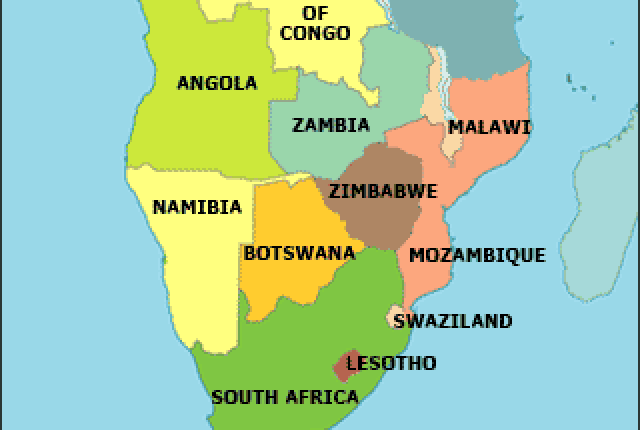
Obi Egbuna Jnr Simunye
For the select few amongst the ranks of so-called African Americans who have always found US imperialism’s concept of Homeland Security not only politically out of bounds, but completely appalling and offensive, each and everyone one of them should be at the forefront of celebrating the recent Bi-National Commission established between the republics of Zimbabwe and South Africa.
The iconic pan-Africanist revolutionary Kwame Toure, formerly known as Stokely Carmichael, would stress to African youth at home and abroad, that so many selfless and fearless servants in struggle are too often denied the privilege of witnessing victory. Two images that immediately come to mind are Cdes Amilcar Cabral, who was assassinated before Guinea-Bissau’s independence, and General Josiah Magama Tongogara, who died in a car crash four months before the flag of Zimbabwe was raised in Rufaro Stadium on April 18, 1980.
While this tragic dimension of the African revolution is responsible for countless tears rolling down the cheeks of our women, children and men, we found solace in knowing that because President Mugabe has been blessed to walk the earth for over 90 years, he has been afforded the opportunity to see the relationship between Zimbabwe and South Africa come full circle.
Because the African National Congress has the distinction of being recognised as Mother Africa’s modern-day oldest liberation movement, which was established in 1912, three years after the NAACP (National Association for the Advancement of Coloured People), the first civil rights organisation in the 20th century was established inside US borders and four years after Partido Independiente de Color (the Independent Party of Colour), the first all African political party established by daughters and sons of Africa in the Western Hemisphere was launched in Cuba, we are reminded that all our organisations and movements regardless of how long they have existed, are in the final analysis, works in progress.
Since we are 40 years removed from the Soweto Uprising and have never forgotten that the plane of one of Mother Africa’s most beloved sons, Mozambique’s first president, the incomparable Samora Machel, mysteriously crashed 30 years ago, it is safe to say that the same African fighting spirit that has always produced warriors of this calibre and prompted our babies to stand up and defiantly reject Afrikaner culture, guided and influenced the decision to establish the Bi-National Commission.
What Mother Africa’s children at home and abroad have overlooked is how the successors of Madiba Nelson Mandela, former South African president Thabo Mbeki and the current President Jacob Zuma, have been put in a rather vicarious position when it comes to correcting his mistakes and dealing with political matters one of Africa’s most decorated historical figures left unresolved.
At the height of his popularity we allowed US-EU imperialism to portray Madiba in a similar if not identical manner to how they have become accustomed to presenting the adventures and exploits of Western movie stars and athletes. The negative aftershock of this dynamic was that Madiba did very little to help empower nations in the SADC region who sacrificed everything for the sovereignty and independence of South Africa.
It can be argued that Madiba stating in 2008 at his birthday celebration that there was a tragic absence of leadership in Zimbabwe, is historically equivalent to the civil rights icon Jackie Robinson deciding to testify against the pan-African artist and human rights champion Paul Robeson before the House of Un American Activities Committee, which Mr Robinson followed up by attacking Muhammad Ali for refusing to enlist in the mandatory draft to fight against the revolutionary people of Vietnam and the immortal Ho Chi Minh. The bitter-sweet aspect of US imperialism’s Jekyll and Hyde construct of the Madiba and President Mugabe is that one of Madiba’s grandchildren said President Mugabe is his favourite African leader.
When Africa’s complete history is written President Mugabe’s decision not to take Madiba to task for his unsolicited attack ranks right up there with the legendary pan-African giant Ahmed Sekou Toure deciding to make Osagyefo Dr Kwame Nkrumah co-president of Guinea, which showed he was completely comfortable in his own skin.
The broader ramifications of Madiba’s words stem from a political atmosphere that saw the now defunct organisation, TransAfrica Forum (TAF), which for many years was guilty of peddling the falsehood that they started the anti-apartheid movement inside US borders, form an alliance with the National Endowment for Democracy to funnel money to 14 civil society groups in Zimbabwe.
This sent a message that it was not contradictory for the most visible political celebrities like Harry Belafonte and Danny Glover, who were on TAF’s board of directors, to work in cahoots with US-EU imperialism for regime change in Zimbabwe. The irony is TAF and the Congressional Black Caucus are credited with establishing the Comprehensive Anti-Apartheid Act of 1986, which former US president Reagan eventually signed.
It appears that a backdoor concession was made between TAF and the Reagan Administration that in exchange for signing this Act, TAF and the mainstream entities who were part of the anti-apartheid network would never pressure President Reagan to honour the Lancaster House Agreement made between former US president Jimmy Carter and former British prime minister Margaret Thatcher and Zimbabwe’s guerilla movements, ZANU and ZAPU, in 1979.
We remember prior to becoming the president of South Africa Brother Zuma was being badgered by the South African media on whether he would introduce a land reclamation programme that would be a duplicate of what President Mugabe and ZANU-PF implemented on the other side of the Limpopo. Brother Zuma’s prompt response was President Mugabe and ZANU-PF were pushed into a corner when US-EU imperialism reneged on the promises made at Lancaster House.
This propaganda offensive by South African media which illustrates that decolonisation from apartheid has yet to be completed, was always discussed by the late Vice President of Zimbabwe and national hero, the Honourable Joseph Msika, who stressed that the manner South African media depicted President Mugabe was never consistent with how the everyday citizen viewed the Zimbabwe question.
Another well-known last ditch effort by the West to isolate President Mugabe was when President Bush called President Mbeki his pointman on Zimbabwe. This rhetoric was supposed to arouse suspicion in President Mugabe and the ZANU-PF top leadership when they engaged the ANC.
During a farewell dinner in honour of former Zimbabwe ambassador to the US Dr Simbi Mubako held at the South African embassy by their former ambassador to the US, Barbara Masekela, our sister discussed how at US State Department briefings, US officials would start demonising Zimbabwe as soon as she walked through the front door. Ambassador Masekela let it be known that Zimbabwe and South Africa were one people with one history.
This shows that the strategy by US-EU imperialism to put the spotlight on well-known South Africans to opportunistically attack President Mugabe like Archbishop Desmond Tutu, Hugh Masekela and most recently Julius Malema makes absolutely no impact. This also goes for Zimbabweans living in South Africa who were coerced by Amnesty International to demonstrate against their Government.
We are thrilled to see Zimbabwe and South Africa strengthen ties and show the world the legacy of the notorious war criminal and invader Cecil John Rhodes is a political and historical afterthought.
Obi Egbuna Jnr is the US correspondent to The Herald and External Relations Officer for the Zimbabwe Cuba Friendship Association (ZICUFA). His email address is [email protected]


 Online Reporter