Theseus Mauruki Shambare recently in Binga
IN Mankobole Village under Chief Saba in Binga District, a cow is more than livestock. It is a bank account that walks on four legs. It is school fees when children need to remain in class. It is food when household supplies run low. It is draught power when farmers prepare their fields. It is a family’s safety net in a harsh environment where every asset matters.
At dawn in this corner of Binga, farmers once prepared for journeys that defined survival.
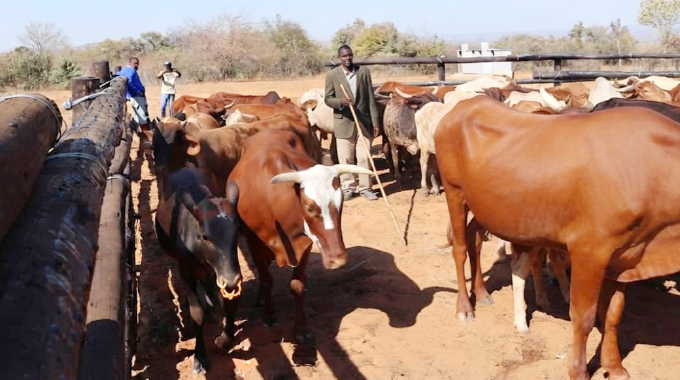
Cattle were gathered and herded for long walks stretching close to 25 kilometres to the nearest dip tank. Under a punishing sun and across dry terrain, that journey was repeated for decades.
It was not a choice. It was a necessity. And all the while, a silent killer was already at work.
A silent erosion of rural wealth
Tick-borne diseases have become one of the most destructive forces in Zimbabwe’s livestock sector, quietly dismantling rural economies and weakening national food security.
The scale of loss is immense.
In 2018 alone, more than 50 000 cattle valued at about US$50 million were lost to Theileriosis, commonly known as January Disease.
Between 2017 and 2022, more than 500 000 cattle succumbed to the disease across the country.
The crisis has continued.
To make matters worse, according to the Ministry of Agriculture, between November and December 2023 alone, Zimbabwe lost 7 004 cattle due to poverty-related deaths, with Matabeleland South accounting for 3 673 and Matabeleland North 2 865.
For Mankobole villagers, these numbers are not abstract. They are empty kraals. Broken livelihoods. Interrupted schooling.
Life on the edge of climate and survival
Much of Binga District lies in agro-ecological regions IV and V, characterised by low and erratic rainfall, frequent droughts and soils that make crop farming increasingly unreliable.
The district receives only 350mm to 450mm of rainfall annually. As a result, households depend heavily on livestock, fishing and other drought-resilient livelihoods. In this fragile system, cattle are not simply animals. They are the economy itself. But climate variability has made survival harder.
Rising temperatures and shifting weather patterns have created conditions where ticks thrive, increasing the spread of disease across already vulnerable herds.
“We were losing everything”
For farmers like Mr Dablo Pendesi, the crisis is written in lived experience.
Since the 1950s, Mankobole has had no local dip tank, forcing generations of livestock owners into long, exhausting journeys for basic animal health services.
“The biggest challenge was that we had no nearby dip tank,” he said in an interview on the sidelines of the official handover ceremony of the Mankobole Dip Tank recently.
“We had to travel long distances with our cattle and sometimes the animals would continue suffering because they were not being dipped regularly.”
The impact went far beyond animal health.
“When cattle die, families suffer because livestock is our wealth. Some children were struggling to go to school because parents could no longer sell cattle to pay fees,” Mr Pendesi said.
The disease behind the devastation
At the centre of this crisis is Theileriosis — commonly known as January Disease — spread by the brown ear tick.
Director of Veterinary Services Dr Pious Makaya said the disease remains one of the most serious threats to livestock production.
“In 2025, more than 60 000 communal cattle were vaccinated against Theileriosis in 25 identified hotspots using the locally developed Theileria BOLVAC vaccine,” he said.
An additional 40 000 cattle were vaccinated against Babesiosis and Anaplasmosis.
Other tick-borne diseases such as Cowdriosis remain under surveillance. Dr Makaya warned that without intervention, the consequences are severe.
“Theileriosis causes swollen lymph nodes, fever and high mortality. Babesiosis destroys red blood cells, leading to fever and red-coloured urine. Anaplasmosis causes severe anaemia and jaundice, while Cowdriosis affects the nervous system and can be fatal,” he said.
For farmers, however, the science is simpler.
A sick cow means a shrinking household economy.
A community-led response
In Mankobole, the solution did not arrive from outside. It emerged from within.
Through the Zimbabwe Red Cross Society’s community-led macro-project approach, villagers identified livestock disease as their greatest challenge and prioritised construction of a dip tank.
The project formed part of the Climate Smart Resilience Programme supported by the Finnish Red Cross and Danish Red Cross.
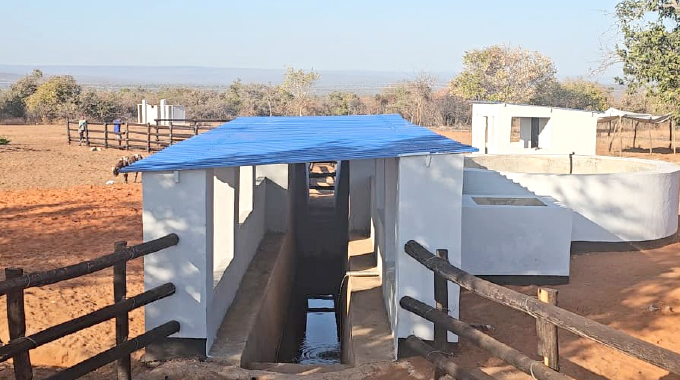
The resulting facility is now fully operational, providing a structured system for regular dipping and disease control. It stands as a critical intervention in improving animal health, protecting household assets and strengthening rural livelihoods in a climate-stressed environment.
But its significance is deeper than infrastructure.
It represents a shift in how rural communities respond to climate and economic shocks — from vulnerability to agency.
‘These projects came from the people’
Zimbabwe Red Cross Society President Mr David Chaliyanika said the project reflects a development model driven by community priorities.
“These projects were not imposed from outside; they were identified and prioritised by communities themselves who worked tirelessly to develop sustainable solutions,” he said.
Finnish Red Cross Programme and Finance Officer Ms Loice Munhenga said protecting livestock is central to protecting rural economies.
“Livestock is the community’s cornerstone of wealth and livelihoods and therefore needs to be protected from diseases. A healthy herd ensures that our wealth is securely preserved at family, community and national level,” she said.
The hidden cost borne by women
For women like Ms Georgina Mnkuli, livestock losses carry a deeper social burden.
“When animals are healthy, families are stronger. A cow can determine whether a child goes to school, whether a family has food and whether a farmer can continue working their fields,” she said.
She said the new dip tank has eased the burden of travelling long distances for livestock treatment.
“Before, we would spend many hours moving cattle for dipping. Now we have a facility close to us, and we can protect our animals before diseases destroy our livelihoods,” she said.
A village story with national meaning
Mankobole’s experience reflects a wider national struggle. Across Zimbabwe, livestock diseases continue to erode rural wealth while climate change intensifies the conditions that fuel outbreaks. In this context, a dip tank is no longer just a rural facility.
It becomes part of a broader national response to protecting food security and rural economies.
A shield against poverty
In Mankobole, the new dip tank is more than concrete and water. It is a line between loss and survival, between hunger and stability, between school dropout and opportunity and also between collapse and resilience.
Because here, cattle are currency and protecting them means protecting everything they represent.
The long walk to survival has ended.
In its place stands a community that is no longer walking alone — but defending its future, one dip at a time.