Online Reporter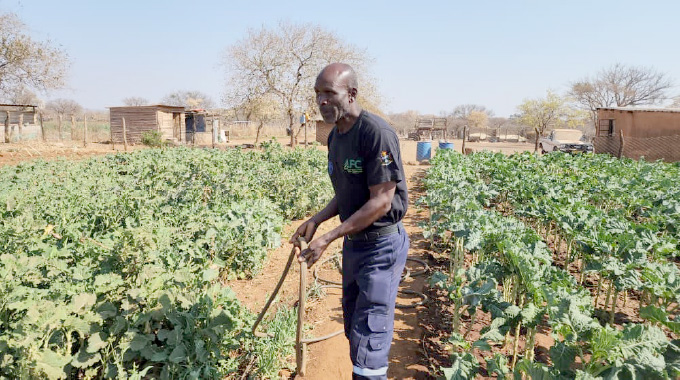
Theseus Shambare, recently in Nyamandlovu
IMAGINE plucking a ripe orange in a desert.
It feels almost biblical — like Hagar and Ishmael, parched and wandering, opening their eyes to find water in the middle of “nowhere”.
But in Nyamandlovu, Umguza District in Matabeleland North Province, this is no miracle.
It is the result of patient labour, local ingenuity and deliberate adaptation to a changing climate.
On a 10-hectare homestead that once yielded little beyond dust, Mr Geshom Dube now walks among citrus trees heavy with fruit, rows of vegetables, a pen of well-fattened cattle and a thriving poultry project.
This is proof that drought-prone landscapes can be transformed into productive, climate-smart farms.
Struggling children, migrant youths
In Matabeleland North, the cost of everyday life has forced many families into untenable choices.
According to a 2024 Zimbabwe Livelihoods Assessment Committee (ZimLAC) report, about 25 percent of school-age children in the province are not attending school due to financial difficulties, early pregnancies, lack of supplies and long distances.
In 2023, 4 557 girls dropped out due to pregnancy, 3 942 from rural schools.
At the same time, many youths are leaving home for the “proverbial green pastures” abroad.
The 2022 census showed roughly 908 913 Zimbabweans live outside the country, mostly in South Africa and Botswana, seeking employment and livelihoods. Some leave school early because fees are unaffordable or because schooling seems irrelevant without a stable future at home.
Geshom’s green homestead: Defying the drought
Against this backdrop, Mr Dube’s story stands out.
Inspired not by modern agronomists but by history books, he studied the struggles of Jewish pioneers in Palestine, who transformed arid lands into productive communities.
“They drained swamps, improved soils, dug wells and planted trees,” Mr Dube recalled.
“History showed me even the harshest lands could yield life. That inspired me to think differently about my own farm.”
Today, his once barren 10-hectare homestead is a green belt of vegetables, livestock, fruit trees and poultry — a model of climate-smart agriculture in a drought-prone district.
The climate challenge in Nyamandlovu
Nyamandlovu lies in agro-ecological Region IV, where annual rainfall averages 450–650 mm and is erratic. Zimbabwe has not been spared from the wider climate crisis.
The Zimbabwe Livelihoods Assessment Committee (ZimLAC) 2024 report estimated 6.5 million people were food insecure due to poor harvests linked to climate variability.
Forest loss, at about 262 000 hectares annually, fuels energy poverty in rural households.
Farmers like Mr Dube are not just surviving—they are pioneering climate adaptation.
Reviving dead soil
Water scarcity was his first hurdle.
“I drilled a borehole because relying on seasonal rains was not enough,” he explained.
He enriched poor soil with fertile topsoil and organic manure.
“The soil was dry and lifeless. I had to bring life back into it.”
University of Zimbabwe lecturer Dr Walter Svinurai, praised such practices.
“Smallholder farmers, who adopt water harvesting, soil enrichment and indigenous plant utilisation are better prepared for erratic rainfall and prolonged droughts,” he said.
Diversification for survival and growth
Mr Dube diversified his farm: rows of oranges, lemons, vegetables and poultry provide both nutrition and income.
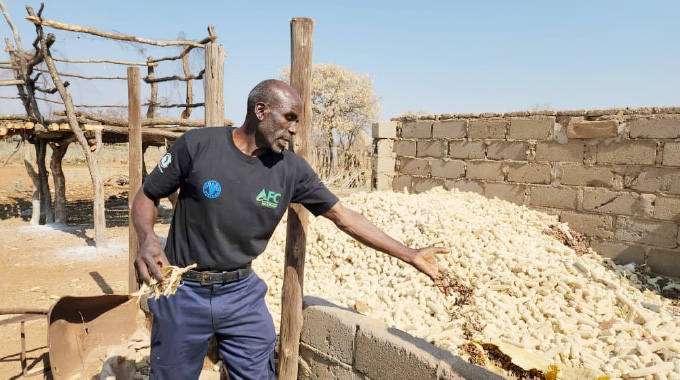
Livestock are fed on a mix of maize stalks, local grasses and wild fruits, reducing reliance on commercial feeds. He plans to establish fishponds for tilapia, leveraging Nyamandlovu’s high heat units.
“This will ensure continuous income for my household,” he said.
He also dreams of a bio-digester to generate biogas, reducing pressure on local forests.
These initiatives resonate with SDG 7 (Affordable and Clean Energy) and SDG 13 (Climate Action), showing local innovation aligning with global goals.
A legacy in the making
Farming is about tomorrow.
Mr Dube mentors his teenage son in gardening.
“If he learns now, he will not be afraid of the soil tomorrow,” he said.
His farm provides fresh vegetables and milk for his family, surplus for local markets and feed for his cattle.
It demonstrates that household-level food security (SDG 2) is achievable with determination and adaptation.
From household to community
Beyond his homestead, Mr Dube co-founded the Phaphamani Irrigation Scheme, one of 12 farmers remaining from the 120 that started it.
“I stayed because I want to see development, not just for my family but for the whole community,” he said.
This aligns with Zimbabwe’s Vision 2030 agenda and the African Union’s Agenda 2063.
Policy connections
The Government promotes Pfumvudza/Intwasa, a climate-proofed conservation agriculture programme mirroring some of Mr Dube’s methods.
Lands, Agriculture, Fisheries, Water and Rural Development Permanent Secretary Professor Obert Jiri spoke of the link between historical practices and sustainable farming.
“The success of Pfumvudza is linked to practices inspired by past agricultural innovations, showing how history can guide sustainable and climate-smart farming today,” he said.
The Government is also finalising its National Adaptation Plan, aligning with the Paris Agreement, with farmers like Mr Dube exemplifying these policies on the ground.
Expert endorsements
Livestock Research director Mr Andrew Chamisa, praised Mr Dube’s approach saying, “Raising local breeds such as Mashona, Nguni and Tuli, combined with locally available feed, enhances resilience while keeping farming affordable.
“Empowering smallholders with climate-smart practices is not just a livelihood issue — it is a national survival strategy.”
Fruits of hard work
Mr Dube’s farm is now a hive of activity: vegetables, citrus fruits, poultry and cattle coexist.
His wife tends the poultry, his son waters the orchard and neighbours learn from his methods.
“I am already feeding my family and my cattle. The next step is to expand and reach more people,” he said.
His homestead has become a living classroom for resilience and innovation.
Building a climate-smart future
As the sun sets over Nyamandlovu, its orange glow mirrors the ripening fruits in his orchard.
Mr Dube walks among his crops, his son by his side, cattle grazing nearby.
His farm is no longer just a household — it is a symbol of how history, innovation and determination can transform dust into green.
“I want to leave a legacy,” he reflected.
“Not just for my family, but for my community. By learning from history, we can fight climate change, feed our families and thrive — even here in Umguza.”