admin
admin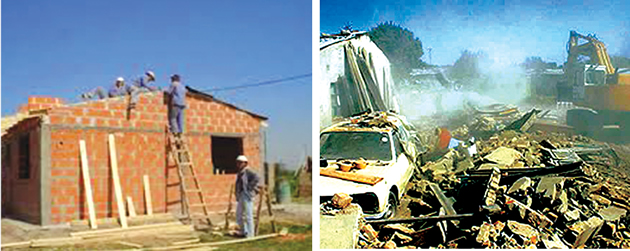
Tichaona Zindoga Acting Features Editor
The building and subsequent destruction by authorities of illegal houses is taking a depressingly familiar cycle. Housing schemes and co-operatives have mushroomed and sprawled in Harare and Chitungwiza under the watch of local authorities but a good number of these schemes later come to grief,
giving the ugly spectacle of machines and men tearing down walls mercilessly amid long faces and shrieks of pain by prospective homeowners.
The word “Murambatsvina”, referring to the first major clean-up operation that saw the destruction of illegal houses and structures in 2005, rings eerily in the ears and its near apocalyptic scenes.
Only this week, the Harare City Council demolished 11 houses built on undesignated land in Glen Norah.
The houses belonged to, according to council, a bogus housing co-operative. The structures were at various stages of construction along Kunzekweguta Road and at Makonye in Glen Norah.
The authorities feel it in their power to destroy such houses which are built at undesignated or reserved places or at critical installations such as under power lines or over water and sewer reticulation systems.
The Urban Councils Act empowers local authorities to put and enforce by-laws that prohibit illegal structures.
The councils effectively deploy Section 18 (2) of the Urban Councils (Model) (Use and Occupation of Land and Buildings By-Laws Statutory Instrument 109/1979) to issue perfunctory warnings and carry out the deed.
Principal communications officer at Harare City Council Mr Michael Chideme this week insisted that the city would go ahead with the destruction of illegal structures and urged residents not to participate in illegal housing schemes.
Better still, those who had should recover their monies, even if it meant enlisting the services of police, he said.
Yet bigger questions remain: who is to blame for the mess? Do people ever learn not to run foul of the law? Why do councils wait for structures to sprout, allow people to settle then pounce on them when they begin to feel comfortable? Is there an end to this confusion?
Experts, stakeholders and ordinary people who talked to The Herald this week expressed mixed views on the issue.
But they all agreed: it is a fine mess.
Stand euphoria
Town planning expert Mr Shingi Kawadza describes what he calls stand euphoria in relation to what is currently obtaining in most urban settings as people seek to own their own piece of residential land which has been fed by housing shortage, with people on the official housing waiting lists running into seven figures.
This euphoria has played into the hands of “land barons” some of whom sell and develop land without the requisite authority. On the other hand, argues Mr Kawadza, city by-laws and planning have not moved with the times.
“For the past decade this has been (the situation) and our planning laws and regulations, council and land barons are all to blame,” noted Mr Kawadza.
“Our town planning laws in terms of housing delivery are so rigid and lengthy and that is causing land barons to use short-cuts in allocating State land.
“Our councils also are to blame as some of their officials are involved in corrupt activities in the allocation of stands. This goes back to the housing delivery process which normally takes 18 months for one to be allocated a properly serviced stand.
“The process is broken down as follows: land preparation nine-12 months, subdivision layout four months, land survey three months, roads, water, sewer designs one month, installation of services three months, house plan drawing and approvals three months,” he explained.
People are neither well informed nor patient enough, says Mr Kawadza.
“Actually, with the current housing demand and backlog the country is experiencing, many people have been made to believe that housing is having a stand and a roof over the head.
“Housing includes other essential services that are important to the welfare of the public, in particular the availability of reticulated water and sewerage infrastructure are more than essential. In summary, housing is firmly embedded in the social, economic and political fabric of the people’s lives.”
Systems failure and the
US dollar factor
It’s all about money.This is the conclusion of another renowned expert in town planning, Mr Percy Toriro.
“The phenomenon of people building illegal houses has gathered momentum within the last decade driven by the use of the US dollar,” Mr Toriro explained to The Herald.
“Certainly, incidences of people selling land illegally to unsuspecting home seekers have increased phenomenally. From the few isolated cases of the past decade, now the cases have become daily occurrences, and it is getting worse. The sales are driven mainly by unscrupulous individuals and cartels that have also been referred to as land barons,” he said.
But some “system failures” have also driven the illegal developments.
“The formal response to housing shortage has fallen short of demand expectations. Housing statistics indicate that while the average figure on the waiting list has been over 150 000 per year in Harare alone, the average number of new stands and houses supplied has always been under 10 000 per year.
“This creates hopelessness and desperation amongst home seekers ready to be taken advantage of by the land barons. Authorities have also not fully appreciated the crisis we are in by quickly approving all issues to do with housing, be it layout plans or building plans. We have created excuses for developers and other parties to say, ‘they will take forever to approve, so let us just start’,” explained Mr Toriro.
Solutions
Experts agree that it may take a while for local authorities and Government to extricate themselves from the current web of confusion. Mr Toriro suggests that a solution can be found in two areas, namely, a paradigm shift in the manner we handle housing approvals as well as full implementation of the Zim-Asset and National Housing Delivery targets.
He explains: “The intention is to deliver 113 368 new housing units nationally over the next three years. If this is done, it will singly be the period in which the country has delivered the highest number of housing units over any similar period of time.
“There should be no excuse accepted for not doing it if we are serious about curbing the entry of opportunists taking advantage of hardworking Zimbabweans who are keen to provide a roof over their families’ heads. Councils must prioritise housing delivery, and the Ministry of Local Government, Public Works and National Housing must strictly monitor this important national programme which is also a basic need and a human right issue.”
He is also of the view that councils as local planning authorities should monitor developments and take corrective measures sooner rather than later.
“It always becomes difficult morally to accept demolitions of complete structures. So we encourage that illegalities are nipped in the bud before too many resources are wasted,” he says.
This is a view shared by civil society.
Mr Simba Moyo of the Combined Chitungwiza Residents’ Trust told The Herald local authorities must be timely in intervening to stop what they consider illegal developments and then temper their reaction when it comes to the destruction of property by paying due regard to human rights.
“You do not correct a wrong by committing another wrong,” said Mr Moyo.
“If authorities are to destroy people’s houses, they should obtain a court order and must also be able to provide alternative shelter. An alert city council should not allow structures to be built over two to three years only to destroy them after,” he said.
He said destruction of people’s houses without an alternative was in violation of Section 74 of the Constitution which provides for shelter as a human right.
“You don’t wake up one day and say that these are illegal houses that must be destroyed and you do not involve the courts. That will be a violation of human rights,” he said.
Other stakeholders suggested the need to stop land barons and for people to be conversant with the operations and legalities of co-operatives.
In addition, it was put forward, Government must foster balanced re-engagement with the international financial community, regional institutions to efficiently supply housing in the country.



 Online Reporter