admin
admin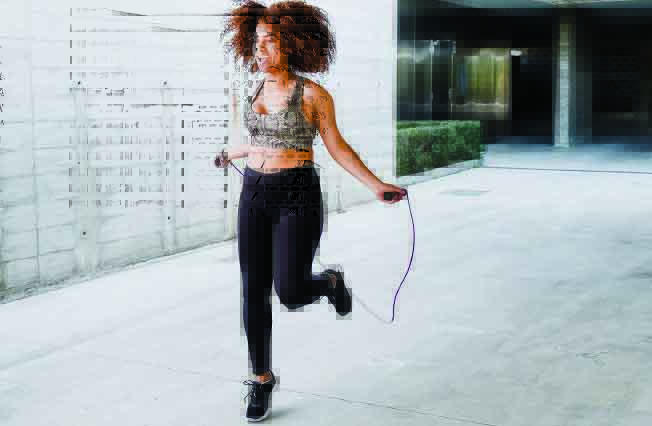
SKIPPING works wonders for your health.
You can take and use a skipping rope (either a standard or weighted skipping rope literally anywhere) — or nowhere, if you would rather stay home.
Is skipping good for you, you ask?
Skipping is a fantastic method for training power, speed and endurance, with key benefits for ankle, pelvic and knee stability.
Skipping is efficient
Fancy footwork aside, skipping exercise is one of the most efficient out there.
A study in Research Quarterly For Exercise And Sport found that skipping for 10 minutes a day delivered the same benefits over six weeks as jogging daily for 30 minutes.
Add in intervals, so go as fast as you can for a set amount of time, then slow down for a certain period, before repeating.
Skipping is a full-body workout
One of the biggest skipping benefits is that it’s a total-body workout, incorporating your arms and shoulders as much as it does your legs.
It also gives poor posture a helping hand by encouraging you to pull your shoulders back and out of the hunched posture in which you probably spend most of your day.
Skipping can strengthen your bones
In one study, women who jumped on the spot three times a week for six months increased their lower-body bone density, getting the jump on osteoporosis in the process.
Skipping is mentally challenging
The only thing standing between you and skipping success is, well, you.
Because it’s tricky to navigate an efficient and effective warm-up or workout when you’ve psyched yourself out so much that you trip over every two seconds or whip your shins like a religious flagellant.
Stick with it.
“As tedious as it sounds, it’s all down to practice,” says Christa DiPaolo, creator of Equinox’s The Cut: Jump Rope class.
“You can always grip both handles in one hand and swing the rope on one side while you practise your basic bounce.
This will help you get comfortable before actually skipping,” she suggests.
Skipping is for everyone
While your skipping technique can be mentally challenging, once you have got to grips with it, it really is for everyone.
You can adapt the workouts to suit all abilities, simply by changing your pace (i.e. how fast you skip), and the duration of your skipping sessions.
Somewhat counter intuitively, weighted skipping ropes that engage more muscles can also make skipping easier for beginners.
“It naturally slows down the rotation, which will set you up for success with a lighter speed rope,” adds DiPaolo.
Then, once you’ve learnt the technique, a heavier one will scale up the demands on your body and bring your results on leaps and bounds.
Skipping is cheap
Skipping can be done anywhere, so long as you have room for the rope to pass your head.
All you need is a skipping rope, most of which you can bag for under $5.
The Basic
Standard jumps – 20 seconds
Rest – 10 seconds
Right foot hops – 20 seconds
Rest – 10 seconds
Left foot hops – 20 seconds
Rest – 10 seconds
High knee jumps – 20 seconds
Rest – 10 seconds
Standard jumps – 20 seconds
Rest – 10 seconds
Rest one minute. – Online.



 Online Reporter