Online Reporter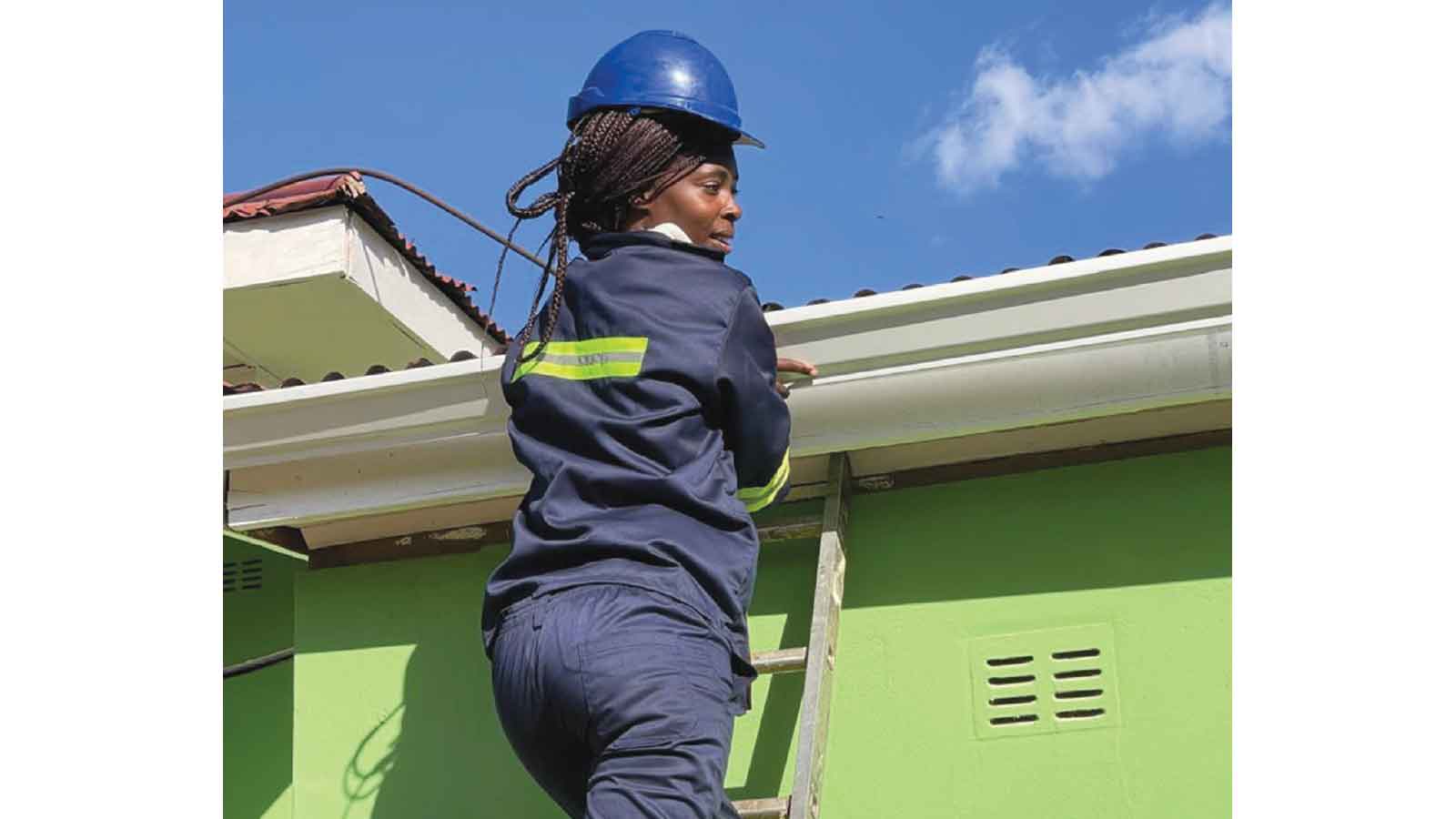
Fatima Bulla-Musakwa
Features Writer
WHEN a lorry unloaded concrete at dawn outside Sally Mugabe Central Hospital in Harare recently, the workmen who gathered along the kerb expected the usual: men giving orders, carrying blocks, measuring and directing traffic.
Instead, two women—hard-hatted, steady-eyed, with hands stained with cement—walked the site as equals. They were not an anomaly. They were the start of a movement.
The Association of Women in Construction (AWIC), registered in 2021, is more than a membership list. It is a deliberate rebuke to a long-entrenched assumption that construction is men’s territory.
Founded by Susan Alivinyu and Masciline Natalie Adams, AWIC brings together more than 30 firms that are 100 percent women-owned, including youth-owned businesses and enterprises run by women with disabilities. Their aim is to ensure that women control every aspect of their enterprises, speak with one voice and seize opportunities traditionally associated with men.
“We want to see women being paid,” said Alivinyu. “If you give a man a 20 percent share in a business, he will take over and push the woman to the sidelines.”
The association insists on full female ownership precisely to prevent that sidelining and to pave the way for women to run projects ranging from tarred roads to major plumbing contracts.
The road to this point was not paved with grant letters and glossy launches. It was dug, hauled and sometimes slept through.
Alivinyu learnt plumbing at her father’s elbow in Mazowe, watching him tuck pipes into walls and bargain with suppliers. But the same father who taught her a trade also denied her formal education.
He believed investing in girls was wasteful because “they would marry and bear children”.
When her father left for a new family after fathering a boy, Alivinyu’s schooling stalled. Without school fees, she completed her Ordinary Levels, but could not collect her results. For two years she stayed at home, then married in search of security, a decision that brought 27 years of emotional and financial abuse.
“I remember when my second child was starting Grade One, we spent a week with the children sleeping in the toilet,” she said. “He would throw away my oranges and tell me he wanted to cause me pain since I would not be able to feed the children.”
Vending became her lifeline, while being locked out of her home became routine. Only after leaving the marriage did she take over her father’s plumbing business, register a company with her sister in 2018 and begin bidding for contracts, often out of a briefcase.
Adams grew up with a similar message: girls did not deserve investment. In Concession, Mashonaland Central Province, her mother sold oranges and plaited hair to keep the household afloat — and to fund her children’s schooling.
In Form One, the school’s practical subject choices steered her towards Building. She took it. Eleven years later, she runs a multi-disciplinary construction firm undertaking shopfitting, repairs, painting, carpentry, electrical and plumbing works, water and sewer reticulation, and road rehabilitation.
The two met during a site visit to Sally Mugabe Central Hospital and discovered a shared experience and ambition. With legal assistance, they applied to register AWIC. Covid-19 delayed the process, but in 2021 the association became official, with Alivinyu as president and Adams as youth president.
Membership rules are strict by design; every member company must be wholly women-owned to protect leadership and revenue from being diluted.
AWIC’s mission extends beyond contracts. It mentors women entering the industry, helps them access training and capital, and uses the association’s platform to tackle social problems such as drug abuse, teenage pregnancy and the stigma that discourages girls from pursuing technical training.
“Acting as a platform gives us the confidence to use our personal experiences as a launching pad for other women,” Alivinyu said.
Their work has started to produce visible results. AWIC members have completed projects for Government and parastatal clients. Adams is overseeing ceiling repairs at the Zimbabwe Manpower Development Fund and electrical upgrades at Manyame Air Base. Alivinyu has installed garden irrigation systems at Grain Marketing Board offices and supplied tiling materials to Sally Mugabe Central Hospital.
Those contracts, they said, are proof that women can deliver projects of scale and complexity.
Government policy has helped. Ministries and empowerment initiatives aimed at micro, small and medium enterprises (MSMEs) and cooperatives have created pathways for women to access markets and capital.
At the recent National MSMEs and Cooperatives Indaba, AWIC showcased its capabilities alongside development partners, industry leaders and financiers. President Mnangagwa told delegates that small and medium enterprises (SMEs) now account for more than 60 percent of Zimbabwe’s gross domestic product and employ millions — an assertion that AWIC’s founders cite as validation of their strategy.
Yet the association’s leaders say policy alone cannot erase prejudice.
“We get harassed when clients discover we are women,” Alivinyu said. “In meetings, when you ask a question, you are ignored because the attitude is that we know nothing about construction.”
To counter this, she proposes quotas in public tenders for female-owned firms, a mechanism already used in other sectors, and equal allocation of national projects between male- and female-owned companies.
“If a male-owned company gets the National Sports Stadium tender to supply bucket seats, women should be allowed to compete for Rufaro Stadium,” she suggested.
Adams added a blunt test: “Give us 10 kilometres of road to build so people can see we can do it.”
AWIC is also pressing for formal recognition and categorisation by Government departments such as the Ministry of Local Government and Public Works. Currently, only two member companies are correctly categorised by line of business, a bureaucratic detail that limits access to sector-specific tenders and opportunities.
Their case is simple and strategic: visibility on national projects destroys stigma. High-profile deliverables build trust and attract follow-on work. With a platform, networks and legal registration, AWIC can move from sporadic successes to systemic participation.
But the story behind the achievements is what gives the Association of Women in Construction its moral force. These women fought personal and cultural resistance to build businesses, employ staff and support households.
They learnt about pipes and pricing, apprenticeships and accounts, bonding and boldness.
They have turned humiliation into expertise and exclusion into association. They want other women who look at cement mixers and see only exclusion to instead see opportunity.
“This is about changing the narrative of what women can do,” said Adams. “We want the next generation to grow up knowing that construction is a career for them too.”
If that seems a modest ambition, consider the stakes. Construction shapes cities and livelihoods. Roads and hospitals, water systems and schools—the work of builders—determine how people access services and markets. When women build, they change not just skylines but priorities and livelihoods, and they expand the circle of those who benefit from national development.
The Association of Women in Construction’s members still face barriers: prejudice in procurement, limited access to working capital, and the invisible labour of childcare and community expectations that still falls disproportionately on women.
But they have developed a strategy calibrated to address those challenges—mentorship, full-ownership rules, public engagement and targeted advocacy for quotas and the allocation of national projects. They have crafted an argument that is both technical and moral: give women the work and watch them deliver.
Outside Sally Mugabe Central Hospital that morning, a foreman who had scoffed earlier watched a female-run team align tiles with the same precision as any crew he had supervised.
He did not say much.
He did not need to.
The work spoke.
For Alivinyu and Adams, the work always has. They want it to speak for an entire generation.