Online Reporter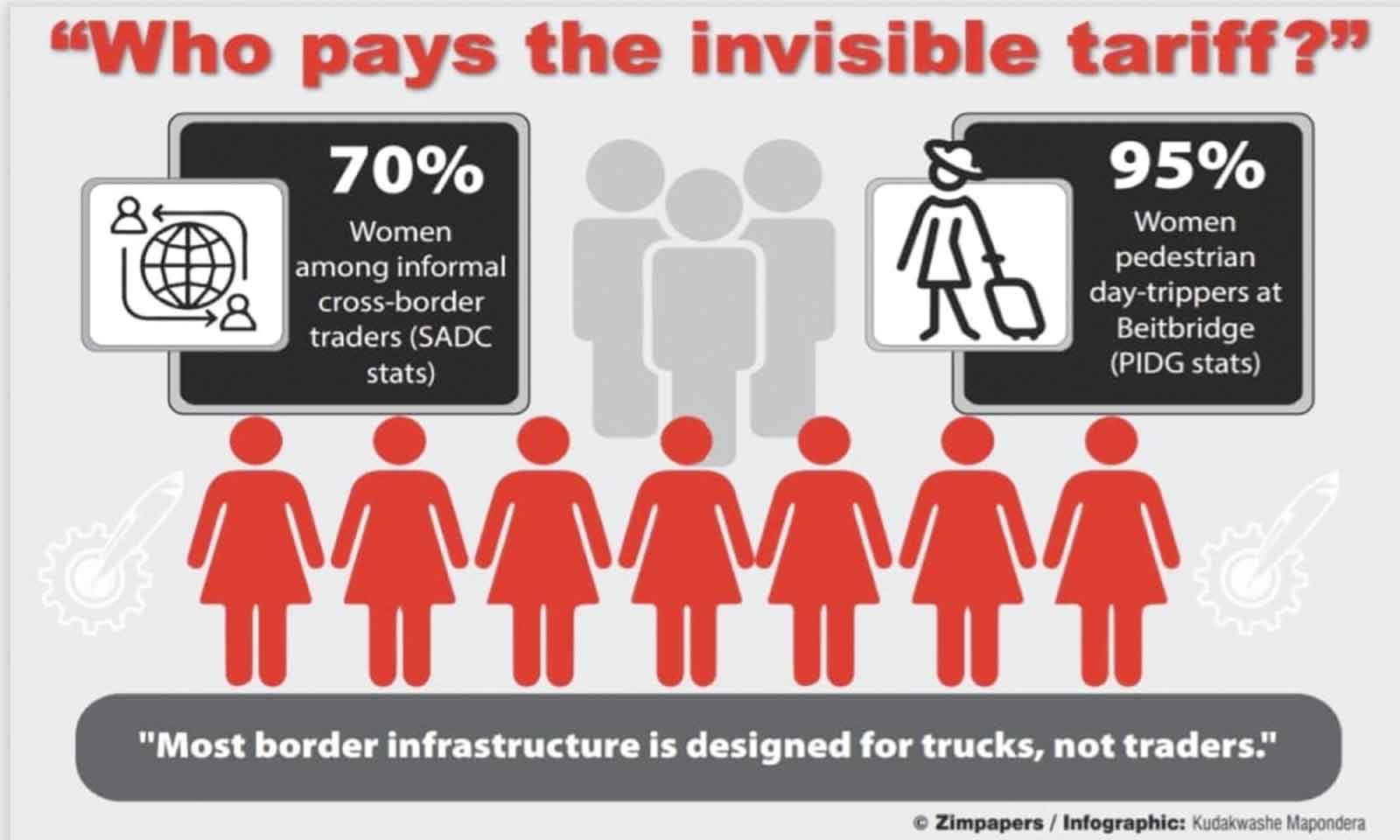
Tawanda Musarurwa recently in CHIRUNDU
AT 4.17am, while most of Chirundu is still asleep, Memory Chikanga steps into a border queue that already stretches beyond the floodlights.
She has crossed this line into Zambia hundreds of times. She knows which goods are cheaper on which side, which taxi drivers will wait, which customs officer is likely to ask questions, and how long tomatoes can survive before heat and delay turn them into loss.
Every extra hour at the border costs her money she does not have.
Memory (29) lives in Mopane suburb, a few kilometres from the Zambezi River crossing.
On most mornings she leaves before dawn, walking or catching a shared taxi to buy baby clothes and food items she will later resell in local markets. Border queues can last several hours.
“Every hour I wait is money lost,” she says.
Across Southern Africa, tens of thousands of traders like Memory begin their work this way – carrying sacks of vegetables, bundles of used clothing, crates of citrus or plastic tubs filled with bread rolls. They walk past customs officers, negotiate with taxi drivers and, depending on the border, sometimes pay small, unofficial fees simply to move.
Together, they form the human infrastructure of regional trade.
They connect rural producers to urban markets, stabilise food supplies and move goods across national boundaries every day. But, the economic systems that depend on their labour rarely record it.
This investigation draws on regional trade data, gender-focused border surveys and corridor monitoring to examine how informal cross-border trade has become both an economic lifeline and a structural blind spot in SADC integration. It also explores why policy tools such as the Simplified Trade Regime (STR) have been slow to reach the very people for whom they were designed.
Women carry the trade
Across the region, women dominate small-scale cross-border commerce. The COMESA Border Profiling Survey: Gender and Informal Cross-Border Trade (2023) states directly that “women make up approximately 70 percent of informal traders in the SADC region.”
At some crossings, the concentration is even higher. According to the Private Infrastructure Development Group (PIDG), at Beitbridge – Zimbabwe’s main gateway to South Africa – an estimated 95 percent of pedestrian terminal users are women day-trippers. However, most border infrastructure across the region remains designed for freight, not for the human-scale trade that keeps markets stocked.
Because they lack formal export documents, transport contracts or storage capacity, these traders remain vulnerable to harassment, unofficial fees and delays that can ruin perishable stock. Their economic efficiency depends on speed; their vulnerability grows with every hour spent waiting at a checkpoint.
Data gaps
In official reporting, SADC trade appears to be strengthening.
The SADC Annual Report 2023/2024 notes that “intra-SADC and SADC extra-regional trade showed signs of improvement at an estimated 23 percent in 2022,” a figure widely interpreted as progress towards deeper regional integration.
But, these statistics capture only formal flows recorded at customs stations and within national trade databases. They do not reveal the scale or structure of informal flows – flows that keep local markets supplied with basic goods, but remain largely undocumented.
This invisibility is beginning to shift. The COMESA Border Profiling Survey introduced, for the first time, systematic gender-disaggregated data on small-scale cross-border trade, allowing analysts to distinguish male and female trading patterns across multiple corridors.
It represents one of the region’s most rigorous attempts to quantify informal trade and is essential for any gender-sensitive reform.
Nonetheless, raw figures conceal the human cost of informality.
A trader who makes the equivalent of between US$6 and US$10 in daily net income can lose two to three days’ worth of earnings when delays cause produce spoilage or when small bribes are required to pass through a checkpoint.
The FinMark Trust Regional Small-Scale Cross-Border Trade Study (2022) documents repeated instances where perishable loss alone accounted for up to one-third of a trader’s potential weekly margin.
Such losses never appear in national trade statistics, although they shape the economic lives of tens of thousands of households.
Delays: the invisible tariff
One of the most significant policy developments in recent years has been the introduction of systematic border-efficiency metrics.
Earlier in February, SADC formally announced the Time Release Study (TRS) along the SADC Regional North-South Trade Corridor, designed to measure the actual time it takes for goods — and people — to clear the border.
The TRS model, used globally under the World Customs Organisation framework, treats time as both an economic variable and a trade-facilitation indicator.
Small-scale traders are disproportionately affected by delays. A transport company can absorb a four-hour wait across multiple consignments, but a trader carrying 20 kilogrammes of tomatoes cannot.
Observational data from the FinMark Trust study, combined with corridor snapshots in the 2023 COMESA survey, show queue times frequently measured not in minutes, but hours.
A delay of more than three hours materially increases the risk of spoilage for fresh produce.
For many micro-traders, this invisible tariff – paid in time rather than currency – is as significant as any formal fee.
According to PIDG, evidence from the Beitbridge modernisation shows that these delays are not inevitable. Following a 2020 public–private-partnership upgrade, average non-commercial crossing times fell to around three hours, from previous waits of between 35 and 65 hours. Time – the most punitive cost for micro-traders – proved responsive to policy.
Chirundu is now slated for a similar intervention. In July 2024, the Government signed a memorandum of agreement with the Chirundu Border Consortium for a US$66 million facelift of the one-stop border post. If implemented effectively, it could dismantle the very time-based tariff that traders like Memory currently pay in silence.
Broken promises
Regional trade frameworks consistently promise support for small traders, including simplified permits, harmonised customs processes, one-stop border posts and the electronic exchange of certificates.
The SADC Secretariat highlights these commitments in the Executive Secretary’s Report 2024/2025, which states that “implementation of simplified trading arrangements . . . enabled an increase in informal cross-border trade.” The intention is clear: to reduce procedural barriers and encourage formalisation.
However, implementation remains uneven. The STR, the most trader-focused tool, is in place in parts of COMESA and the East African Community (EAC), but in the SADC region its rollout has been limited and inconsistent.
Although the COMESA and EAC STRs are already operational in multiple member states, SADC’s STR framework was only concluded in August 2024 and formally signed on October 18, 2024. Its accelerated implementation plan is only now being operationalised – underscoring how recent, partial and uneven STR implementation remains across southern Africa.
The result is a patchwork. At some borders, a trader encounters a functioning one-stop border post or a digital single-window system that consolidates paperwork. At others, she must navigate multiple agencies, duplicated forms and unofficial gatekeepers. The lived experience of trade varies dramatically from one crossing to the next.
At Beitbridge, infrastructure reform has gone further – reducing illegal crossings and raising Government revenue, demonstrating that facilitation and fiscal performance can reinforce each other. Elsewhere, in the absence of such investment, traders are pushed back into informality.
Economic analyst and former secretary-general of the COMESA Business Council (CBC), Mr Trust Chikohora, argues that this informality is not accidental but systemic.
“Formalisation is best achieved by lowering the cost of compliance,” he says. “When we talk about intra-regional trade being pushed mainly by female traders, it is true – and most of these goods are sourced within the region.
“That should prompt a hard look at whether duty regimes are genuinely promoting intra-regional trade, and whether countries are adhering to the principles of free movement of goods and free movement of people.”
Reform, he adds, must also occur within member states, not only at border posts, including the provision of efficient, accessible markets that allow small traders to operate legally and profitably without being priced out of the system.
The price of passage
Although quantifying corruption is inherently difficult, multiple sources document its impact. The FinMark Trust study describes persistent “unofficial payments requested at various stages of the crossing process,” often small in absolute terms but significant relative to traders’ slim margins.
Non-governmental organisation (NGO) monitoring reports from 2021 to 2024, including gender-focused research by regional women’s associations, consistently identify harassment – verbal, physical and financial – as a barrier that both discourages formalisation and reinforces gender inequality.
Formalisation initiatives aim to reduce these risks by offering clear guidelines and documented procedures.
However, these same initiatives sometimes introduce fees or administrative burdens — licensing costs, tax registration obligations and document requirements — that informal traders find overwhelming.
“The licence, the forms and the taxes all cost money and time. By the time you finish, there is nothing left to trade with,” said another crossborder trader at Chirundu.
A trader’s day
Drawing on data from the COMESA Border Profiling Survey (2023) and the FinMark Trust Regional Study (2022), it is possible to reconstruct a typical working day.
A micro-trader wakes around 3am, travels between one and three hours to the border, and queues anywhere from three to six hours depending on traffic and staff availability. After crossing, she reaches the market around midday, sells what remains unsold from the previous day or what survives the delay and begins her return journey in the late afternoon.
Transport charges, stall fees and unofficial payments erode an already narrow margin. By the time she returns home, often after dark, her net income may fall below a living wage.
At upgraded crossings such as Beitbridge, traders report improved safety, lighting and sanitation – design changes that reduced harassment and restored dignity. Dignity, it turns out, is a trade-facilitation tool.
These dynamics underscore the importance of targeted trade facilitation that focuses not only on large infrastructure investments, but also on small-scale administrative reform. Simplified electronic permits, rapid dispute-resolution points at border posts and explicit protections for women traders can reduce the time-related costs that trap traders in cycles of low profitability.
What must change
A clearer path emerges when recent regional data is considered together.
Gender-disaggregated monitoring must become standard at every major crossing point so policymakers can track who trades and under what conditions. Time-based metrics such as the TRS must evolve into publicly available performance dashboards that make border delays a policy priority rather than an anecdotal complaint.
Formalisation frameworks must be redesigned with micro-traders in mind, removing procedural hurdles rather than adding them. The STR, in particular, requires rigorous pilot testing and public evaluation to determine whether it reduces vulnerability and increases profitability for small-scale traders. Without evidence, policy remains aspirational rather than transformative.
Beitbridge now serves as a regional benchmark, with at least nine similar border public–private partnerships announced across Southern Africa.
The persistence of long delays elsewhere is therefore not a capacity problem, but a policy choice.
By the time Memory returns home, often after dark, the margins are gone. Transport costs, stall fees, small payments demanded along the way and the hidden costs of delays consume most of what she earns.
None of this registers in official trade data.
Regional integration is counted in percentages and protocols.
But, at the border it is measured in hours lost, produce spoiled and income quietly surrendered to move.
Until time is treated as an economic cost – and informal traders as economic actors – SADC integration will continue to be subsidised by the unpaid labour of women who never appear in the statistics.



 Bongani Ndlovu