Online Reporter
Victoria Ruzvidzo-Editor’s Brief
If China did it, Zimbabwe can do it too.
THIS may sound like pure daydreaming, but my recent two-week stay in China has shown me that all is possible.
China went through wars and serious poverty levels, but it was determined to wiggle itself out of this and it did achieve results.
Today it’s a trillion-dollar economy and still counting.
I have often been commended for being an eternal optimist, and almost in equal measure I have also been vilified for choosing to see the glass as half full instead of half empty.
Fortunately the criticism has not dissuaded me from a thought process that sees the possibility of a beautiful story coming out of this country despite present challenges.
Today, China is the second biggest economy (if not the biggest) but at one point it was really struggling.
This indicates that no country is condemned to permanent challenges but it can pick itself up and become a global giant.
So it is with Zimbabwe. The economy has been facing challenges and is on the road to recovery. Just like China, this country has the wherewithal to become an economic powerhouse through determination, discipline and a huge dose of tenacity.
Of course we cannot be like China in terms of its size and other factors, but we can achieve success in our own right and definition.
My recent visit to that country did not only reveal new developments, but cemented my previous experiences in this giant nation that mesmerises visitors at every turn, be it in terms of road infrastructure, its transport system or the quality of exhibitions it hosts.
It is not a giant just in terms of geographical size and population but its performance as an economy, and the extent to which it is leading technological advancement is out of this world.
It is commonplace to meet an average-sized robot in the lobby directing itself to an elevator so it can go to the 5th floor, room 517, to tidy up the place and return to the lobby once it is done, awaiting its next assignment.
It was almost eerie to some of us not too exposed to such technology yet.
Our group of 22 editors and reporters from Zimbabwe was taken through lectures and physical tours by the Hunan International Business Vocational college, from which we emerged more knowledgeable about China’s socio-economic development thrust.
The lectures were quite informative and revealing while the tours to Shanghai, Hangzhou and Changsha where we were based, left us in awe of developments in the Asian country.
Poverty alleviation strategies, promotion of tourism through film and adoption of new technology in the media and elsewhere in the economy were an eye-opener,
The seminar was hosted by China’s Ministry of Commerce as relations between our two countries are consolidated.
China has managed to lift more than 800 million people out of poverty and has gone on to be a vibrant economy. In one of the lectures we were taken through the various stages and strategies employed by China to reduce poverty levels
The country embarked on economic reforms in 1978, initiated by Deng Xiaoping. It essentially shifted from a planned economy to mixed one.
A number of factors propelled its development trajectory. China opened up to the world with aggressive policies that were focused on foreign direct investment, putting emphasis on Special Economic Zones. These offered tax incentives, seamless regulations and infrastructure support.
This is one strategy Zimbabwe has also adopted over the past decade or so in its endeavour to attract investment,
The broad market was inevitably an attraction as it provided a huge consumer base. It was also seized with infrastructure development, building roads, bridges, airports and ports.
The skilled and low cost labour was and still is a business enabler. It goes without saying that government support was instrumental, as it always is in any economy.
Government officials were predisposed to support investment and other opportunities. FDI brought capital, introduced advanced technology, created jobs and boosted exports. This was particularly pronounced in the 1990s and 2000s
China became a global manufacturing hub, underpinned by a large workforce and competitive labour costs. As alluded earlier, infrastructure development put it in very favourable stead, facilitating trade and economic growth.
Furthermore, huge investments were made in research and development, a trend which obtains to this day. For example, China spent between US$418 billion and US$456 billion on Research and Development alone, a figure only surpassed by the United States, which spent US$800 billion in the same year
China was also helped by large scale urbanisation as a significant number of people moved from rural areas to urban cities, creating a broad workforce and driving economic growth.
Foreign investment came from US, Japan and South Korea largely. One may be forgiven for asking where the funding came from. State-Owned Enterprises provided some funds, much like Zimbabwe used to a while back. Thank God there are substantive reforms in that area.
Research shows that China also funded its projects through foreign exchange reserves, which were very significant and derived from trade surpluses. The government also issued bonds to finance infrastructure projects and other priority areas.
State-owned banks such as China Development Bank also provided finance while the government allocated substantial amounts for its development programmes.
Sovereign Wealth Funds, such as China Investment Corporation, invested in strategic sectors of the economy, while domestic savings were also a factor. The international Monetary Fund paid tribute to China in a paper entitled “China’s Export-Led Growth Model”.
All this is not to say China does not have challenges. China has recorded impressive growth rates in the last few decades.
Some statistics will attest to this. Between 2004 and 2007 it recorded 10.7 percent and 14.2 percent. In 2010 it was 10.6 percent. Then between 2011 and 2015 it averaged between 6.9 percent and 9.5 percent.
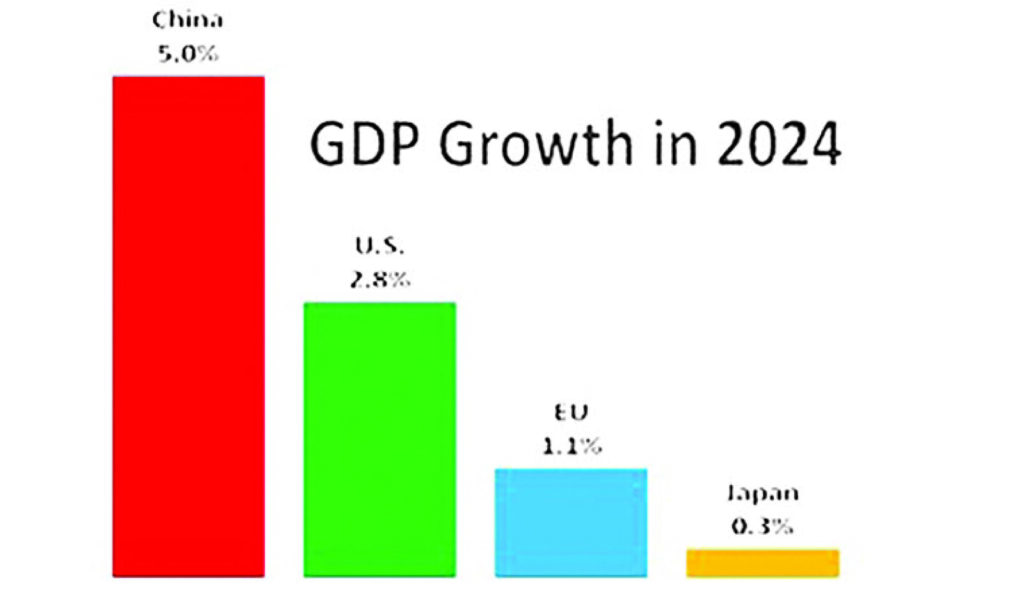
It has, however, slowed to a 5 percent growth in 2024. Some economists argue that every economy reaches a point where it levels off. Others argue still that China’s economy is undergoing a transition to a more balanced and sustainable growth model which entails slower growth rates.
However, China, like every other country, is also susceptible to global economic uncertainties which are impacted upon by global economic trends such as trade tensions and pandemic-related disruptions. The trade war with US has not helped.
China also faces structural challenges such as a rapidly aging population,a declining labour force and environmental degradation which poses a clear and present danger.
China’s overall unemployment figures stand at 4,10 percent, and that is less than the USA whose figure hovers around 6 percent.
The country has shown the world how economic trajectories can be fashioned. There is no denying the unity that is prevalent in the country. China’s shared culture, heavily impacted upon by Confucianism, emphasises social harmony and collective identity.
Its economic development has created a sense of shared progress and national pride,lifting millions out of poverty and consequently enhancing international pride.
Government initiatives such as the system of regional ethnic autonomy, encourages groups to strive for common prosperity. Its global vision is there for all to see.
It is exhibited by programmes such as the Belt and Road Initiative. The global Gross Domestic Figures are telling. In 2024,the top 5 performing countries were as follows:-
1)US US$30.51 trillion
2)China US$19.23 trillion
3Germany US$4.74 trillion
4)India US$4.19 trillion
5)Japan US$4.19 trillion
There are and clear lessons China to Zimbabwe.
As in all learning, we adopt that which works in our peculiar circumstances. We are a nation blessed with much resources that we can fully leverage on.
As with China, we can grow this economy at phenomenal rates. We have most of the ingredients required in terms of resources at our disposal, to achieve real growth. The success of such programmes as the National Development Strategy 1 shows that it can be done.
Yes we can!
In God I Trust!
X handle: @VictoriaRuzvid2; Email: [email protected]; [email protected]; WhatsApp number: 0772 129 972.