


 malvernmugadzikwa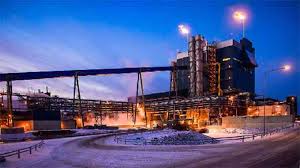
Oliver Kazunga
Senior Business Reporter
MIDLANDS-BASED Zimbabwe Alloys Limited (ZimAlloys) has resuscitated its smelting plant for the first time in 11 years following the company’s takeover in 2019 by Kuvimba Mining House (KMH), which has injected nearly US$7 million into the business.
ZimAlloys, which is reasserting itself as a leading alloy producer in the country, is targeting 120 000 tonnes of high-carbon ferrochrome annually.
The company had been under corporate rescue for about eight years, and stopped smelting in 2013, before KMH took over.
The alloy producer was placed under corporate rescue due to a combination of factors, including a significant dip in the price of high-carbon ferrochrome on the international market. At that time, the furnaces were due for realignment and the company did not have funding to undertake the project.
Briefing the media before a tour of the company’s smelting plant in Gweru on Thursday, ZimAlloys managing director Mr Deric Dube, who is also KMH head of the bulk minerals cluster, said their first smelting furnace under Phase 1 of rebooting production was restarted last month. No major technical challenges have been experienced since the restart of the smelting furnace.
KMH, which is under the Mutapa Investment Fund, is the country’s largest mining conglomerate and is the major shareholder in ZimAlloys, with an 85 percent stake, while 15 percent is held by Core Metal, a foreign entity.
“We have restarted smelting after almost 11 years of no smelting happening here. The smelters at Zimbabwe Alloys closed in 2013 and 11 years later, we have restarted the first one, and we’re not stopping there.
“Our plan is to actually set up a completely greenfield furnace in the next 12 to 18 months, subject obviously to the conditions of manufacture, construction, commissioning of that furnace.
“And the target is to eventually get to 120 000 tonnes per annum of high-carbon ferrochrome production,” he said.
High-carbon ferrochrome is a ferroalloy used in the production of stainless steel and other chromium-containing alloys.
“For now, we’re excited to be back and be part of the smelting industry in Zimbabwe and to be a participant and a strong voice in that particular space.
“Around US$7 million has so far been spent and this spread between recapitalisation, restart of old furnaces, as well as equipment acquisition,” said Mr Dube.
He said KMH has invested quite a significant amount of money in taking ZimAlloys out of a substantial debt position, where the entity owed local and foreign creditors.
“Basically, we’ve been able to paint our own picture and grow our business without the burden or the holdback of having to pay back debts.
“So, that is one thing that we give thanks to our parent company or to our main shareholder with regards to actually giving a particular finance team an ability to start its growth from a very clean position,” said Mr Dube.
From the first smelting furnace, ZimAlloys will be producing about 6 000 tonnes annually of high-carbon ferrochrome, generating revenue amounting to US$6 million per annum.
So far, ZimAlloys has six other furnaces that are defunct and plans are afoot to gradually revamp them.
Under Phase 2, the alloy producer plans to set up another furnace in the next 12 to 18 months, producing 24 000 tonnes of high-carbon ferrochrome per annum.
At present, ZimAlloys is employing 350 people, from about 100 in 2019, and the figure is expected to continue on a growth trajectory, in line with the resuscitation of the company that used to employ around 3 500 people at its peak, from the late 1990s to the early 2000s.
On account of a new lease of life brought by KMH, ZimAlloys has also managed to restart three chrome concentrator plants and this has almost doubled production from what it was in the corresponding period last year.
“Our functional operations at the moment, we produce about 8 000 tonnes of chrome concentrates on a monthly basis — we are in the process of growing that number. This is all in aid of trying to revive the business and strengthen it to the place where it needs to be and beyond what it used to be,” said Mr Dube.
He said his organisation is the only smelting company in the country that is not just producing high-carbon ferrochrome but also low-carbon ferrochrome.
“If you look at our exports in terms of the value chain, we’ve also got exports of low-carbon ferrochrome, which is actually quite a premium.
“We also have ferrosilicon chrome and ferromanganese. A different basket of alloys helps a company to be able to pivot in difficult times when it comes to depression of a particular product or various other market sensitivities that could shift a business that would have the concentration risk of just doing one product.”
Between 2009 and 2012, ZimAlloys used to export around 120 000 tonnes of ferrochrome per annum, generating at least US$100 million.
The company’s exports were destined for China, Japan, South Korea, the United States and other countries in Europe like Germany and France.
ZimAlloys has subsidiaries that include ZimAlloys Chrome, which operates chrome mining claims along the Great Dyke region; as well as ZimAlloys Mines and JM Alloys that are currently dormant. Plans are in the pipeline to revive the entities.
Mr Dube said ZimAlloys is a polymetallic entity. This means the business produces or explores for multiple metals or minerals.
The objective is to participate in specialised markets.
“As a polymetallic company, we produce a different basket of ferroalloys and concentrates and ores that require placing in probably the premium markets that can achieve the best prices given the cycle that the chrome market is in at the particular moment,” he said.



 Bongani Ndlovu
 Online Reporter